Dietary Transition: Study Shows 42 Percent Less Livestock | allfacts360
Study: Global Dietary Shift Could Reduce Livestock Farming by 42 Percent
Potsdam, 15 July 2026
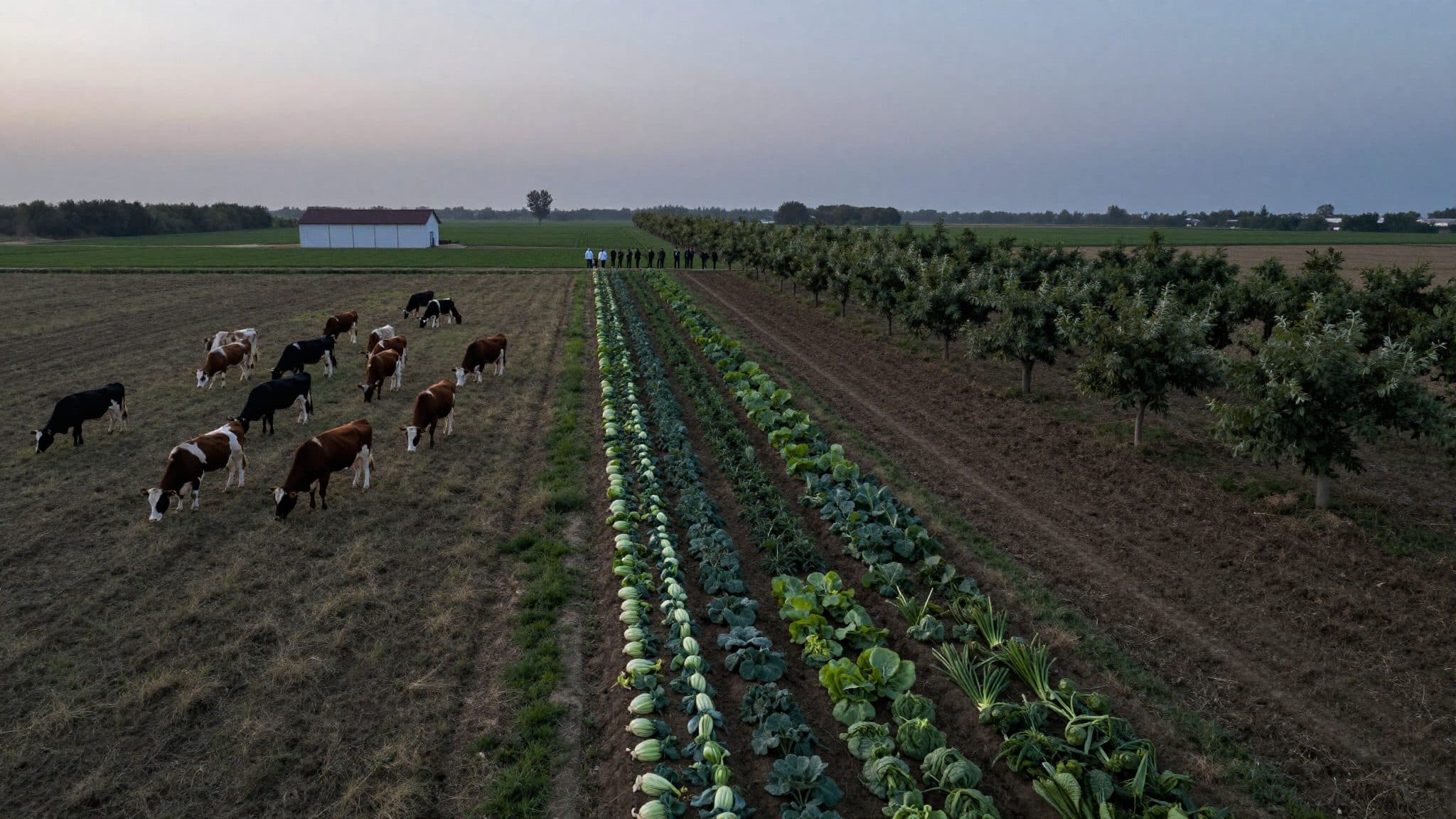
AI-generated image (z-image via Kie.ai)
Summary
An international modeling study shows that a dietary shift toward the Planetary Health Diet could reduce livestock farming by around 42 percent by 2050. At the same time, millions of premature deaths could be avoided and greenhouse gas emissions from agriculture would drop significantly.
Potsdam, 15 July 2026
An international modeling study involving the Potsdam Institute for Climate Impact Research (PIK) shows that a global dietary shift toward the so-called Planetary Health Diet could reduce livestock farming by approximately 42 percent by 2050.
The research group used ten common global economic models to calculate two scenarios: a "business-as-usual" scenario, in which food production continues as before until 2050, and a transformation scenario based on the recommendations of the EAT-Lancet Commission. This envisions a diet rich in fruits, vegetables, whole grains, nuts, and legumes, supplemented by about three to four eggs per week, moderate amounts of fish and poultry, and as little meat from ruminants as possible.
In the transformation scenario, the production value of animal husbandry would decline by 60 percent compared to 2020, according to the study. The number of ruminants—meaning cattle, sheep, and goats—would fall by around 400 million animals, equivalent to the level seen in the mid-1990s. The cultivation of vegetables, fruits, nuts, and legumes would increase by around a quarter in return.
Model Calculation with Two Scenarios
Total agricultural land use would shrink by about six to seven percent by 2050 compared to 2020. The decline would be particularly pronounced for pastureland: minus around ten percent, corresponding to about 274 million hectares. The researchers consider this the largest absolute reduction in agricultural land use in over 2,000 years.
At the same time, emissions from agriculture—primarily methane and nitrous oxide—could be on average about one-third below "business-as-usual" projections in 2050, and thus significantly lower than today. Climate-damaging greenhouse gases from livestock farming could be reduced by up to 85 percent, and net CO2 emissions from land-use changes would also drop significantly. Overall, agricultural production would be about 17 percent lower than in the continue-as-before scenario.
Hermann Lotze-Campen, head of the Climate Resilience research department at PIK and co-author of the study, told the ARD climate editorial team: "Das aktuelle Agrar- und Ernährungssystem ist mit Gesundheitskosten, vorzeitigen Todesfällen, Treibhausgasemissionen, stickstoffbedingter Verschmutzung sowie Wasser- und Landverbrauch verbunden." An analysis the previous year had also shown that the Planetary Health Diet could more than halve emissions from the food industry.
Impacts on Climate and Environment
According to the EAT-Lancet Commission, this dietary pattern could prevent up to 15 million premature deaths worldwide each year. Health systems would also be massively relieved through fewer diet-related illnesses. "Unsere Studie zeigt, dass die Fortsetzung des derzeitigen Kurses die teurere Option ist," Lotze-Campen emphasized.
Lead author Matt Gibson of the International Institute for Applied Systems Analysis (IIASA) in Laxenburg said: "Anstatt diese Ergebnisse als Vorwand zum Nichtstun zu nutzen, ist es entscheidend, dass Regierungen sich der Herausforderung stellen und schwierige Entscheidungen zum Wohle unserer Gesundheit und unseres Planeten treffen." The changes would affect millions of people working in agriculture and food production. "Eine Transformation dieser Größenordnung kann nicht erst im Jahr 2050 beginnen."
Health Effects
Co-author Daniel Mason-D'Croz framed the calculations as orientation: "Wir sollten diese Szenarien nicht als Vorhersage einer Zukunft betrachten, die eintreten wird, sondern als nützlichen frühen Anhaltspunkt dafür, wo Herausforderungen und Chancen entstehen könnten." The researchers consider it plausible that reality in 25 years will fall somewhere between the recommendation and today's agricultural and dietary practices.
Florian Zabel, research associate in the Department of Environmental Sciences at the University of Basel, said: "Weitermachen wie bisher wäre teurer. Ein gesünderer, nachhaltigerer Speiseplan würde die Landwirtschaft grundlegend verändern und ökologischer gestalten." However, the transformation scenario would produce "Verlierer und Gewinner," particularly regions with intensive livestock production facing significant structural change. "Es gäbe eine Verschiebung zu deutlich weniger Tierproduktion und deutlich mehr Pflanzenproduktion," Lotze-Campen explained.
Structural Change in Livestock Regions
The authors therefore call for a "Bruch mit vielen historischen Trends" and "mutige politische Entscheidungen." "Für eine gesamtgesellschaftliche Umsetzung muss es ein Zusammenspiel zwischen veränderten Ernährungsgewohnheiten und den entsprechenden politischen Rahmenbedingungen geben," the study states. The researchers point to currently powerful lobbies from meat, sugar, and grain producers, evident for instance in discussions about sugar taxes or advertising bans for particularly unhealthy foods.
The transformation must be accompanied politically, the study emphasizes. Agricultural and food policy should guide the process, because the transition is "nicht ohne weiteres zu gewährleisten ist." Among others involved in the study were Amanda Palazzo, Marta Kozicka, and Petr Havlik from IIASA in Laxenburg.
Taken together, the model calculations illustrate that a globally coordinated dietary transition could significantly improve both the climate and health balance of the agricultural sector. The results are to be understood as an option for action, the realization of which is tied to political decisions, changed consumer habits, and compensation for affected regions.
Political Framework Conditions
Comparing the two scenarios reveals very different possible realities in around 25 years, according to the study. While the "business-as-usual" scenario is associated with rising livestock numbers, larger cultivated areas, higher production volumes, and greater environmental burdens such as greenhouse gas emissions and nitrogen fertilization, the transformation scenario paints a picture of land-, climate-, and health-conserving agriculture.
The calculations on the "potenziellen großen Ernährungstransformation" showed that especially the decrease in required pastureland would be "beispiellos," according to the study authors. Overall, under the transformation assumptions, the area used worldwide for food production would decrease by around six percent compared to 2020.
The study is published against the backdrop of growing concerns about the food security of a growing world population. Providing all people with a healthy diet would, according to the researchers, roughly keep the total value of agricultural production at the 2020 level while simultaneously reducing environmental and health costs.
Classification of Results
Overall, the work provides arguments both for advocates of stricter climate and health policy and for those warning of social and economic upheavals. Which of the two paths is taken will depend on political decisions in the coming years.
The EAT-Lancet Commission is an international panel of experts that formulates scientific foundations for a healthy, sustainable, and equitable global diet. It was founded by the EAT organization and the journal "The Lancet."
With the transformation scenario, it would be possible to ensure that a growing world population is supplied with a healthy diet without further expanding the agricultural production base—on the contrary: it would shrink. The study thus provides quantitative points of reference for a debate that has often been conducted in the abstract up to now.
Questions & Answers
What is the Planetary Health Diet?
The Planetary Health Diet is a dietary model from the EAT-Lancet Commission that provides for plenty of fruits, vegetables, whole grains, nuts, and legumes, supplemented by about three to four eggs per week, moderate amounts of fish and poultry, and as little meat from ruminants such as cattle, sheep, and goats as possible.
By what percentage could livestock farming decrease?
In the transformation scenario, the number of ruminants would decline by around 400 million animals, corresponding to a reduction of the livestock farming sector by approximately 42 percent compared to 2020.
Who published the study?
Involved were, among others, researchers from the Potsdam Institute for Climate Impact Research (PIK), the University of Basel, as well as Amanda Palazzo, Marta Kozicka, and Petr Havlik from the International Institute for Applied Systems Analysis (IIASA) in Laxenburg.