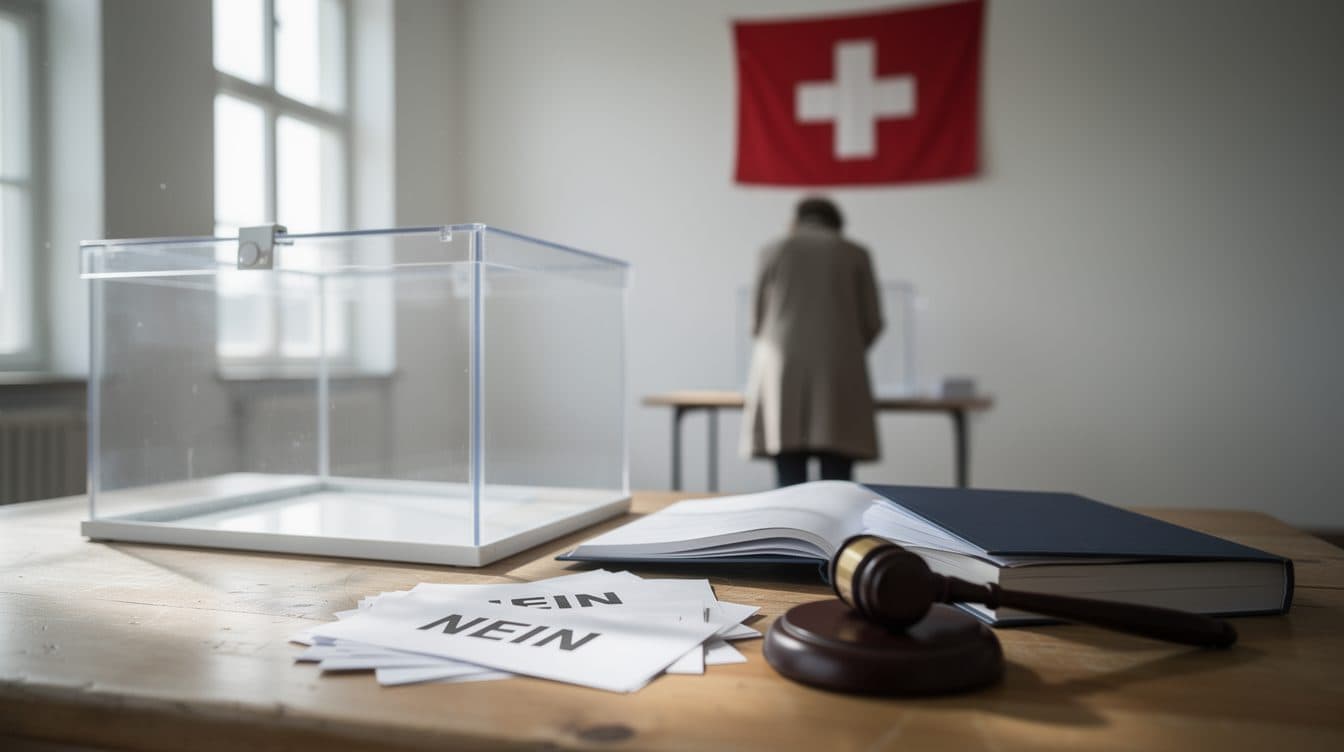
Switzerland rejects popular initiative for population cap of ten million
Bern, 14 June 2026
AI-generated image (flux-2/pro-text-to-image via Kie.ai)
Summary
Swiss voters have rejected the SVP's popular initiative for a population cap of ten million inhabitants by around 55 percent. Had it been accepted, the initiative would have medium-term put into question the agreement on the free movement of persons with the EU.
Bern, 14 June 2026
Swiss voters on 14 June 2026 rejected the popular initiative of the Swiss People's Party (SVP) for a "population cap" ("Bevölkerungsdeckel") of ten million inhabitants by around 55 percent No votes, according to the projection.
Initial situation and projection
After polling stations closed on Sunday morning, Swiss television (SRF) released the projection, based on figures from the opinion research institute GFS Bern. According to it, around 55 percent of voters voted against the initiative "No to a ten-million Switzerland" ("Keine Zehn-Millionen-Schweiz"), and around 45 percent voted in favor. The margin of error of the projection was two percent. An official final result was expected later in the afternoon.
Content of the initiative
The right-wing populist Swiss People's Party (SVP) wanted to use the initiative to curb what it saw as excessive and uncontrolled immigration. The SVP positioned the proposal as a sustainability initiative and warned in the run-up of a "population explosion" that would overwhelm the country. Specifically, the initiative text provided that from an inhabitant figure of 9.5 million, the Federal Council should examine measures in the asylum sector and on family reunification. If the population had nevertheless risen above the ten-million mark, Switzerland would ultimately have had to terminate the important agreement on the free movement of persons with the European Union (EU).
That scenario has now not materialized. After adoption, the initiative would have been the first instrument worldwide to impose a hard demographic ceiling on a national economy. The SVP had formulated the goal of stabilizing the Swiss population at no more than ten million by 2050. Switzerland currently has around 9.1 million inhabitants, of whom about 2.4 million do not hold Swiss citizenship. Around 40 percent of voters have a migration background.
Economic arguments of the opponents
The openness of the Swiss labor market had underpinned the country's economic growth in recent decades. Since the introduction of free movement of persons in 2002, the Swiss population has grown by almost a quarter to 9.1 million people. Italians form the largest foreign population group in Switzerland, Germans are the second largest group with 330,000 to 340,000 people. In the city of Zurich alone there are 32,700 German nationals, corresponding to around 8 percent of the city population. In the canton of Basel-Stadt the foreign population share is 39 percent; of the 211,000 inhabitants, more than half there are not allowed to vote, because they are not Swiss citizens or are under 18 years of age.
Almost all parties, the government and business representatives had opposed the proposal in the run-up. They feared economic damage and a shortage of skilled workers. Justice Minister Beat Jans had even warned of a "Brexit moment" ("Brexit-Moment") and emphasized that without personnel from abroad the country's hospitals and nursing homes would no longer function. The foreign national share in the construction industry is, according to statistics, 34 percent, with cross-border commuters not included. In addition, tens of thousands of Germans cross the border daily to work in Switzerland.
Voices from the parties
Cédric Wermuth, co-president of the Social Democrats, spoke after the projection became known of an "enormous relief" ("enormen Erleichterung"). "Im Abstimmungskampf habe ich gespürt, dass viele Menschen die Nase voll haben von dieser andauernden Spalterei, wonach die Migrantinnen und Migranten an allem schuld sind", he said. This politics of scapegoating had – fortunately – reached its limits. The SVP president Marcel Dettling, on the other hand, expressed disappointment and described the result as "kein gutes Resultat für die Schweiz".
Yvonne Bürgin, parliamentary group president of The Centre in the National Council (ZH), told Swiss radio that the failure of the population cap would not draw a line under the debate. It was rather a mandate to politicians to take the "growth pains" ("Wachstumsschmerzen") in the population seriously. "Der Erfolg der Schweiz hat zu Wachstumsschmerzen geführt. Diese Wachstumsschmerzen müssten ernst genommen werden. Aber ein starrer Deckel ist keine Lösung", explained the vice-president of her party. To curb immigration, the country would have to make better use of the labor potential of the people already living in the country, she said further in an interview with SRF.
Regional differences
The FDP also assessed the result as a "commitment to an open and economically interconnected Switzerland". The Green Liberals stated that the population tackles problems "traditionally with matter-of-factness, innovation and cohesion, not with isolation and simple slogans". Lukas Golder of the opinion research institute gfs.bern said on Swiss television SRF that French-speaking Switzerland and the cities had been decisive for the proposal's failure. In fact, a clear rejection of the initiative was emerging in the Swiss cities, while in the rural canton of Appenzell Innerrhoden, where few foreigners live, the SVP initiative was accepted with a narrow 66 percent in favor.
In substance, the SVP had pointed to concrete burdens: housing shortage, higher rents, paving over of the landscape, traffic jams and overcrowded trains, rising crime, a health system at breaking point and declining educational quality. An important buzzword in the referendum campaign was the so-called "density stress" ("Dichtestress"): immigration has led to housing shortages and full trains. The Financial Times had criticized in the run-up that the Swiss government had so far not delivered a comprehensive answer to questions of housing shortage and overloaded infrastructure. The German news magazine Der Spiegel devoted a cover story to the topic with a Swiss electoral map and the heading "Deutsche raus".
Civil service reform adopted
The SVP has for decades positioned itself against foreigners and the European Union. In 2009 it pushed through a ban on minarets in a referendum, in 2021 a ban on face covering (burqa initiative). In the past 26 years Swiss voters had already confirmed free movement of persons ten times; the current vote was thus the eleventh occasion to do so. 235,000 people in Switzerland are asylum seekers or temporarily admitted persons.
In parallel with the population initiative, voters decided on the reform of civilian service. Parliament in Bern had adopted a corresponding reform in September that is intended to make access to civilian service more difficult. A coalition of left-wing parties and organizations formed against it, collecting more than 50,000 signatures and thus forcing a referendum on the issue. According to the final result, the proposal passed with 52.5 percent Yes votes and 47.5 percent No votes. A final gfs.bern poll had measured 48 percent supporters and 46 percent opponents. Business associations assessed the result as "endlich im Einklang mit dem Bundesrecht". Critics warned that a reduction in civilian service personnel would leave gaps in care and nature conservation.
Cantonal proposals in Geneva
In the canton of Geneva, which voted on several cantonal proposals together with Switzerland, voters accepted further decisions: a change to the law on shop opening hours, which de facto no longer ties Sunday sales to a generally applicable collective employment contract (CEA), was adopted with 52.8 percent. Geneva business associations spoke of a "regelrechten Atemzug" for the heavily weakened local retail trade, which provides almost 18,000 jobs in the canton. In 2025, a ruling by the Federal Court had made clear that such a tie to a CEA violates federal law.
In addition, the Geneva electorate approved by 51.4 percent a constitutional amendment that prohibits cantonal and communal officeholders from wearing conspicuous religious symbols at plenary sessions. The proposal had been brought forward by the SVP, FDP, Centre and the right-wing populist Mouvement citoyens Genevois (MCG) in the name of laicism. Feminist and anti-racist groups criticized the ban as "eine systematische Schikane muslimischer Frauen". Left-wing parties and Pierre Maudets's "Libertés et justice sociale" (LJS) rejected the ban because in their view it impairs fundamental freedoms. The Geneva voter turnout was 51.5 percent.
European context
The national vote is part of a series of right-wing and right-wing populist initiatives in Europe that play on fears of immigration – from the rise of the AfD in Germany and the Rassemblement National in France to the FPÖ in Austria. In Switzerland, however, the SVP's proposal found support far beyond nationalist circles. According to a second SRG poll at the end of May, a majority rejected the initiative for the first time, after it had at times been capable of securing a majority in the spring.
On voting Sunday, polling stations in Switzerland were open only a few hours in the morning, as most voters had already cast their ballots by postal vote. While only a projection was available for the population cap, the results on the Geneva cantonal proposals and on civilian service were already final. The next federal vote is scheduled for autumn as usual; whether the SVP will put the issue back on the political agenda, Dettling left open after voting Sunday.
Questions & Answers
What was the Swiss popular initiative "No to a ten-million Switzerland" about?
The SVP's popular initiative wanted to cap Switzerland's permanent resident population at ten million people. From 9.5
Switzerland: Population cap vote 2026 – No to a ten-million | allfacts360