Switzerland: SVP initiative on population cap rejected | allfacts360
Switzerland rejects SVP initiative for population cap of ten million
Bern, June 14, 2026
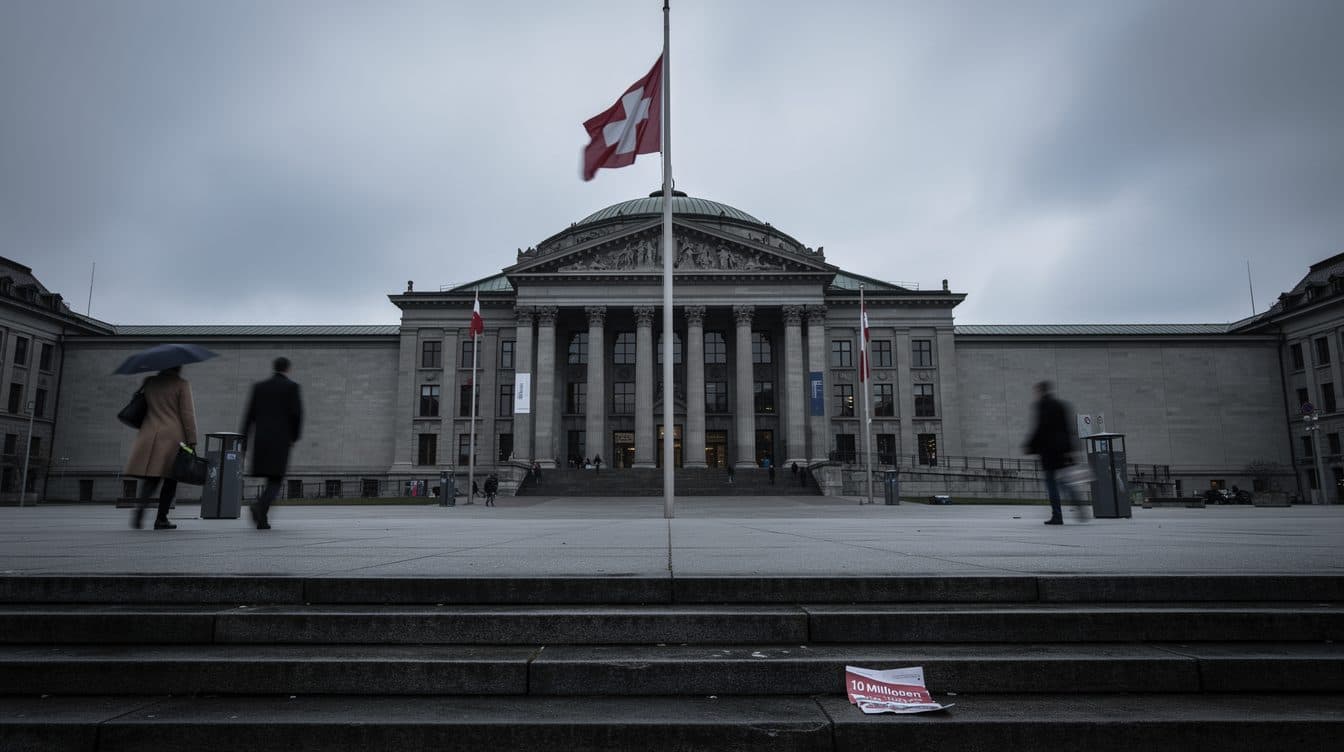
AI-generated image (flux-2/pro-text-to-image via Kie.ai)
Summary
Swiss voters have rejected the popular initiative «No to a 10-million Switzerland!» from the right-wing conservative SVP with around 55 percent no votes. The bilateral agreement on the free movement of persons with the EU remains untouched; the initiative would have only been implementable through its termination.
Bern, June 14, 2026
Swiss voters rejected on Sunday the popular initiative of the right-wing conservative Swiss People's Party (SVP) «No to a 10-Million Switzerland! (Sustainability Initiative)» with around 55 percent no votes, according to projections.
Content and mechanism of the initiative
The attempt to enshrine in the constitution a cap of ten million inhabitants thus failed, as Swiss television (SRF) reported, citing figures from the opinion research institute GFS Bern, after the polling stations closed. The initiative would have made Switzerland the only country in the world with a constitutionally fixed population cap. Adoption would have required both a popular majority and a majority of the cantons. The margin of error of the projections is 2 percent; the official result was expected later in the afternoon.
The SVP had proposed that the permanent resident population remain below ten million before 2050. The full text of the initiative asked: whether Switzerland should enshrine a population cap of a maximum of 10 million people in the constitution. Should the population exceed the 9.5 million mark before 2050, the government should, according to the initiative, intervene and take in fewer refugees as well as limit family reunification.
If adopted, Switzerland would ultimately have had to terminate the important bilateral agreement on the free movement of persons with the European Union (EU). The initiative states literally: «Ist die 10-Millionen-Grenze vor 2050 überschritten, muss die Schweiz diese Abkommen kündigen, nach zwei Jahren auch die Personenfreizügigkeit mit der EU.» A termination of the free movement of persons negotiated with the EU would only become an issue if all other measures were of no use – but then a termination of the bilateral agreement would have become mandatory.
The Federal Council and Parliament had spoken out against the initiative in advance. In the National Council, 123 members voted against it, 67 in favor. In the Council of States, the initiative was rejected with 30 to 9 votes. Almost all parties, the government and business representatives had fought the proposal in advance.
Broad opposition from politics and business
The national government, business associations, the trade unions, the universities as well as all other parties except the SVP warned of a shortage of skilled workers, loss of growth and uncertainty in relations with the EU. They feared economic damage and a shortage of skilled workers. The openness of the Swiss labor market had supported the country's economic growth in recent decades.
Justice Minister Beat Jans had even warned of a «Brexit moment» and emphasized that without personnel from abroad the country's hospitals and nursing homes would no longer function. In the hospitality industry they make up 46 percent, in construction 34 percent, not yet counting cross-border commuters. In addition, tens of thousands of Germans commute daily to the neighboring country to work.
Switzerland today has 9.1 million inhabitants. Since the introduction of free movement of persons in 2002, the country's population grew by around 1.7 million, mainly through immigration. Since the introduction of free movement of persons in 2002, a net 1.5 million people have moved to Switzerland, not including the asylum sector. Ten times in the past 26 years the population has stood behind free movement of persons, and the eleventh time was no different.
Demographics and foreign population
2.4 million people in the country do not have a Swiss passport. That corresponds to more than every fourth resident of the country. 235,000 people in Switzerland are asylum seekers or admitted persons. Around 40 percent of those eligible to vote have a migration background. 453,000 people live in the city of Zurich. 32,700 of them are German. That corresponds roughly to the city of Bad Nauheim or 8 percent of Zurich's city population. In Basel-Stadt the share of foreigners is 39 percent. More than half of the 211,000 city residents are not allowed to vote because they do not have citizenship or are not yet eighteen years old. Germans follow in second place with 334,000 immigrants.
The SVP presented the initiative as a «Sustainability Initiative». According to the initiators from the Swiss People's Party (SVP), the government would have to start above all with asylum migration and family reunification. From 9.5 million inhabitants, the Federal Council would have to examine measures to curb immigration. The initiators argued that resources had to be conserved, further construction stopped, public transport relieved and crime combated. The SVP has positioned itself for decades against foreigners and the European Union.
Arguments of supporters: «density stress»
An important argument was the so-called «density stress»: immigration has led to a housing shortage and full trains. The SVP listed the consequences: «Wohnungsnot, höhere Mieten, Zubetonierung der Landschaft, Stau und überfüllte Züge, steigende Kriminalität, ein Gesundheitswesen am Anschlag und sinkende Bildungsqualität» were the consequences. The «Financial Times» wrote in advance that the Swiss government had to date provided no comprehensive answer to questions about the housing shortage and overloaded infrastructure. Official statistics suggest that by 2055 around 10.5 million people will live in Switzerland.
Reactions: relief and disappointment
Reactions to the result were split along political camps. Cédric Wermuth, the co-president of the Swiss Social Democrats, spoke of an «enormous relief». He declared: «Im Abstimmungskampf habe ich gespürt, dass viele Menschen die Nase voll haben von dieser andauernden Spalterei, wonach die Migrantinnen und Migranten an allem schuld sind.» This politics of scapegoating has – fortunately – reached its limits. The Green Liberal Party notes with satisfaction that the population «traditionally tackles problems with objectivity, innovation and cohesion, not with isolation and simple slogans». The Swiss FDP interprets the result as a «commitment to an open and economically networked Switzerland».
SVP President Marcel Dettling expressed disappointment. He declared that the result was «kein gutes Resultat für die Schweiz». The vice-president of The Centre said in an interview with SRF: «Der Erfolg der Schweiz hat zu Wachstumsschmerzen geführt. Aber ein starrer Deckel ist keine Lösung.» To curb immigration, the country would have to make better use of the labor potential of people already living in the country.
According to poll researcher Lukas Golder of the institute gfs.bern, French-speaking Western Switzerland and the cities were decisive for the defeat of the proposal. In the cities the initiative was clearly rejected. In the rural canton of Appenzell Innerrhoden, which has few foreigners, the SVP proposal was, however, approved with almost 66 percent. The second SRG survey at the end of May showed for the first time a majority against the proposal, after the initiative had temporarily gained ground in spring surveys. In polls, the opponents of the SVP proposal were narrowly ahead.
In Switzerland, however, the proposal found support well beyond nationalist camps. Around 100,000 people come to Switzerland each year, from the EU, from third countries and as asylum seekers, according to the SVP. The German news magazine Der Spiegel dedicated a cover story to the Swiss vote and showed a Swiss ballot paper with the wording «Deutsche raus». Across Europe, right-wing parties are picking up on fears of immigration, as can also be observed with the rise of the AfD in Germany, the Rassemblement National in France or the FPÖ in Austria.
Historical context: a Swiss tradition of immigration debates
The initiative is part of a long series of similar proposals. In 1965 the Zurich Democrats filed the first «Überfremdungsinitiative» (overforeignization initiative), which was withdrawn in 1968. The so-called Schwarzenbach Initiative of 1970 failed with 54 percent no votes, a further initiative in 1974 with almost 66 percent, a fourth in 1977 with 70 percent. In 1988 a further attempt by the National Action was rejected with 67 percent no votes. In 1996 the SVP initiative against illegal immigration received 53 percent no votes; in 2000 an FDP initiative failed with 64 percent. In 2002 the SVP initiative against abuse of asylum law was narrowly rejected with 50.1 percent, in 2008 an initiative for democratic naturalizations with 66 percent. In 2010, however, the deportation initiative was approved with almost 53 percent. In 2014 the Ecopop initiative failed with 70 percent no votes, while the SVP mass immigration initiative was narrowly approved with 50.3 percent. In 2016 the enforcement initiative was rejected with almost 59 percent, in 2020 the limitation initiative with almost 62 percent. On June 14, 2026, around 60 percent of those eligible to vote voted no.
Questions & Answers
What exactly did the SVP initiative «No to a 10-Million Switzerland» want?
The initiative of the Swiss People's Party (SVP) required that the permanent resident population of Switzerland remain permanently below ten million before 2050. From 9.5 million inhabitants, the Federal Council would, according to the text of the initiative, have to examine measures to curb immigration; if necessary, Switzerland would have had to terminate the bilateral agreement on the free movement of persons with the EU.