Switzerland vote 14 June: SVP initiative "No to a | allfacts360
Switzerland votes on SVP initiative against immigration: What the "10-million Switzerland" means
Bern, 13 June 2026
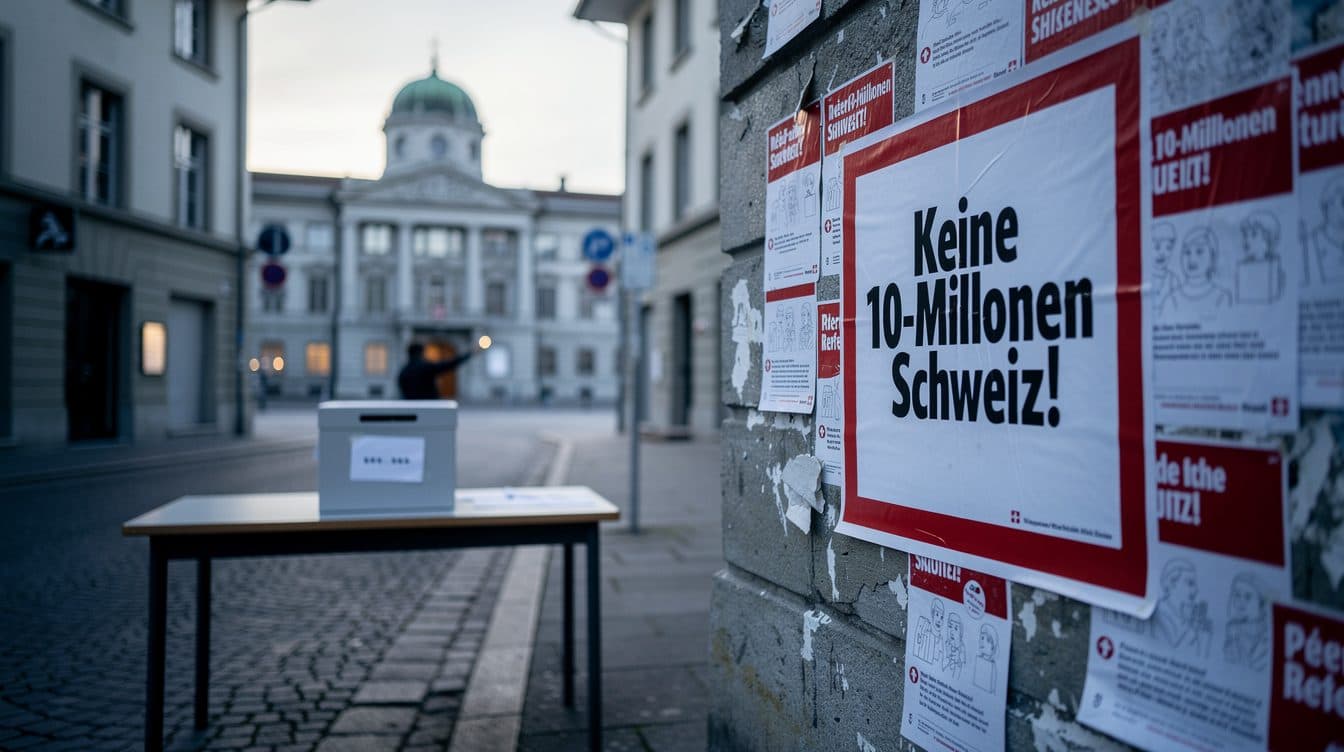
AI-generated image (flux-2/pro-text-to-image via Kie.ai)
Summary
Switzerland votes on Sunday on the SVP initiative "No to a 10-million Switzerland!", which aims to cap the population at under 10 million by 2050. Current polls show a majority of 52 percent against the initiative, but the race is considered open.
Bern, 13 June 2026
Swiss voters will decide on 14 June 2026 on the popular initiative "Keine 10-Millionen-Schweiz!" (No to a 10-million Switzerland!), with which the nationalist-conservative SVP wants to limit the permanent resident population to under ten million by 2050.
The initiative by the Swiss People's Party (SVP) aims to keep Switzerland's permanent resident population below the ten-million mark by 2050. At the end of 2025, around 9.1 million people were living in Switzerland; mainly through immigration from the EU, the population has grown by approximately 1.7 million since the introduction of the free movement of persons in 2002. The largest foreign groups are Italians (15 percent), Germans (14 percent), Portuguese (11 percent) and French (8 percent). In total, around 27 percent of people living in Switzerland do not hold a Swiss passport; roughly 28 percent of those living there are foreign nationals.
Should the 10-million mark be exceeded before 2050, the Swiss government would have to terminate international treaties related to migration – as a last resort, including the free movement of persons with the EU. From 9.5 million inhabitants, the Federal Council and Parliament would also be obliged to intervene in the asylum sector and on family reunification. According to statistics, the figure of 9.5 million could be reached as early as 2031.
Arguments from supporters
Supporters of the initiative describe the vote as a «Nachhaltigkeitsinitiative» (sustainability initiative). They argue that immigration leads to «Dichtestress» (density stress), housing shortages, a landscape paved over with concrete, traffic jams and overcrowded trains. On stickers in Switzerland's national colours, the initiative campaigns with the slogan «Bewahren, was wir lieben» (Preserve what we love). An SVP representative sums up the concern: «Die Problematik ist, dass wir an unsere Grenzen kommen» ("The problem is that we are reaching our limits").
Opponents see an economic risk in the initiative. In the hospitality industry, 46 percent of employees come from abroad; in the construction sector, 34 percent – not counting cross-border commuters. More than 400,000 cross-border commuters travel into Switzerland, over half of them from France. Mattea Meyer, co-president of the Social Democratic Party (SP), warns of «dramatische Folgen» ("dramatic consequences") from the initiative and speaks of the SVP's «menschenverachtende Politik» ("inhumane politics").
Current polls and sentiment
A survey published in May by the Swiss Broadcasting Corporation initially showed a tie between supporters and opponents. A second survey from early June, however, now shows a majority against the initiative: 52 percent of Swiss intend to vote No, 45 percent Yes. The race is nevertheless considered open.
Housing shortage as driver of the debate
Regardless of the outcome of the vote, Switzerland is grappling with a housing shortage. In 15 cantons, vacancy rates in 2025 were below 1 percent, in some cases significantly. Michael Furger, head of communications at the Federal Office for Spatial Development (ARE), explains: «Das grösste Hindernis beim Wohnungsbau sind Einsprachen und nicht, dass zu wenig Bauland verfügbar wäre» ("The biggest obstacle to housing construction is objections, not that too little building land is available"). In urban regions, vacancy rates have been «seit Jahrzehnten deutlich unter 1 Prozent» ("well below 1 percent for decades"). For example, the city of Zurich has more than 100 hectares of free building land.
Since 2013, the federal government has pursued a strategy of creating more living space within existing settlements rather than on greenfield sites. At that time, the people voted in favour of the partially revised Spatial Planning Act. FDP Council of States member Damian Müller wants to «gezielt nachjustieren» ("make targeted adjustments") in the Spatial Planning Act: new zoning should once again be possible where regions have recorded a vacancy rate of below one percent for two years and no improvement is in sight. In the newly zoned areas, a share of up to 30 percent of affordable housing is to be created.
Political initiatives in Parliament
Jakob Stark, SVP Council of States member, still supported the Spatial Planning Act in 2013, but says today: «Man hat es übertrieben» ("They overdid it"). He additionally calls for a «Bauoffensive in die Höhe» ("building offensive upwards") to save farmland: «Wir brauchen hohe Häuser» ("We need tall buildings"). Council of States members from all major parties have signed the motion, including SP politician Pierre-Yves Maillard, who values the proposal as a compromise: «Die Motion sollte verbessert werden. Doch wenn das Bedürfnis nach gemeinnützigen Wohnungen in der FDP anerkannt scheint, kann man ihr eine Chance geben» ("The motion should be improved. But if the need for non-profit housing seems to be recognised in the FDP, one can give it a chance").
After the Council of States welcomed the proposal, the National Council must now deliberate on it. The small chamber has indeed discussed the motion, but referred it to the responsible commission for deliberation – on which Stark also sits. The Federal Council rejects the motion.
Outlook: National Council and consultation
In parallel, the ARE is preparing a consultation draft by the end of 2026, in which measures against abusive objections will be examined. Back in 2023, Council of States member Andrea Gmür-Schönenberger and Centre National Council member Leo Müller had asked the Federal Council to examine whether abusive objections could be made subject to costs. Gmür-Schönenberger followed up in September of last year with a motion and is calling for a corresponding amendment to the law. The federal government is also examining several measures to speed up planning and building permit procedures – for example, by declaring certain settlement projects to be projects of national interest.
Resistance to current practice is also forming at the municipal level. For example, the population of Kriens voted this spring in favour of imposing a zoning moratorium for a specific area. Spatial planning remains primarily the responsibility of the cantons, which determine where densification occurs; the municipalities are subsequently involved. Cantons are currently required to designate their building zones in such a way that they have sufficient building land for the next fifteen years.
With the popular vote on 14 June, a preliminary decision will be made with far-reaching consequences for Switzerland's migration, housing construction and foreign policy. While supporters understand the initiative as a contribution to quality of life and sustainability, critics see in it a break with the bilateral line vis-à-vis the EU and a danger to the country as a business location.
Questions & Answers
What is the "Keine 10-Millionen-Schweiz!" initiative about?
The SVP initiative aims to limit Switzerland's permanent resident population to under ten million by 2050 and, if necessary, terminate international treaties on migration, including – as a last resort – the free movement of persons with the EU.
What is the current mood in Switzerland ahead of the vote?
A survey from early June 2026 shows 52 percent of voters at No and 45 percent at Yes, after a May survey had still shown a tie between supporters and opponents.
What consequences would a Yes have for the asylum sector?
From 9.5 million inhabitants, the Federal Council and Parliament would have to intervene in the asylum sector and on family reunification; according to statistics, this mark could be reached as early as 2031.