The fate of "Timmy": the remains of the humpback whale turned into biodiesel and biomass at a Danish factory
Randers, 9 June 2026
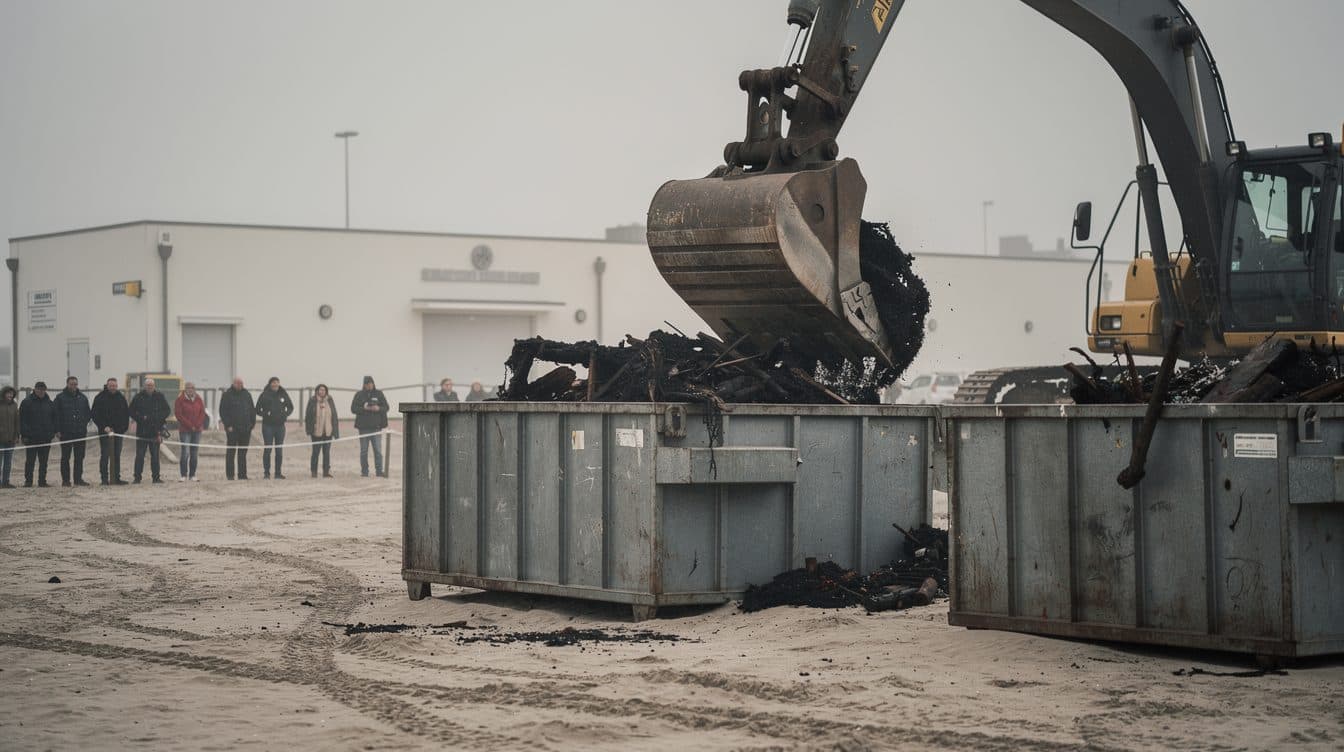
AI-generated image (flux-2/pro-text-to-image via Kie.ai)
Summary
The remains of the humpback whale known as "Timmy", found dead on 14 May on the beach of the Danish island of Anholt, are now being processed at the Daka Denmark plant in Randers. The whale's blubber and fat are turned into biodiesel, while bones, tendons and skin become biomass for the cement industry.
Randers, 9 June 2026
The remains of the humpback whale known as "Timmy", found dead on 14 May 2026 on the beach of the Danish island of Anholt, are currently being processed at the Daka Denmark factory in Randers, in Jutland, where blubber and fatty tissues are turned into biodiesel and the remaining part into biomass to be burned.
A humpback whale far from home
The animal, a female humpback whale whose sex was only established during the autopsy, had first appeared at the beginning of March off the German Baltic Sea coast, well away from its natural habitat. For weeks its fate kept residents and tourists in the region on tenterhooks, as reported by the dpa news agency. The case had gained growing attention as the animal, increasingly weakened, repeatedly stranded on the beaches of Mecklenburg-Western Pomerania and Schleswig-Holstein, only to be guided back out to sea each time.
At the end of April a private initiative, with the involvement of the authorities of Mecklenburg-Pomerania, decided to load the heavily weakened animal onto a cargo ship to transport it towards the North Sea and release it in deeper waters more suitable for the species. A tracker had been fitted to the animal to record its movements. In the following weeks, however, the humpback continued to show signs of exhaustion and to strand several times along stretches of coast in Mecklenburg-Western Pomerania and Schleswig-Holstein, before being guided back into the water again.
On 14 May the humpback was found dead, stranded on the shoreline of the island of Anholt, in the Kattegat. For the autopsy the body was opened and cut into several parts during an examination lasting several hours on site, which ended on Thursday evening. A spokesperson for the Ministry of the Environment of Mecklenburg-Western Pomerania explained, asked by dpa, that the tracker data is now available and that "Die Daten sollen möglichst zügig abschließend ausgewertet werden" — literally: the data should be evaluated as quickly as possible, after which the public will be informed of the results obtained. The same spokesperson specified that the data had been provided in full to the private initiative and in part to the ministry.
The autopsy and the still uncertain causes
The causes of death remain so far unclear. The autopsy, concluded last week, found no obvious injuries or foreign bodies, and it was not possible to determine with certainty why the animal had been unable to return to its natural range. The analysis of the tracking data, still under way, could in the future clarify the route taken by the humpback and provide indications about the animal's last days of life, as well as useful elements for assessing similar cases.
After the death, the heaviest parts of the carcass were loaded with an excavator into several containers, initially left on the beach. The first loads were transported away on Friday, while the rest of the carcass was only removed from the beach on Monday, after the remains had been left on site for several days. A dpa spokesperson described the recovery and disposal operations, stressing that the operation required several days of work on site.
The journey of the remains to Randers
In the meantime, the company Daka Denmark has taken charge of the carcass, confirming that the remains are now being processed at its Randers plant, in Jutland, specialised in the collection, processing and recycling of by-products from agriculture and the food industry. In the factory the animal's remains are first separated into three distinct components. The water present in the body is purified and then discharged into the fjord, the company spokesperson explained: "Das im Körper enthaltene Wasser wird gereinigt und anschließend in den Fjord geleitet."
The fat, including that of the thick layer of subcutaneous blubber typical of cetaceans, is processed to produce biodiesel. The remaining parts of the carcass — bones, tendons and skin — are instead reduced to a powdery mass similar to flour, destined to be burned as biomass in a cement factory, as described by a Daka spokesperson: "Und alles andere – Knochen, Sehnen und Haut – wird zu einer Art Mehl verarbeitet, das als Biomasse zur Verbrennung in einer Zementfabrik endet".
From carcass to biodiesel and biomass
Some of the animal's bones were instead set aside immediately after the autopsy and delivered to the Natural History Museum of Copenhagen, where they will become part of the institute's scientific collection. According to dpa, the finds may be used for research purposes or, in the future, put on public display, thus ensuring a documentary and museum destination as well for the remains of "Timmy".
The bones at the Copenhagen museum
The entire rescue operation and the subsequent carcass management procedure were accompanied by heated political controversy. The Environment Minister of Mecklenburg-Western Pomerania, Till Backhaus (SPD), played a central role in the affair: his ministry authorised and accompanied the operation, despite the misgivings expressed by parts of the scientific community about the real chances of success. Backhaus subsequently defended the decision to attempt the transfer, arguing that the humpback deserved a chance, and specified that responsibility for planning and execution would have rested with the private initiative, with the Land having merely tolerated the intervention.
The political controversy over the rescue
The minister was, however, criticised for not having given sufficient weight to the scientific warnings and for having supported the initiative too generously. The story of "Timmy" thus became a local political case, amid questions about the appropriateness of using public resources in an operation of uncertain outcome and accusations of excessive discretion in the management of an intervention which, in light of the animal's death, proved unfortunately unsuccessful.
The humpback, affectionately nicknamed "Timmy" and later confirmed as a female specimen, had first been sighted at the beginning of March off the German Baltic coast. It was a young animal, visibly in difficulty, which had progressively moved away from the species' usual routes. The sighting had attracted great attention in the media and on social networks, where the story was followed day by day.
In the following days, before the transport towards the North Sea, the humpback had stranded several times off the German Baltic coast, including near the island of Poel, one of the locations where rescue operations were repeated. Each time the animal had been recovered and guided back out to sea, in a succession of interventions that kept rescue teams and coastal authorities busy.
After the transport to the North Sea and the subsequent release, the animal — already heavily debilitated — had stranded again on several occasions, until the lifeless discovery on the beach of Anholt. The outcome relaunched the debate on the management of cetaceans in difficulty in European internal waters and on the need for shared protocols among the coastal countries. The conclusions of the analysis of the tracker data, expected in the coming weeks, could provide useful elements to better define criteria and practices for the future.
For the moment, what remains of the humpback thus takes two paths: one part is sent to biodiesel production, another to combustion as biomass in a cement factory, while the bones destined for the Natural History Museum of Copenhagen are kept for scientific purposes. The name given to the animal, originally chosen by those who had rescued it and then spread by the media, had in the meantime fuelled a wave of emotion and participation, especially in Mecklenburg-Western Pomerania, where the animal had first been sighted and where its presence had mobilised residents, volunteers and local authorities.
The story of "Timmy" — from the first appearance to the industrial processing of the remains — was told live by dpa, in a report signed by Veronika Huber, who reconstructed the entire affair, from the early stages of the rescue to the transfer of the remains to the mainland and their arrival at the Randers factory. According to the German agency, the episode fits into a broader context of growing public attention to Baltic marine fauna and the challenges linked to the rescue of large cetaceans in coastal waters.
The private initiative that promoted the transport of the animal collaborated from the start with the authorities of Mecklenburg-Pomerania, and it is precisely to this collaboration that the installation of the tracker on the humpback's body is owed, now at the centre of the ministry's analyses. The Ministry of the Environment has announced that, once the data processing is completed, the results will be made public — a step considered decisive to clarify the causes of the animal's deviation and the dynamics of the death.
Questions & Answers
Who was the humpback whale known as "Timmy"?
It was a female humpback specimen, as established by the autopsy, first sighted at the beginning of March 2026 off the German Baltic Sea coast, far from its natural habitat.
Where are the humpback's remains being processed?
The remains have been taken in charge by the company Daka Denmark and transported to its Randers plant, in Jutland, where they are separated into components and processed.
Why did the rescue attempt raise political criticism?
The initiative to transport the animal to the North Sea was promoted by a private group with the involvement of the Ministry of the Environment of Mecklenburg-Pomerania, led by Till Backhaus (SPD), despite the reservations of experts: after the animal's death, Backhaus was criticised for not having given enough weight to the scientific warnings.
The fate of "Timmy": the remains of the humpback whale… | allfacts360