Necropsy Set for Humpback Whale Timmy After Failed Rescue and Weeks Adrift
Anholt, 30 May 2026
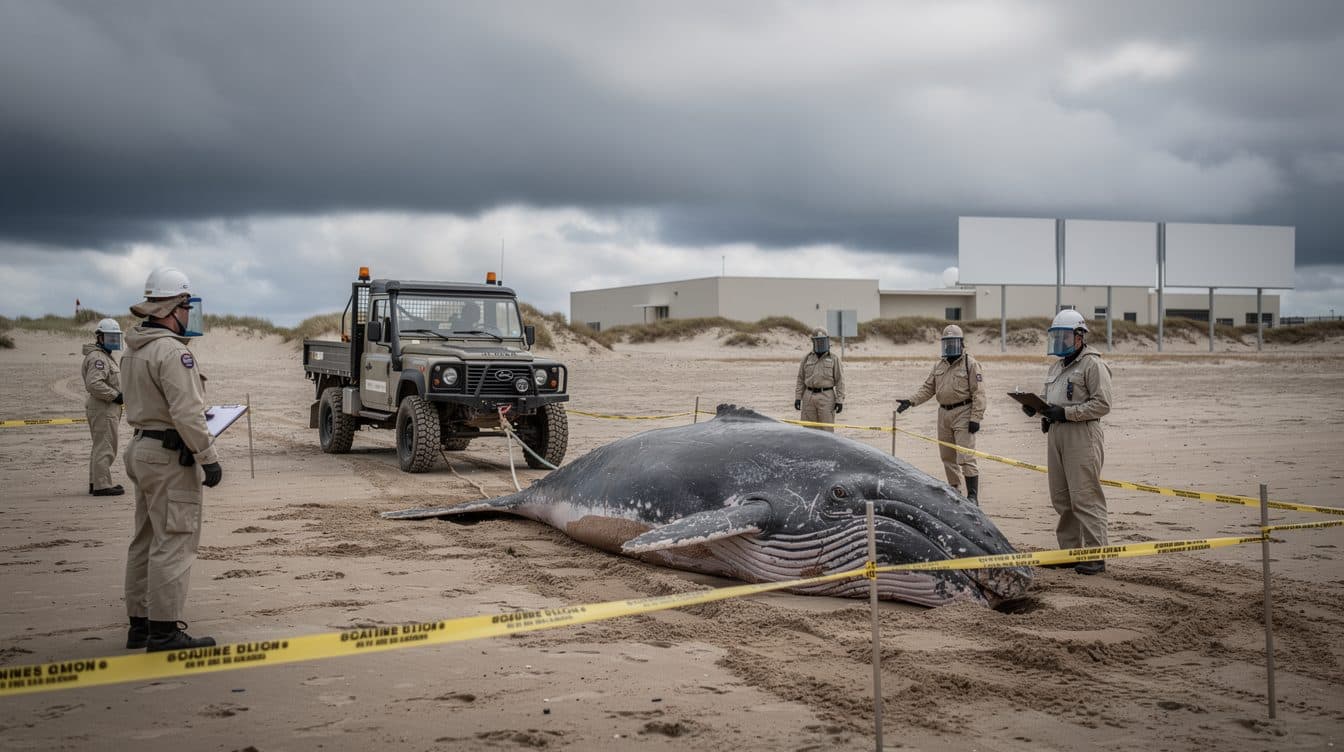
AI-generated image (flux-2/pro-text-to-image via Kie.ai)
Summary
The carcass of humpback whale Timmy has been pulled ashore on the Danish island of Anholt for a necropsy. Experts aim to determine the cause of death after a controversial private rescue attempt and weeks of drifting in shallow waters.
Anholt, 30 May 2026
A recovery team pulled the decomposing carcass of a humpback whale known as Timmy onto a beach on the Danish island of Anholt this week, ahead of a scheduled necropsy.
The operation, shown in a livestream by provider News5, involved a vehicle dragging the gas-bloated carcass from shallow water using a rope, leaving a huge furrow in the sand. The whale had been drifting off the holiday island for more than two weeks.
The Danish environmental authority had warned residents and bathers not to approach the animal due to a risk of infection. A barrier with caution tape was erected a few meters around the carcass, which now smells strongly.
A Controversial Rescue Attempt
The necropsy is scheduled to begin on Thursday afternoon directly on the beach and is expected to last about six hours. Veterinarians, authority representatives, and experts will search for remains of fishing nets and plastic in the animal's digestive tract and esophagus.
Peter Teglberg Madsen, a whale researcher from Aarhus University who has been accompanying whale necropsies in Denmark for 25 years, is involved in the examination. He stated that the main goal is to find out what the animal died from, because the discussion has centered on whether the whale could have been saved or not.
Madsen noted that fishing nets demonstrably played a role in the death of four of the last six stranded humpback whales in Denmark. In the two other cases, fishing nets were a possible but unconfirmed factor.
The whale, which had repeatedly entered shallow water areas along the German Baltic Sea coast, only moved on after people approached. It was eventually located off the island of Poel in Mecklenburg-Vorpommern, Germany.
Failed Interventions
Against the recommendation of German experts and institutions, the state environment ministry tolerated a private initiative that transported the animal away and released it in the North Sea. Madsen described this rescue attempt as 'reine Tierquälerei' (pure animal cruelty).
He said the whale was confined in a metal box for days and transported across the sea despite never having lived in captivity. 'Es wurde von den Wellen hin und her geschmissen, dem Lärm der Motoren ausgesetzt, um dann einfach ins Meer gekippt zu werden – das muss höllisch stressig und beängstigend für das Tier gewesen sein,' Madsen said.
Danish authorities once attempted to tow the gas-bloated whale into deeper water to bring it to a harbor, but the attempt failed. Madsen said the animal was obviously a sick, weakened animal that could not be saved and should have been left in peace.
'Das war ganz offensichtlich ein krankes, entkräftetes Tier, das nicht gerettet werden konnte, und man hätte es einfach in Frieden lassen sollen,' he stated.
Local Reactions on Anholt
Morten Abildstrom from the Danish Nature Agency said the two-hour operation to pull the carcass ashore went according to plan. 'Alles ist nach Plan verlaufen,' he said, adding that veterinarians and experts will now take care of examining the whale.
The island of Anholt has approximately 130 residents, and the carcass is located at the most popular and most accessible beach on the island. Local Matthias Vanman expressed concern about the impact on tourism.
'Wenn er liegen bleibt und noch stärker stinkt, wird das zum Problem für unsere Sommergäste und den Campingplatz,' Vanman said.
Hanne Skov, who has been spending summers for over 30 years at the island's campsite not far from the beach, said the biggest problem is that such a carcass contaminates everything. 'Das größte Problem ist, dass so ein Kadaver alles verschmutzt,' she said.
A Call for Prevention
A Danish woman named Susanna told dpa she does not understand why Germans are making such a fuss about this whale. 'Ich verstehe nicht, wieso die Deutschen so ein Aufhebens um diesen Wal machen,' she said. Some locals refer to the animal as the 'German celebrity whale'.
Madsen said people should be glad to see more humpback whales in the Baltic Sea again. 'Wir sollten uns darüber freuen, dass wir wieder mehr Buckelwale in der Ostsee sehen,' he said.
However, he argued that instead of spending so many resources trying to save a single animal, efforts should ensure animals do not get into such situations. 'Aber anstatt so viele Ressourcen auf den Versuch zu verwenden, ein einzelnes Tier zu retten, sollten wir dafür sorgen, dass Tiere nicht in solche Situationen geraten,' Madsen said.
The beach will be cordoned off when work on the animal begins. Madsen warned that the carcass will smell strongly because it has been lying in the sun for a long time. 'Weil das Tier so lange in der Sonne gelegen hat, wird es stark stinken,' he said, adding that the odor will be overwhelming for those not accustomed to it.
Questions & Answers
Why is a necropsy being performed on the whale Timmy?
The necropsy aims primarily to determine the cause of death, especially given the debate over whether the whale could have been saved after a private rescue attempt.
What role did fishing nets play in previous humpback whale strandings in Denmark?
According to whale researcher Peter Teglberg Madsen, fishing nets demonstrably played a role in the death of four of the last six stranded humpback whales in Denmark, and were a possible factor in the other two cases.
Where exactly is the whale carcass being examined?
The carcass was pulled ashore on the most popular and accessible beach on the Danish island of Anholt, and the necropsy will take place directly on that beach.
Timmy Whale Necropsy: Danish Experts Examine Cause of Death | allfacts360