Necropsy of humpback whale 'Timmy' to be held publicly on Danish island of Anholt
Anholt, 04 June 2026
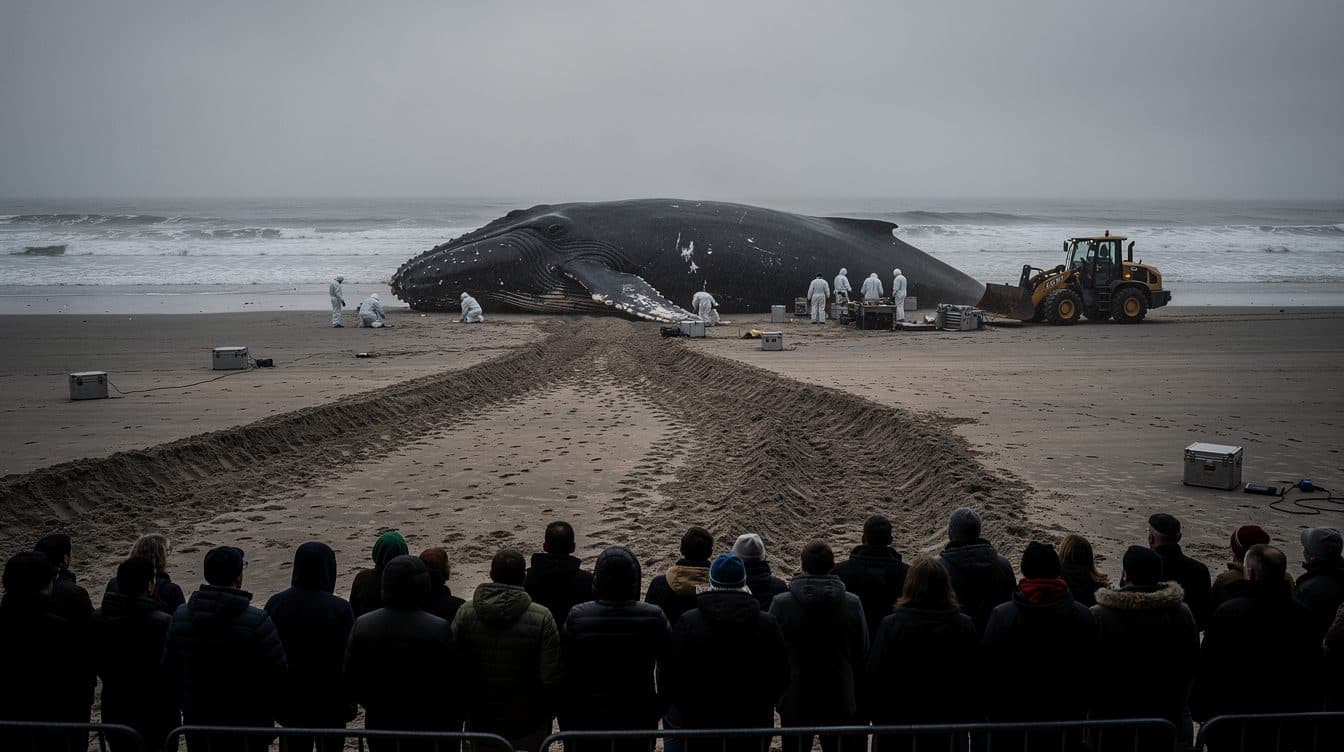
AI-generated image (flux-2/pro-text-to-image via Kie.ai)
Summary
Veterinarians and whale experts are set to perform a public necropsy of the humpback whale known as 'Timmy' on the beach of the Danish island of Anholt on Thursday afternoon. Danish and German authorities are coordinating the investigation, which is expected to last about six hours and to determine the animal's cause of death.
Anholt, 04 June 2026
A dead humpback whale nicknamed 'Timmy' is to be necropsied in public on the beach of the Danish island of Anholt on Thursday afternoon, with Danish veterinarians and whale experts leading a roughly six-hour examination to determine the animal's cause of death.
The whale, which had been lying in shallow water off Anholt for about two weeks, was pulled onto the beach over the weekend in an operation that lasted about two hours, according to the Danish Environmental Agency. 'Alles ist nach Plan verlaufen,' a spokesperson said of the recovery, which used a rope and a vehicle to drag the carcass ashore, leaving a deep furrow in the sand. Early in the week, a wheel loader was used to level the ground around the whale, and metal plates and containers were placed at the site to prepare for the necropsy.
Public health warnings and safety measures
Danish whale researcher Peter Teglgaard Madsen, who has been present at every whale necropsy in Denmark over the last 25 years, warned that the procedure would not be for the faint of heart. 'Der Wal hat jetzt schon sehr lange in der Sonne gelegen und wird sehr stinken,' Madsen said, noting that the carcass had become heavily bloated in recent weeks due to putrefaction gases. The Danish Environmental Agency has urged residents and bathers not to approach the animal because of the risk of infection, and the area will be cordoned off. 'Jeder, der sich dem Wal nähert, kann sich mit Krankheiten, Viren oder Bakterien anstecken,' Madsen said.
What the experts hope to learn
The investigation team is expected to arrive on Anholt by ferry on Thursday afternoon, with the necropsy beginning shortly after their arrival, according to Morten Abildstrøm of the Danish Nature Agency. 'Die Obduktion wird am Nachmittag beginnen und etwa sechs Stunden dauern,' Abildstrøm said. Press and members of the public are allowed to watch the procedure from a safe distance, a practice that is not unusual in Denmark. Madsen added that while the stench during such examinations is overwhelming, 'daran gewöhnt man sich'.
Experts say the primary goal is to determine why the whale died. According to Madsen, the animal will first be measured, its sex determined, and skin samples taken for a DNA test. The team will document external injuries and look for signs of disease and parasites, then cut into the carcass with a long knife. 'Das wird heftig: Man kann sich das vorstellen, als wenn man in einen Ballon sticht - da ist wirklich Druck drauf,' Madsen said, referring to the buildup of decomposition gases. Because the animal has been dead for so long, Madsen cautioned that it may be difficult to determine certain things about the cause of death.
A necropsy in public view
Organs and other parts of the animal will be thoroughly examined, including for evidence of internal bleeding. Water in the lungs could indicate that the whale drowned. Researchers will also search the animal's intestines for plastic and fishing gear. Madsen stated that four of the last six humpback whales stranded in Denmark had prior contact with fishing nets, and that this contact certainly contributed to their deaths.
From the Baltic to Anholt: Timmy's journey
The necropsy on Anholt's beach was not the original plan. Danish authorities had initially tried to tow the carcass into a harbor, but that attempt failed. After the procedure, the remains are to be taken to a rendering plant on the Danish mainland. Jane Hansen of the Danish Environmental Agency said that Danish authorities are in close contact with German counterparts, with ongoing coordination between Danish and German research institutions: 'Die dänischen Behörden sind zugleich in engem Austausch mit den deutschen Behörden über die Situation, und es findet eine laufende Abstimmung zwischen dänischen und deutschen Forschungseinrichtungen statt.'
'Timmy' first drew attention earlier this year, when the humpback wandered along the German Baltic coast starting in early March and stranded multiple times. The animal first came ashore at Timmendorfer Strand in Schleswig-Holstein, which gave the whale its nickname, and then stranded definitively on 31 March off the island of Poel in Wismar Bay, Mecklenburg-Vorpommern. A large-scale rescue operation was launched from Poel, and the whale was transported in a barge toward the North Sea before being released on 2 May. Two weeks after that release, it was confirmed that the whale had died.
Reaction in Anholt and beyond
The case drew public comment from Angela Merkel, who addressed the situation during the WDR podcast '0630' at the re:publica digital conference. 'Ich hätte mir wahrscheinlich eine Expertenkommission von Meeresbiologen genommen, Deutsche und auch Ausländer, und denen hätte ich gesagt, auf euren Rat höre ich, egal was ihr mir jetzt sagt,' Merkel said, describing how she would have handled the rescue operation.
On Anholt, the mood has been mixed. Island residents want the carcass removed from the popular bathing beach, fearing that the bloated, decomposing whale will deter tourists. The carcass is being pecked at by seagulls and is at risk of bursting. Entrepreneur Karin Walter-Mommert, who financed the original Baltic rescue mission, has said she wants the carcass towed into the open sea, pending approval from the Danish royal house.
What happens next
Whale strandings are not unusual in Denmark, but the public nature of Thursday's procedure — and the international interest in 'Timmy' — has turned the necropsy into a notable event. The necropsy, scientific investigations, and disposal of the carcass were scheduled to take place at the end of the following week, according to Jane Hansen, who added: 'Der Wal wird im Laufe dieses Wochenendes an Land gezogen.' The procedure itself is now expected to last roughly six hours, with the carcass subsequently transported to a rendering facility for final disposal.
Questions & Answers
Who is conducting the necropsy of whale 'Timmy' on Anholt?
The necropsy is being carried out by Danish veterinarians and whale researchers, including Peter Teglgaard Madsen, a Danish whale expert who has attended every whale necropsy in Denmark over the past 25 years.
Why is the necropsy being held on the beach rather than elsewhere?
The necropsy was originally planned for a harbor, but Danish authorities' attempt to tow the carcass into a harbor failed, so the examination is now being conducted directly on the beach of Anholt.
What do experts hope to find out from the necropsy?
Experts primarily want to determine the whale's cause of death, including checking for signs of drowning, disease, parasites, and contact with fishing gear or plastic; they have warned that the animal's advanced state of decomposition may make some findings difficult.
Whale Timmy necropsy on Anholt: public viewing, June 2026 | allfacts360