TKMS receives multi-billion order from Canada: Up to twelve submarines for North America
Berlin, 7 July 2026
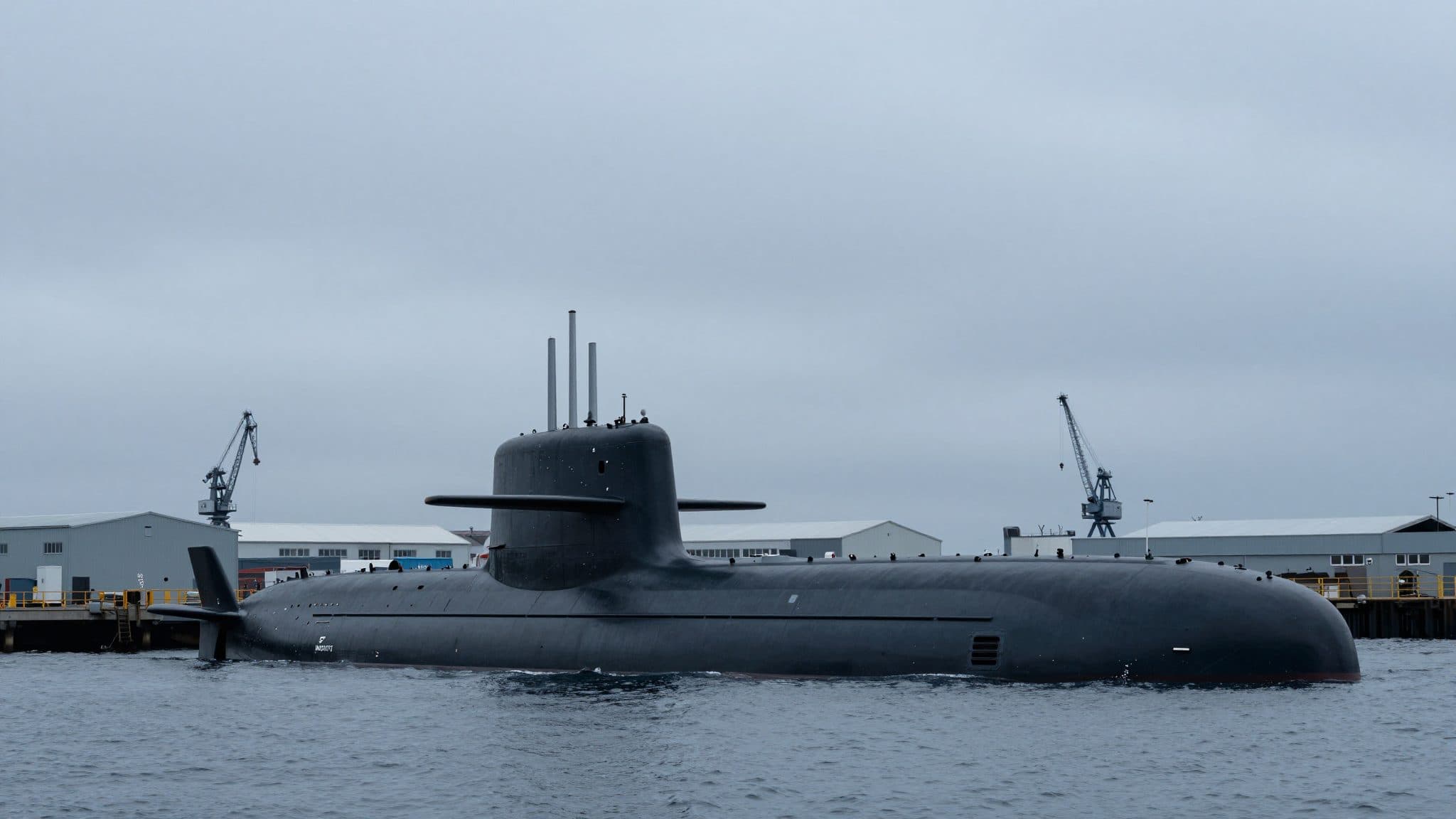
AI-generated image (z-image via Kie.ai)
Summary
The Kiel shipyard TKMS will deliver up to twelve Type 212CD submarines to Canada. The order, worth around 20 billion euros, is the largest in the company's history and strengthens German-Norwegian-Canadian cooperation in the North Atlantic.
Berlin, 7 July 2026
The Kiel naval shipbuilder TKMS is to deliver up to twelve Type 212CD submarines to Canada, as Canadian Prime Minister Mark Carney announced on Monday ahead of the NATO summit in Turkey.
The order has a volume of around 20 billion euros for the submarines including service, as reported by the Deutsche Presse-Agentur citing its own information. Including maintenance and operation over several decades, the overall program amounts to approximately 100 billion Canadian dollars, equivalent to around 62 billion euros, according to Canadian media reports. Neither the Canadian government nor TKMS provided information on the order volume. According to TKMS CEO Oliver Burkhard, it is the largest single order in the company's history.
Canada had announced in August 2025 that the multi-billion contract would go either to TKMS or to South Korean competitor Hanwha Ocean. TKMS ultimately prevailed with the German-Norwegian offer. Prime Minister Carney spoke of the largest military procurement in Canada's history and stated that TKMS had been selected as the "preferred supplier." At the same time, Ottawa reserved the right to fall back on the South Korean KSS-III Batch II model if negotiations failed. Concrete contract negotiations between Ottawa and TKMS have not yet been concluded.
Contract and state of negotiations
The 212CD submarine is a further development of the current German Class 212A and was jointly developed with Norway for uniform use. The abbreviation "CD" stands for "Common Design." The approximately 73-meter-long boat, with a displacement of around 2,750 tons, is equipped with six 533-millimeter torpedo tubes, improved sensors, and more powerful diesel engines. Thanks to modern lithium-ion batteries, it can operate autonomously and almost silently for weeks. The hulls have a diamond-shaped construction to reduce the acoustic signature. Each boat is to operate with 30 crew members.
The joint construction type is intended to reduce costs and facilitate cooperation. After the contract is signed, Canada will become the third major partner in the 212CD program, after Germany and Norway have each already ordered six boats of this type. This increases the total number of 212CD submarines ordered to 24. Defense Minister Boris Pistorius (SPD) said that in the future, information from all 24 boats in the North Atlantic, the Arctic, and the high north could be quickly exchanged, analyzed, and used among each other. He spoke of a "wesentlichen Pfeiler in der Strategie der NATO zur Sicherung des hohen Nordens" and a visible contribution to burden-sharing within the alliance.
Technology of the 212CD
"Die zukünftige U-Boot-Flotte der drei Nationen sei wesentlicher Pfeiler in der Strategie der Nato zur Sicherung des hohen Nordens und sichtbarer Beitrag zur Lastenteilung im Bündnis," Pistorius said before the start of the NATO summit. Federal Chancellor Friedrich Merz (CDU) welcomed Canada's decision: ahead of the NATO summit, the Canadian government sent "ein starkes Zeichen der transatlantischen und europäischen Zusammenarbeit in der Verteidigungsindustrie." Merz spoke of an expression of a long-term partnership that extends far beyond security and defense policy. Foreign Minister Johann Wadephul also commented via the short-message service X, stating: „Ich freue mich, dass wir Kanada von unserem deutsch-norwegischen Angebot im Rahmen des kanadischen U-Boot-Programms überzeugen konnten. Kanada hat damit ein starkes Signal des Zusammenhalts im transatlantischen Bündnis abgegeben."
Pistorius had personally lobbied for the order several times in recent months and traveled to Canada in May specifically for this purpose. Federal Chancellor Merz recently invested "viel an politischer Arbeit," according to his own account. The federal government had repeatedly pointed to the project, citing the joint deterrence of Russia and the security situation in the Atlantic and the Arctic as reasons. The background is also the strained relationship between Canada and the USA since the renewed inauguration of US President Donald Trump, who has repeatedly referred to Canada as a potential 51st US state and imposed tariffs. According to the federal government, the USA is reducing its military contributions, which demands that Europe do more and rearm.
The boats are to be built at the TKMS sites in Kiel and Wismar in Mecklenburg-Western Pomerania. At the Wismar site, a production line for submarine hulls was specifically set up, which is expected to create up to 1,500 jobs. The Wismar site, which TKMS took over in mid-2022, had previously focused on the construction of cruise ships until the operator became insolvent in 2022. All of the company's production sites are likely to be fully utilized for years as a result of the Canadian order. According to its own information, TKMS employs more than 9,100 people, of whom around 3,300 are in Kiel. Another site is located in Itajaí, Brazil.
Political background and sites
The competitors from South Korea had offered, in the event of being awarded the contract, to use Canadian steel for the construction of armored vehicles. Ultimately, however, costs and industrial counter-performance are likely to have been decisive, according to reports. TKMS had offered Canada participation in the entire 212CD program, including the possibility of manufacturing components or complete submarines in the country. In addition, investments in Canadian aerospace, rare earths, and battery production were discussed as part of a larger package to strengthen German-Canadian economic relations.
The Canadian Navy currently has only four Victoria-class submarines, which were taken over from Great Britain in 1998. Three of these are currently undergoing maintenance, according to the facts. Since the Victoria class is not ice-capable, the supply of arctic waters is a central concern. The new 212CD is specifically designed for operations under arctic ice, according to TKMS information. The protection of communications and trade routes across the Atlantic, as well as potential allied supply routes, are at the center of the program.
First deliveries to Canada are to be made by 2035 at the latest, according to earlier TKMS information; there are indications of a possible earlier delivery. According to company information, the first submarine could be handed over in 2033. TKMS also stated that it would be able to build three to four submarines per year for Canada from 2027. In the first half of fiscal year 2025/26, TKMS's revenue rose by ten percent to 1.17 billion euros, according to its own information; adjusted EBIT increased by 14 percent to 60 million euros, while net profit fell by 41 percent to 27 million euros due to investments in expansion, research, and development.
The news was also reflected in the financial markets: TKMS shares rose by up to eleven percent at times. The DAX marked a new record high in early trading on Monday, and the Dow Jones reached another record high after the extended US Independence Day weekend. TKMS CEO Burkhard had already shown confidence when presenting the half-year figures in May: „Ich gehe davon aus, dass wir das gewinnen."
Economic impact and markets
Independently of the submarine business, Defense Minister Pistorius pulled the emergency brake on the F126 frigate project and declared: „Können wir uns nicht leisten." According to reports, 2.3 billion euros in tax money had already flowed into the project. Market sentiment was also influenced by a 1.8 percent rise in German industrial sales in May. Easyjet shares gained 9.3 percent after the low-cost airline essentially agreed to a higher takeover offer from Castlelake. Continental, on the other hand, lost 2.2 percent despite the announcement of a special dividend from the sale of the Contitech division. BE Semiconductor fell by 5.5 percent following reports of delayed customer demand.
The German-Norwegian cooperation on the 212CD submarine and the now-additional Canadian participation are intended to secure the industrial base in Germany. TKMS is expected to receive stable capacity utilization and employment in Schleswig-Holstein and Mecklenburg-Western Pomerania for years as a result of the order. According to its own description, TKMS is one of the world's leading manufacturers of non-nuclear submarines and is the defense division of the Thyssenkrupp Group, headquartered in Kiel.
The federal government described the contract on Monday morning as an expression of a major strategic project. A German government representative said in Berlin: „Das ist ein großes strategisches Vorhaben. Wenn es gelingt, dann wird es Kanada an uns für Jahrzehnte binden." The abbreviation "Common Design" also aims to simplify maintenance, training, and logistics between the three navies involved. All three countries also operate the P-8 Poseidon maritime patrol aircraft, which should further facilitate cooperation.
Significance for Canada and NATO
According to official information, Canada currently sources around 80 percent of its defense goods from the United States. In the 2025 budget, Ottawa had pledged to spend over 80 billion Canadian dollars, equivalent to approximately 49.4 billion, on the modernization of its armed forces. The decision in favor of TKMS marks a shift in Canadian procurement policy and at the same time strengthens the European defense industry. The NATO summit in Ankara on Tuesday and Wednesday is likely to bring the topic of rearmament and burden-sharing further into focus.