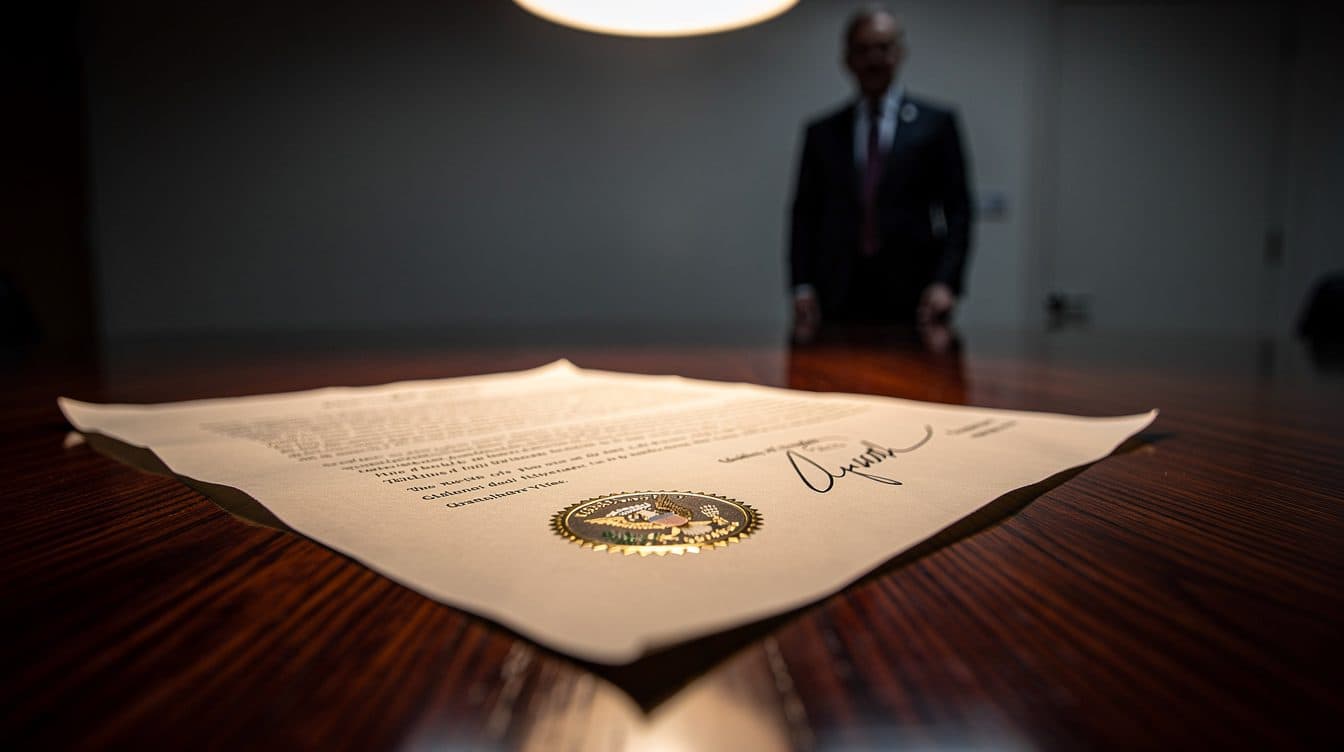
Trump signs executive order giving US agencies early access to new AI models
6/2/2026
AI-generated image (flux-2/pro-text-to-image via Kie.ai)
Summary
President Donald Trump signed an executive order on Tuesday in Washington calling on major technology companies including OpenAI and Google to voluntarily share new artificial intelligence models with the US government up to 30 days before public release. The order, which replaced a stricter Biden-era review regime, stops short of mandating licensing or pre-approval requirements for AI developers.
President Donald Trump signed an executive order in Washington on Tuesday calling on technology companies including OpenAI and Google to give US agencies early access to new powerful AI models for up to 30 days before their public release.
A voluntary framework, not a licensing regime
The order, published by the White House, frames the arrangement as a "freiwillige Zusammenarbeit" — a voluntary cooperation between the federal government and leading AI developers. Under its terms, companies would hand over frontier AI models to US authorities for review and vetting before the software is made available to the general public. The decree explicitly states that it is not about "Einführung einer verpflichtenden behördlichen Lizenz, Vorabgenehmigung oder Zulassung für die Entwicklung, Veröffentlichung, Freigabe oder Verbreitung neuer KI-Modelle."
The executive order creates a "Koordinierungsplattform" led by the US Treasury Department and operated in cooperation with the National Security Agency (NSA) and the Cybersecurity and Infrastructure Security Agency (CISA). According to the order, the platform is meant to be achieved through "Zusammenarbeit mit der Privatwirtschaft zwecks Modernisierung von IT-Systemen in Verwaltung und Privatwirtschaft und deren Härtung gegen Bedrohung von außen."
Industry pushback and the postponed signing
The signing of the order had originally been planned for June 21, but the date was postponed at short notice following pushback from the technology industry, according to US media reports. Industry figures warned that any exclusivity period for the government could disadvantage US firms competing with Chinese rivals in the global AI race.
An early draft of the order had proposed giving US agencies up to 90 days of exclusive access to a new AI application before its public release. That window was reduced to 30 days in the final version, while technology companies had pushed for a period of only 14 days. The compromise reflects the administration's effort to thread the needle between national security concerns and competitive pressure on the US tech sector.
Reversing the Biden-era review rules
Speaking at the signing, Trump said the United States was leading the global race in artificial intelligence. "We have a very substantial standard on AI, it's causing – it's causing tremendous good, and it's also bringing in a lot of jobs, tremendous numbers of jobs," Trump said, adding, "again, we have more people working right now than we've ever had." He also said the early access provision had been a sticking point: "I really thought that could have been a blocker."
In a separate remark, Trump said the United States was ahead of China and every other country in the AI race, and that he did not want to do anything "was uns bei diesem Vorsprung in die Quere kommt." The reference to a competitive lead over Beijing underscores one of the central motivations behind the order: maintaining US primacy in frontier AI development.
Anthropic dispute and the Mythos Preview model
The voluntary framework allows the government to vet powerful new AI systems up to 30 days before their public release but stops short of mandating review regulations, which were reportedly considered. That decision marks a clear departure from the approach taken by Trump's predecessor, Joe Biden. Shortly after returning to office in January 2025, Trump rescinded a Biden-era executive order that had required AI companies to submit their software to a formal security review process. The Trump administration argued that those rules were holding back the US AI industry.
Industry voices have also pushed back against the framework's underlying approach. The AI company Anthropic, for example, had refused to make its technology available to the US Department of Defense for "Massenüberwachung im Inland" or for use in fully autonomous weapons systems. The Pentagon subsequently classified Anthropic as a "Sicherheitsrisiko" in what was described as an unprecedented step, and the company is fighting that designation in court.
Contrasting approaches in the United States and the European Union
Anthropic has also been developing a separate AI system called Mythos Preview, which the company says has uncovered previously unknown software vulnerabilities — some of which had gone undetected for decades. The company has no plans to release Mythos Preview publicly, but is providing access to select IT firms and government agencies. IT security experts warn that AI tools of this kind could soon be used at scale by cybercriminals for offensive operations.
The new US framework contrasts with the regulatory approach taken in Europe. In the European Union, a comprehensive AI Act has been in force since 2024, establishing binding obligations for developers of high-risk AI systems. The US order instead favors a partnership model, with the Treasury-led coordination platform serving as the main conduit between government and industry.
The White House has emphasized that the early access window is intended to "promote secure innovation and strengthen the cybersecurity of critical infrastructure." Officials argue that giving federal agencies advance visibility into frontier models will help them identify risks before the systems are widely deployed, while still allowing US companies to move quickly against international competitors.
Open questions and what comes next
Supporters of the order say the lighter-touch approach will preserve American innovation leadership and avoid the kind of bureaucratic slowdown that, in their view, hampered AI development under the previous administration. Critics, including some cybersecurity researchers and civil society groups, warn that a voluntary regime with no binding pre-release review may leave critical infrastructure exposed to AI-enabled threats.
The order does not specify enforcement mechanisms for companies that decline to participate, leaving compliance to the discretion of individual firms. How widely the framework will be adopted remains to be seen, but the order sets the terms for a new phase in US AI policy — one in which cooperation, rather than regulation, is the stated default.
For the AI industry, the most immediate practical impact is a 30-day window in which new frontier models are reviewed by federal agencies before wider release. That timeline is significantly shorter than the 90 days first floated by the administration, and longer than the 14 days preferred by some companies, positioning the final figure as a negotiated compromise.
Questions & Answers
What does Trump's AI executive order actually require?
The order calls on AI companies to voluntarily give US agencies early access to new frontier AI models for up to 30 days before public release. It explicitly does not introduce a mandatory licensing, pre-approval, or certification regime for AI developers.
Why was the signing of the order postponed?
The signing was originally planned for June 21 and was pushed back at short notice after pushback from the technology industry, according to US media reports. Industry figures warned that a long government exclusivity window could disadvantage US companies competing with Chinese rivals.
How does the US approach compare with the European Union's AI rules?
The US order relies on voluntary cooperation between the government and AI developers, with a Treasury-led coordination platform working with the NSA and CISA. In the European Union, by contrast, a comprehensive AI Act has been in force since 2024, imposing binding obligations on developers of high-risk AI systems.
Trump AI executive order: 30-day early access framework | allfacts360