UNICEF: Approximately 1.1 billion children worldwide exposed to at least three climate hazards simultaneously
Cologne, 16 June 2026
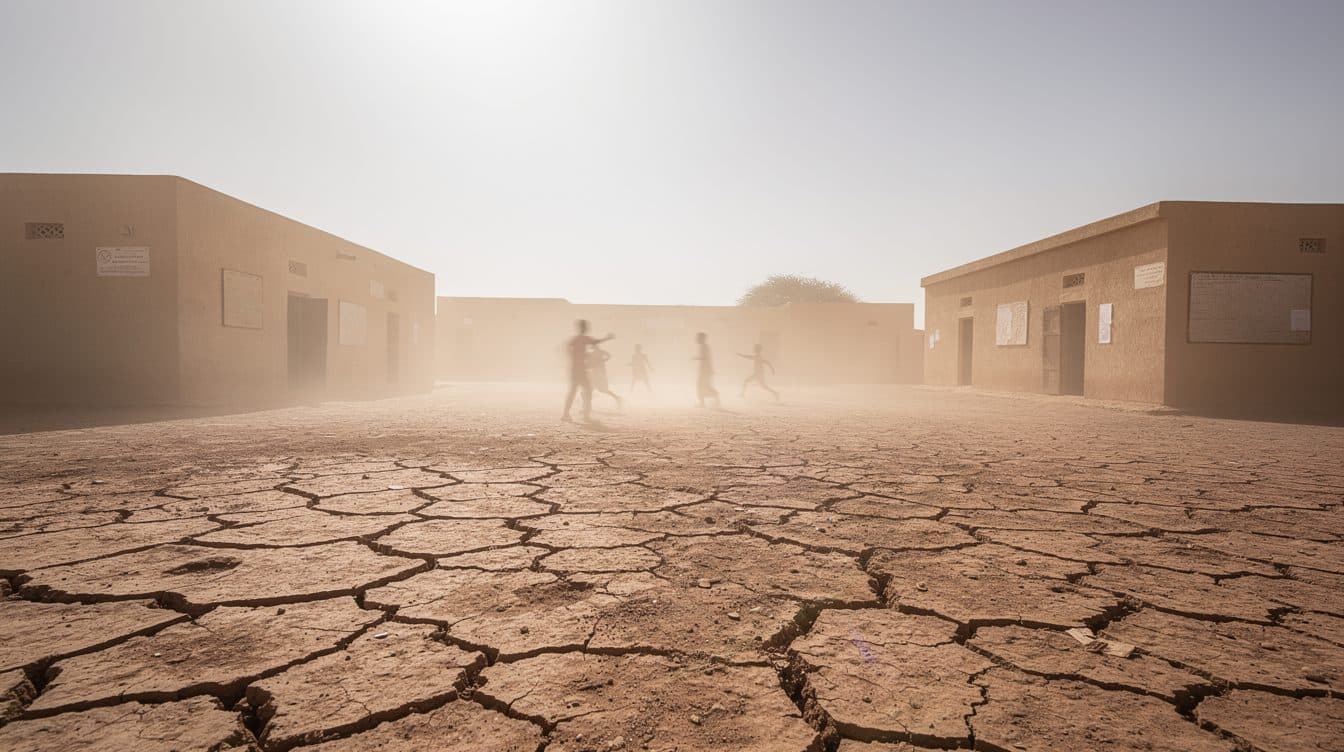
AI-generated image (flux-2/pro-text-to-image via Kie.ai)
Summary
Approximately 1.1 billion children worldwide are affected by at least three climate hazards simultaneously, according to the Children's Climate Risk Report 2026 published by UNICEF on Tuesday in Cologne. Droughts, extreme heat, and heatwaves are the most common combination; in Germany alone, 8.3 million children live in risk areas.
Cologne, 16 June 2026
The United Nations Children's Fund (UNICEF) published the Children's Climate Risk Report 2026 on Tuesday, according to which approximately 1.1 billion children worldwide – nearly half of all minors – are exposed to at least three climate hazards simultaneously.
Risk Atlas highlights focal points of multiple exposure
The report was presented in Cologne and evaluates the global data on climate and environmental risks for children. According to the organization's estimates, approximately 2.4 billion children live on Earth; around 1.1 billion of them are affected by at least three climate hazards at the same time. Overlaps between multiple risks that reinforce one another are common, the organization explained. The report contains a risk atlas designed to make particularly affected regions visible.
Droughts, extreme heat above 35 degrees Celsius, and heatwaves are the most common combination of climate hazards, according to UNICEF. Nearly 300 million children live in risk areas for these three hazards. More than four million children are simultaneously exposed to heatwaves, extreme heat, and sand and dust storms. Another frequent combination is droughts, extreme heat, and tropical storms – affecting more than 115 million children worldwide.
Most common combinations: Droughts, heat, and storms
In addition to droughts and heatwaves, floods and storms are among the dominant risks. In 2025 alone, there were 157 extreme weather events worldwide, including floods in Southeast Asia and wildfires in Southern Europe. The report shows that climate hazards overlap in many regions, particularly in the Sahel region as well as in Bangladesh, Myanmar, and Pakistan.
Children are considered particularly vulnerable, according to UNICEF. They breathe faster than adults and therefore absorb more pollutants, their bodies heat up more quickly, and they sweat less efficiently, the organization explained. In addition, children require more food and water relative to their body weight than adults and have lower chances of survival during extreme weather events. "Children need their own voice in climate policy," the report states. "They are least at fault, but most affected."
Millions of children in Germany also affected
The data also show significant impacts in Germany, according to UNICEF: 97.5 percent of children in Germany experience at least one climate impact, and 66.5 percent experience at least two simultaneously. The combination of both types of exposure affects 8.3 million children in Germany. "Children and young people are least responsible for climate change, yet the impacts hit their generation and those that follow particularly hard," said Christian Schneider, Executive Director of UNICEF Germany.
UNICEF spokesperson Katja Sodomann stressed the scale of the findings: "Über eine Milliarde Kinder ist sogar drei Klimagefahren gleichzeitig ausgesetzt". Schneider also called for political consequences: "Germany too must do its part – on climate protection as well as in supporting particularly affected countries."
Why children are particularly vulnerable
Medical experts warn of the particular risks for children. Pediatrician Christof Wettach explained: "Sie schwitzen weniger und haben keine so gute Möglichkeit Wärme abzugeben, wie Erwachsene". Children with pre-existing conditions, disabilities, or those taking medication are especially at risk. For example, ADHD medications suppress the sensation of thirst, which can quickly become a problem on hot days in the schoolyard, Boßerhoff explained. Wettach also cautioned that daycare centers and kindergartens in Germany are not structurally designed for increasingly hotter days. Even newly built facilities are "einfach völlig kopflos geplant."
The report points to the increasing frequency of extreme weather events. The combinations of droughts, heatwaves, and storms primarily affect children in countries of the Global South, whose health systems and infrastructure offer less protection, according to UNICEF. In Europe and North America, children are mainly affected by heatwaves, wildfires, and floods. The organization therefore sees a clear mandate in the UN Convention on the Rights of the Child to treat climate protection as a matter of child welfare.
Catherine Russell, head of UNICEF, had repeatedly pointed to the particular vulnerability of children in recent months. The report takes up this line and calls on governments to involve children more strongly in climate policy decisions. Among other things, UNICEF calls for the expansion of early warning systems, heat-adapted school and care buildings, and greater consideration of children's needs in climate change adaptation.
Demands on policymakers and the international community
The report's release comes at a time when the consequences of climate change are visibly increasing worldwide. According to the organization's data, the number of children at risk from heat has risen significantly in recent years. The authors emphasize that without decisive countermeasures, future generations will be exposed to a steadily growing multiple burden. The upcoming UN climate talks are seen as an important test of whether demands for greater climate justice for children will translate into concrete resolutions.
With the report, UNICEF continues its annual "Children's Climate Risk Report" series. The methodology combines global data on climate hazards with information on children's vulnerability. The risk atlas makes it transparent, according to UNICEF, in which regions the overlap of multiple hazards is particularly severe. The aim is to sensitize political decision-makers, donor organizations, and the public to the urgency of action.
The economic consequences of the multiple exposure are considerable, according to the report. Children who suffer health damage from heatwaves, floods, or droughts are more often absent from school, suffer long-term health problems, and have poorer educational opportunities. In affected regions, this exacerbates existing inequalities, the authors warn. Girls, children with disabilities, and children from poorer households are particularly affected.
Consequences for education, health, and inequality
UNICEF calls on governments, municipalities, and families to expand protective measures. These include cool retreats in cities, heat-adapted school buildings, early warning systems for heatwaves, and better access to drinking water. Schneider announced that UNICEF Germany would present the report's findings in discussions with federal and state policymakers. The European level also needs to be considered more closely.
Internationally, UNICEF sees a particular need to support African and South Asian states. Especially in the Sahel region, Bangladesh, Myanmar, and Pakistan, multiple climate hazards overlap. Millions of children there live in regions where droughts, floods, and storms occur simultaneously. The international community must significantly increase funding for adaptation and disaster preparedness, the report demands.
The report was broadcast on 16 June 2026 on Deutschlandfunk. UNICEF also sees the report as a launchpad for greater child and youth participation in climate policy debates. Planned initiatives include youth forums where those affected can share their perspectives. The organization also intends to bring its findings into upcoming international climate conferences and push for binding protection standards for children.
With the report, UNICEF combines a warning of a worsening situation with concrete political demands. These include binding national adaptation plans, better financing of climate-resilient infrastructure, and the consideration of children's rights in climate agreements. Should these measures fail to materialize, an entire generation faces a childhood under multiple burdens of heatwaves, droughts, storms, and floods – with consequences that extend into adulthood.
Reactions from policymakers and civil society were measured but concerned. Environmental and children's rights organizations welcomed the data collection and called for swift action. The German federal government referred to ongoing climate adaptation programs but announced no additional measures. UNICEF announced that it intends to update the report annually in order to make developments visible and maintain pressure on decision-makers.
Questions & Answers
What does the UNICEF Children's Climate Risk Report 2026 show?
The report shows that approximately 1.1 billion children worldwide – nearly half of all minors – are simultaneously exposed to at least three climate hazards, most commonly droughts, extreme heat, and heatwaves.
Which regions are particularly affected according to the report?
According to UNICEF, the Sahel region as well as Bangladesh, Myanmar, and Pakistan are particularly affected, where multiple climate hazards such as droughts, heatwaves, storms, and floods overlap.
How many children in Germany are affected?
In Germany, 97.5 percent of children experience at least one climate impact, and 66.5 percent at least two, according to UNICEF; the combination of both exposures affects 8.3 million children.
UNICEF Climate Report 2026: 1.1 billion children at risk | allfacts360