US and Iran move toward framework deal to end war, mediated by Pakistan
Geneva, 14 June 2026
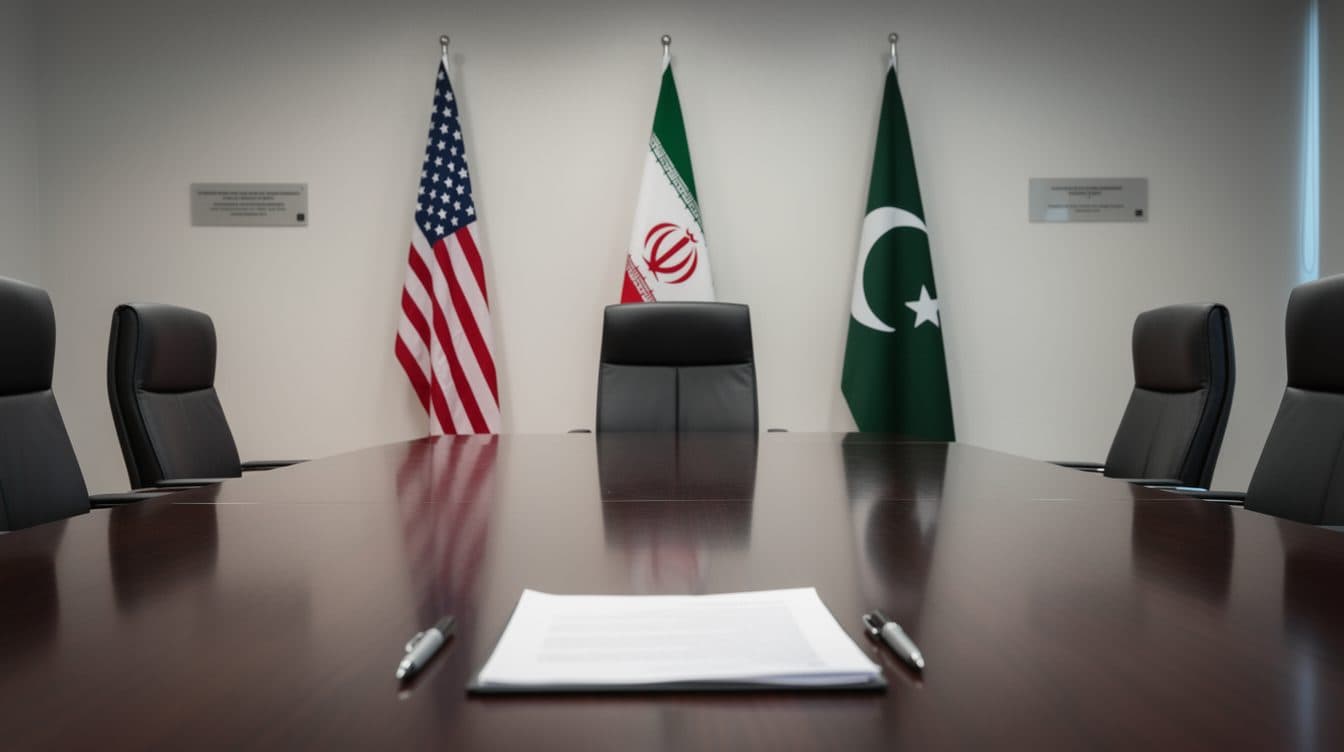
AI-generated image (flux-2/pro-text-to-image via Kie.ai)
Summary
The United States and Iran are on the verge of signing a framework agreement to end the war that began on 28 February 2026, with mediator Pakistan announcing a virtual ceremony within 24 hours. The draft envisages reopening the Strait of Hormuz, lifting the US naval blockade, and launching 60-day nuclear talks.
Geneva, 14 June 2026
The United States and Iran are on the verge of signing a framework agreement to end the war that erupted on 28 February 2026, with Pakistani Prime Minister Shehbaz Sharif announcing on Saturday that a virtual signing ceremony is expected within 24 hours.
Mediator Pakistan announced on Saturday that the two sides had reached agreement on the text of a declaration of intent. Sharif wrote on platform X that the parties were closer to a peace deal than ever before and expressed confidence that the agreement would form a solid foundation for lasting peace. In a subsequent post, he said technical-level talks would follow in the coming week and that Pakistan was preparing for an electronic signature within 24 hours, effectively on Sunday.
Mediator Pakistan pushes 24-hour timeline
Iranian Foreign Ministry spokesman Esmail Baghaei confirmed the general direction of travel but pushed back on the timetable. Speaking to state broadcaster IRIB and the state news agency IRNA, Baghaei said the signing would not take place on Sunday, but rather in the coming days. 'We have never been so close to an agreement, and it is therefore very likely that the declaration of intent will be finalized in the coming days,' Baghaei said, according to IRIB. He also ruled out any travel by Iranian representatives to Geneva or to the Pakistani capital Islamabad in the next one to two days.
Trump: deal on Sunday, Strait open immediately
US President Donald Trump contradicted the Iranian position in a post on his Truth Social account, insisting that the agreement would be signed the next day and that the Strait of Hormuz would be open to all commercial traffic immediately afterward. 'The agreement is to be signed the next day, and immediately after the signing, the Strait of Hormuz is open to everyone,' Trump wrote. He also said Iran would receive no money in the first step and repeated his long-standing demand that the country's buried uranium stockpiles be recovered, diluted and destroyed. 'At the right time, when everything is calm, we will go in and get the nuclear dust, buried deep under the mighty sunken granite mountains,' Trump wrote. He added that the United States looked forward to longer-term cooperation with Iran and the broader Middle East, and warned of an 'ultimate alternative' if the process falters, a phrase Middle East analyst Sina Toossi wrote on X 'sounds very much like a nuclear threat.'
The framework deal is intended to extend the fragile ceasefire that has been in place since early April by 60 days, during which the two sides would negotiate over Iran's nuclear program. According to a senior US official, the framework already includes an Iranian commitment to roll back its nuclear program, including renouncing uranium enrichment and the expansion of nuclear facilities. The United States is pushing for the destruction of Iran's highly enriched uranium, while Tehran wants to keep the material at most in diluted form. Iran has also reportedly committed to neither producing nor acquiring nuclear weapons.
What the framework contains
Beyond the nuclear file, the draft envisages several major steps. Iran would immediately reopen the Strait of Hormuz, a chokepoint for global oil, gas and fertilizer shipments, while the United States would lift its naval blockade of Iranian ports, suspend oil sanctions for a defined period and release roughly 25 billion US dollars in frozen Iranian assets. The Iranian Foreign Ministry has designated the release of the frozen funds as a firm component of the deal and is also demanding an end to the foreign military presence in the region. Iran has announced plans to charge fees for initially unspecified services in the strait, and Foreign Minister Abbas Araghchi told Iranian state television on Friday that the administration of the waterway 'will no longer be as it was before.'
Strait of Hormuz: the central flashpoint
Iran partially shut the Strait of Hormuz through threats and attacks on shipping shortly after the war began, and the United States responded with a naval blockade of Iranian ports to choke off Tehran's oil revenues. On Saturday morning, US Central Command reported that Iran had again launched multiple drone attacks on commercial ships in the strait and that US forces had shot them all down. A separate incident, a projectile strike on a tanker about six nautical miles east of Oman reported by the British maritime authority UKMTO, caused no injuries and the vessel continued its voyage.
Why the signing is going virtual
The signing is now expected to take place virtually rather than in person. The US news portal Axios reported that US officials and sources in mediating states confirmed the format, citing logistical reasons: Vice President JD Vance, who is leading the US delegation, would otherwise not have managed to return to the United States before Trump departs for the G-7 summit in Évian-les-Bains, France, on Monday morning. The United States generally avoids having the president and vice president abroad at the same time. Earlier, a ceremony in Geneva had been mentioned as a possible venue.
Lebanon front complicates the deal
The agreement is meant to address hostilities on all fronts, according to the Iranian Foreign Ministry, including the conflict between Israel and the Iran-aligned Hezbollah militia in Lebanon. A ceasefire has officially been in effect in Lebanon since 17 April, but Israel and Hezbollah have continued to trade fire, and Israel has ordered evacuations in southern Lebanese localities in recent days. Tehran is demanding that the Israel-Hezbollah ceasefire be implemented as part of the deal; Israel is opposed to linking the Lebanese front with the US-Iran agreement. Israel is not directly participating in the US-Iran negotiations. Iran, for its part, has demanded that Israel end its offensive against Hezbollah and that Israeli ground troops fully withdraw from Lebanon.
Iranian politics and Khamenei's funeral
Iran's negotiating position has been complicated by political turbulence at home. The official funeral of Ayatollah Ali Khamenei, the Iranian Supreme Leader killed in an Israeli airstrike on his official residence in Tehran at the end of February 2026 at the age of 86, is planned for 9 July in his birthplace Mashhad, with mourning ceremonies in Tehran on 4 and 5 July and in Qom on 6 July. His son and successor Moqtaba was appointed one week after his father's death but has not appeared in public since, prompting speculation about his health and even possible death. On Saturday in Mashhad, demonstrators protested in front of a Foreign Ministry office against a peace deal with the United States, chanting slogans against Foreign Minister Araghchi; Iranian hardliners have publicly rejected the agreement and demanded that Iran not give up its leverage over the Strait of Hormuz.
A Qatari delegation traveled to Tehran on Sunday in connection with efforts to conclude the agreement, according to a Reuters insider report, and Iranian government representatives told Reuters that a final agreement is to be negotiated within 60 days after both sides approve the draft. Parliament speaker Mohammad Baqer Qalibaf is Iran's chief negotiator in the Pakistan-mediated talks. The United States is pushing for further steps regarding Iran at next week's G-7 summit in France, where boats flying Palestinian flags have gathered to protest.
Cautious optimism despite a long history of delays
Friday had already brought signs of movement: an unnamed US government official told American media they were '80 to 85 percent' confident in a near-term signing. Trump has announced nearly 40 times that a deal between the United States and Iran would be ready shortly, a pattern that has bred skepticism in some quarters. Iranian caution was on display on Saturday when Baghaei urged waiting for the exact date of the signing, citing the volatility of the other side. 'We have to wait until the exact date of the signing is set,' he told IRNA.
Questions & Answers
What is the US-Iran framework agreement announced on 14 June 2026?
It is a declaration of intent intended to extend the ceasefire by 60 days, reopen the Strait of Hormuz, lift the US naval blockade, release roughly 25 billion dollars in frozen Iranian assets, and launch negotiations on Iran's nuclear program.
Why is the signing of the US-Iran deal being held virtually?
According to the US portal Axios, Vice President JD Vance, who is leading the US delegation, would otherwise not have been able to return to the United States before President Trump departs for the G-7 summit in France on Monday morning, and the US avoids having both leaders abroad at the same time.
Who is mediating the US-Iran talks?
Pakistan is acting as the principal mediator. Prime Minister Shehbaz Sharif announced on Saturday that the two sides had agreed on the framework text and that an electronic signature was expected within 24 hours.
US-Iran Framework Deal: Peace Agreement Signing on 14 June | allfacts360