US Central Bank Keeps Key Interest Rate Stable Under New Chief Warsh
Washington, June 17, 2026
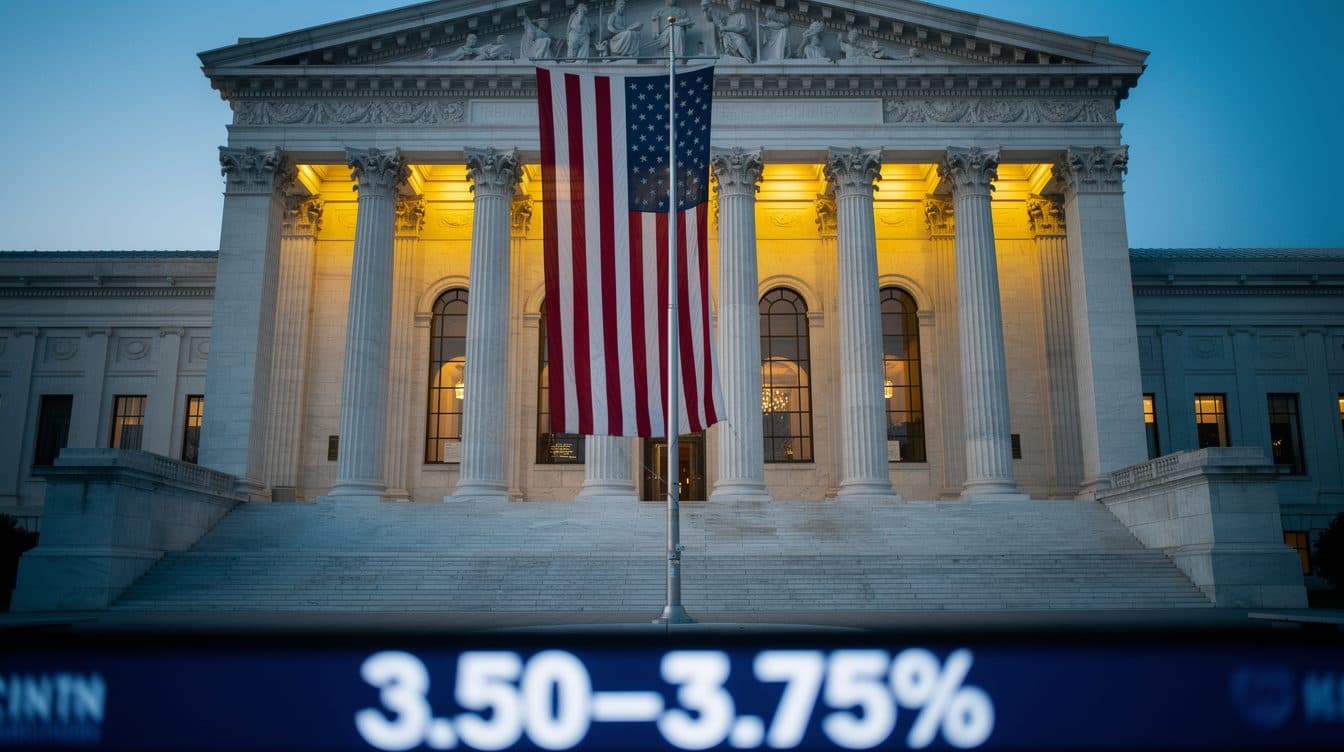
AI-generated image (flux-2/pro-text-to-image via Kie.ai)
Summary
The US Federal Reserve left its key interest rate unchanged under new Chair Kevin Warsh. The twelve voting members unanimously decided on Wednesday to keep the rate in the range of 3.50 to 3.75 percent.
Washington, June 17, 2026
The US Federal Reserve, under its new Chair Kevin Warsh, left its key interest rate unchanged, thereby rejecting US President Donald Trump's demands for immediate rate cuts.
Unanimous Decision Amid High Inflation
The US Federal Reserve, under its new Chair Kevin Warsh, left its key interest rate unchanged, thereby rejecting US President Donald Trump's demands for immediate rate cuts. The decision by the twelve voting members was unanimous on Wednesday. As a result, the key interest rate remains in the range of 3.50 to 3.75 percent – a level the Fed has held since December of last year.
This is the first interest rate decision under the leadership of the new Fed chief Kevin Warsh. Warsh succeeded long-time Fed Chair Jerome Powell at the end of May. The 56-year-old was appointed to the position by Trump, and according to US media, Warsh is considered open to lower key interest rates – to Trump's delight. In fact, however, the Fed initially held its course steady.
The Fed's decision came against the backdrop of significantly higher consumer prices in the US. Inflation had surged to a three-year high of 4.2 percent in May due to the oil price shock from the Iran war – well above the Fed's target of two percent. Warsh said following the meeting that the Fed would continue to „für Preisstabilität sorgen", as its mandate requires.
Energy Prices as Main Driver of Inflation
The consequences of the Iran war, the blockades in the Strait of Hormuz, and the resulting constrained global energy supply have sharply fueled inflation. In May, US energy prices were 23.5 percent above the prior-year level, with gasoline rising particularly sharply – by around 40 percent. According to the facts, companies currently have to spend significantly more on oil, gas, and fertilizers.
Monetary policy should, according to the Fed, be decided independently of political influences and thereby balance inflation and full employment. The fact that the central bank clearly placed price stability at the top in its statement on the rate decision was interpreted by Thomas Altmann, Chief Portfolio Manager at QC Partners, as a clear signal.
At the same time, the labor market proved more robust than expected. In May, US employment unexpectedly rose by 172,000 jobs, nearly twice as much as experts had forecast. That argued against an easing of monetary policy. The Fed now expects economic growth of 2.2 percent for the current year, down from its previous assumption of 2.4 percent. Growth expectations for the following year remain at 2.3 percent.
Monetary Policy Outlook: Tightening More Likely
Under Warsh, the central bank also significantly revised its inflation expectations upward. For the current year, an inflation rate of 3.6 percent is now expected. In March, shortly after the start of the Iran war, Fed experts had still assumed 2.7 percent. A rate cut in the near future thus appears unlikely. Instead, a tighter monetary policy over the course of the year seems more likely in order to get inflation under control.
This expectation is also reflected in the projections of the central bank members. In a survey of 18 members, 9 expected at least one interest rate hike of 25 basis points over the remainder of the year. Six of them even envision an even more extensive tightening. Eight additional members assume that the rate pause will hold throughout 2026. Only a single member considers a rate cut likely. The Fed's expected path is thus clearly tilted upward.
Reform Course and Communication Change
Warsh announced reforms in five key areas that, in his words, require a „frischen Blick". Warsh also wants to reshape the Fed's balance sheet, its use of data sources, its handling of the topics of productivity and employment, as well as inflation. To this end, he set up working groups that are to deliver results by the end of the year at the latest. He is also considering incorporating „neue Datenquellen" from the private sector, as he views the current data as based on „altmodischen Befragungsmethoden". In addition, the new Fed leadership wants to change the central bank's communication and make fewer public statements about future rate decisions.
Warsh also reaffirmed to journalists his intention to bring about a course change at the Fed and to open a „neues Kapitel". Warsh is currently considered an „Inflation Hawk" and tends toward a more restrictive monetary policy in order to get inflation under control. KfW expert Stephan Bales therefore saw Warsh facing a „Balanceakt". That makes „Zinssenkungen auf absehbare Zeit unwahrscheinlich erscheinen", Bales explained. Investors looking for falling rates that would support stocks relative to bonds would likely have to wait until 2028.
Bernd Weidensteiner, economist at Commerzbank, also considers an upward rate move unlikely: „Wir halten einen solchen Schritt weiter für unwachrscheinlich." However, he also sees a risk in the medium term: Warsh runs the risk of his relationship with President Trump cooling significantly if he cannot implement the rate cuts Trump has demanded.
Even before Warsh took office, Trump had made clear what he expected from his new central bank chief: should Warsh not lower rates „sofort", he would be very disappointed. Trump had repeatedly and unsuccessfully pushed the independent central bank for substantial rate cuts. Trump also assured that he would not exert pressure on the Fed chief. President Trump comes away empty-handed with his demands for rate cuts.
Political Pressure and Central Bank Independence
Former Fed Chair Jerome Powell had repeatedly been the target of Trump's attacks. Trump had repeatedly insulted Powell as a „Versager" because he did not advocate for the desired lowering of the key interest rate. Trump also disparaged him as a „Schwächling". Allegedly at Trump's initiative, justice authorities had opened investigations against Powell over allegedly excessive costs in the renovation of the Fed building in Washington. Powell said he would remain as Governor until the investigation against him is „endgültig und transparent abgeschlossen".
As long as Powell remains in office, Trump cannot place another candidate on the Fed's leadership board. Powell has a separate term as a member of the Board of Governors that runs until January 2028. This blocks Trump's ability to appoint another person to the seven-member leadership board of the Fed. Powell is also likely to make it difficult for Warsh to push through rate cuts.
Markets and Outlook
The US central bank is under massive pressure. Since Trump's renewed inauguration in January 2025, the Fed has faced unprecedented pressure to lower the key interest rate. Lower rates would boost the economy, make it easier for Americans to buy homes, and reduce the interest burden of US government debt. Economists fear that Trump could exert significant influence over such decisions through Warsh and indirectly force a looser monetary policy. The opposition Democrats accuse Trump of undermining the central bank's independence.
Meanwhile, the European Central Bank has also responded: The ECB raised its deposit rate by 0.25 percentage points to 2.25 percent – the first rate hike since 2023, justified by the inflationary impact of the Iran war. Markets reacted accordingly. The Dow Jones Industrial fell 0.98 percent to 51,492.55 points, the S&P 500 lost 1.21 percent to 7,420.10. The Nasdaq 100 dropped 0.99 percent to 29,670.95 points. The DAX closed slightly in positive territory at 24,934.67 points. Bitcoin traded on Bitstamp at $63,767, a decline of 1.05 percent. One market participant now considers a rate hike in October under Warsh to be realistic.
Questions & Answers
Who is Kevin Warsh and what role is he taking on at the Fed?
Kevin Warsh is the new Chair of the US Federal Reserve. He succeeded Jerome Powell at the end of May and on Wednesday led his first interest rate decision. Previously, he had already been a member of the Fed's Board of Governors until 2011.
Why did the Fed not cut the key interest rate?
The Fed kept the key rate stable because inflation had recently risen to 4.2 percent – well above the target of two percent. The trigger was the fallout from the Iran war and the blockades in the Strait of Hormuz, which drove energy prices sharply higher.
How did markets react to the rate decision?
US stock markets were mostly down: the Dow Jones lost 0.98 percent, the S&P 500 lost 1.21 percent, and the Nasdaq 100 lost 0.99 percent. The DAX, by contrast, closed slightly in positive territory at 24,934.67 points.