US Central Bank Leaves Key Interest Rate Unchanged – Warsh Chairs First Meeting
Washington, 17 June 2026
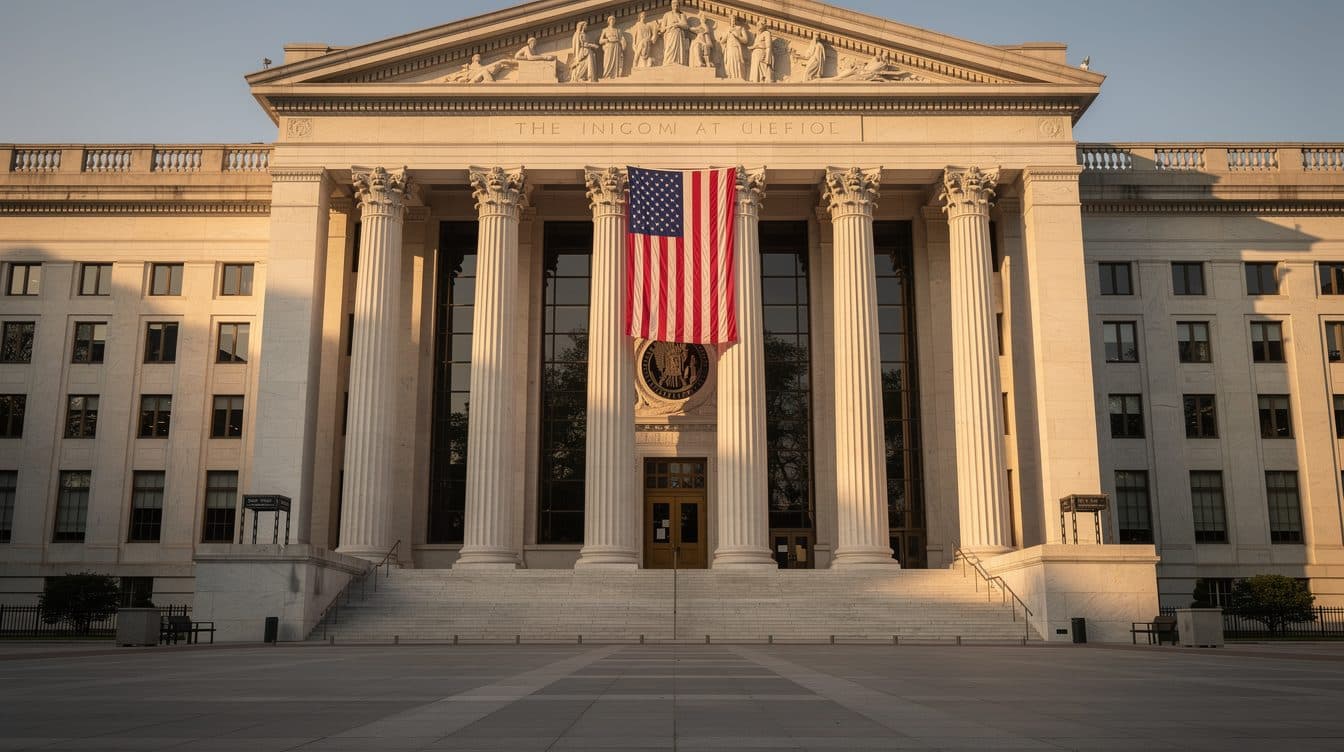
AI-generated image (flux-2/pro-text-to-image via Kie.ai)
Summary
The US Federal Reserve has left its key interest rate unchanged at 3.50 to 3.75 percent. At the same time, it raised its inflation forecast for 2026 significantly and lowered its growth expectation slightly.
Washington, 17 June 2026
The US Federal Reserve has left its key interest rate unchanged in the range of 3.50 to 3.75 percent, while new Fed Chair Kevin Warsh chaired his first meeting of the Federal Open Market Committee (FOMC).
Warsh's First Meeting as Fed Chair
With the decision of 17 June 2026, the central bank followed market expectations, which had largely anticipated a pause in the interest rate cycle. The Fed justified the move, citing in part a more robust labour market and persistent inflation risks that warranted a wait-and-see stance.
Kevin Warsh, who previously served as a member of the Fed Board of Governors, chaired the Federal Reserve for the first time at this meeting. His first FOMC meeting was also closely watched by observers as a signal for the central bank's future communication strategy.
The economic data before the Fed painted a mixed picture: The US unemployment rate remained stable at 4.3 percent in May, while employment grew significantly more strongly than analysts had expected. In the view of many economists, this combination of a robust labour market and price stability not yet fully achieved argued against a rapid rate cut.
Growth Forecast Revised Downward
At the same time, the central bank revised its growth forecast downward: For the current year 2026, the Federal Reserve now expects economic growth of 2.2 percent, after previously projecting 2.4 percent. This correction reflects the burdens currently weighing on the US economy.
An even more striking signal came from the Fed on inflation: For the coming year, the central bank forecasts an inflation rate of 2.3 percent, 0.1 percentage points higher than before. For 2026 itself, the inflation expectation was raised from 2.7 to 3.6 percent – a notably large jump.
Iran War and Strait of Hormuz as Price Drivers
Among the factors weighing on the global economy, the Fed cites the Iran war and the ongoing closure of the Strait of Hormuz. These developments have put pressure on global supply chains and kept energy prices and inflation at elevated levels.
Financial markets took the decision in stride overall. Investors in equity markets see the unchanged monetary policy as providing planning certainty in the near term, as stable financing costs support corporate valuations. In the bond market, observers expect a sideways move in the short term, as interest rate expectations have barely changed.
Impact on Investors and Savers
For savers, the decision means that interest rates on overnight and time deposits are likely to remain at current levels. The Fed itself has given no indication that it is considering a rate cut in the near future.
Behind the scenes, attention is now focused on how the Fed will communicate under Warsh. The new Chair took over from Jerome Powell, who had led the central bank through several years of high inflation and monetary tightening.
Warsh faces the challenge of navigating between the expectations of US President Donald Trump, who had repeatedly pushed for lower interest rates, and the central bank's stability mandate. The Fed is independent by mandate and committed to price stability and maximum employment.
The next meeting of the Federal Open Market Committee is scheduled for 29 July 2026. Until then, new data on inflation, employment, and economic developments will determine whether the central bank maintains or adjusts its course.
Outlook for the July Meeting
Observers interpret the recent forecast adjustments as an indication that the Fed assesses inflation risks as higher than just a few months ago. The significant jump in the inflation forecast for 2026, from 2.7 to 3.6 percent, suggests that monetary policy makers expect a longer period of elevated prices.
Beyond the US, the Fed's decision has implications for the global economy: Since the US dollar and US monetary policy serve as a benchmark worldwide, interest rate decisions in Washington also affect capital flows, exchange rates, and financing conditions in Europe, Asia, and emerging markets.
The reporting on the meeting originates from the environment of the financial portal finanzen.net and is based, among other sources, on material from the news agency dpa-AFX. Thus, both specialised financial analyses and general economic news flowed into the assessment of the decision.
Overall, the Federal Reserve is sending a signal of caution with the unchanged interest rate decision and the higher inflation forecasts. The central bank appears determined to maintain monetary tightening until inflation sustainably returns toward the target of two percent.
The coming weeks will show whether the labour market strength observed in May was an outlier or is solidifying into a trend. Should employment continue to grow robustly, the Fed could hold its wait-and-see stance even longer – which in turn would influence yields in bond markets and financing conditions for businesses.
Questions & Answers
Who is Kevin Warsh and what role does he play at the Fed?
Kevin Warsh is the new Chair of the Federal Reserve. On 17 June 2026, he chaired his first meeting of the Federal Open Market Committee (FOMC).
Why did the Fed not change the key interest rate?
The central bank pointed to a robust labour market and persistent inflation risks. Markets had in any case largely expected a pause in the interest rate cycle.
What inflation forecast did the Federal Reserve give for 2026?
The Fed raised its inflation expectation for 2026 significantly, from 2.7 to 3.6 percent. For the following year 2027, inflation of 2.3 percent is expected.