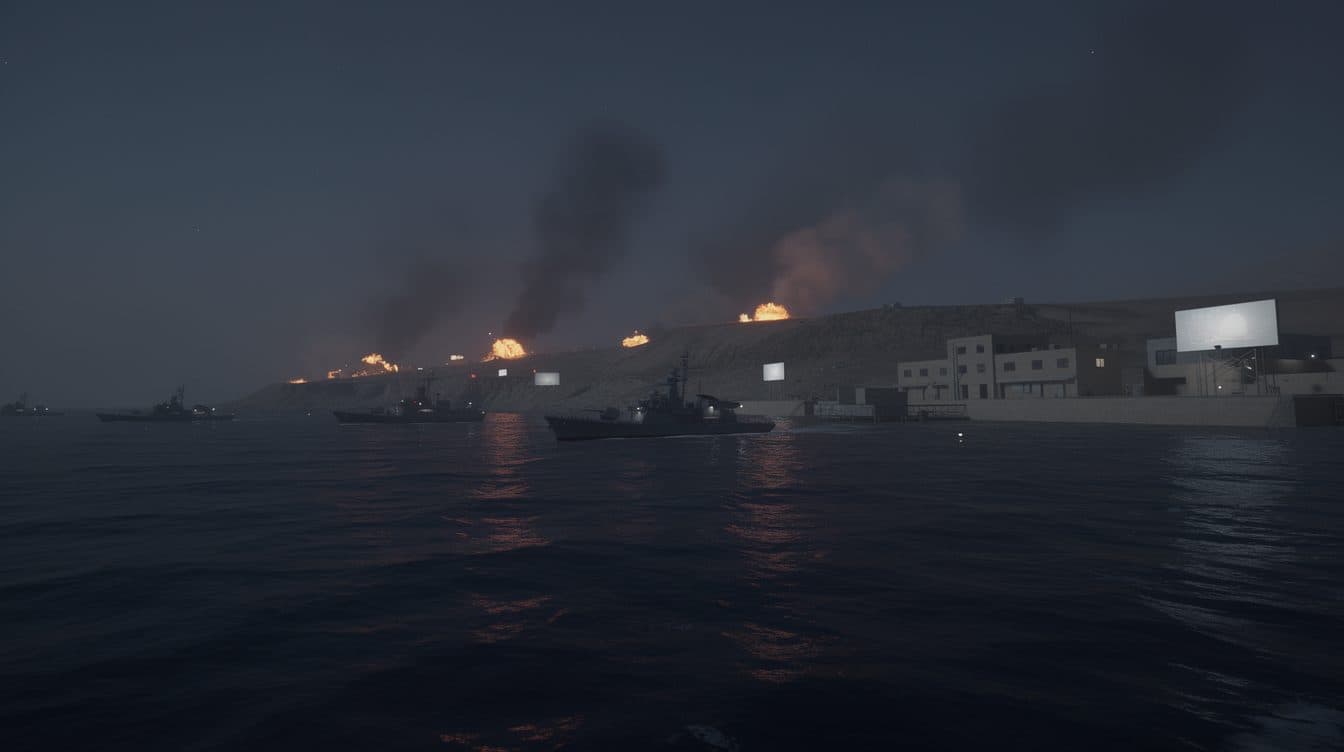
US strikes Iranian air defense and radar systems at the Strait of Hormuz
Washington/Jerusalem, June 10, 2026
AI-generated image (flux-2/pro-text-to-image via Kie.ai)
Summary
US forces attacked Iranian air defense and radar systems at the Strait of Hormuz overnight into Wednesday. US President Donald Trump spoke of a forced response to Iran's shootdown of an Apache helicopter. The rescue of the two pilots took about two hours.
Washington/Jerusalem, June 10, 2026
US forces bombed Iranian air defense and radar systems at the Strait of Hormuz in multiple strike waves overnight into Wednesday, after a US Army Apache attack helicopter had been shot down near the coast of Oman the previous evening.
The US military began the strikes, which it characterized as self-defense, on Tuesday at 5:00 p.m. Washington local time, as the Middle East-based regional command Centcom announced on the X platform. In Germany, the operations began at 11:00 p.m., according to the statement. President Donald Trump had ordered the strikes, Centcom said. In total, facilities at five locations in the region around the strait between Iran and the Arabian Peninsula were hit. According to consistent media reports, the targets were air defense positions, radar installations, and artillery batteries.
Trump had announced the retaliation a few hours before the strike on his online platform Truth Social. The Iranians had shot down a "highly sophisticated" US Army Apache helicopter during the previous night as it was on patrol in the Strait of Hormuz, the president wrote. He added that the United States had no choice but to respond. In a phone call with ABC correspondent Jonathan Karl, Trump later said the response would have to be "very strong, very powerful" – "and it is."
Apache Helicopter Shootdown
The background to the incident, according to the US military, was the shootdown of the AH-64 Apache helicopter. CNN had reported, citing people familiar with the matter, that an Iranian Shahed drone had hit the helicopter off the coast of Oman. Later agency reports, however, cited unconfirmed US military information suggesting there may have been a collision with a drone. At the time of the incident, Centcom stated that the exact cause was still unclear.
The two crew members of the downed helicopter were uninjured and safe, according to the US military. The soldiers had been safely rescued within about two hours and were in stable condition. According to Centcom, an unmanned surface vessel from the manufacturer Saronic was involved in the rescue for the first time. The "New York Times" had previously reported on the crash.
Scale of the US Strikes
Centcom described the US strikes as a "appropriate response to unjustified Iranian aggression." Iranian media reports indicated that there had been several explosions along the country's southern coast near the Strait of Hormuz. The Iranian news agency Mehr reported impacts in the port city of Sirik and in the regional capital Bandar Abbas. Explosions were also heard on Qeshm Island and in the greater Bandar Abbas area.
The strikes took place against the backdrop of an already fragile security situation in the Middle East. Already on Sunday evening, Iran had fired missiles at Israel for the first time since a fragile ceasefire came into effect at the beginning of April. The Iranian Revolutionary Guards justified the attacks with Israeli airstrikes on neighborhoods of the Lebanese capital Beirut, which are considered strongholds of the pro-Iranian Hezbollah militia. Tehran had explicitly warned Israel against further attacks on targets in southern Lebanon.
Iranian Response and Regional Escalation
On Monday, the Israeli Air Force subsequently flew attacks on targets in Iran. Iran and Israel then both declared that they would stop their respective attacks, but both sides threatened to resume hostilities in the event of another attack. On Tuesday, Israel again struck targets in Lebanon despite Iranian demands and threats. The Lebanese Health Ministry reported at least eight dead in an airstrike on the city of Tyre. The Israeli army had previously called on residents to flee. Iranian state media reported on Tuesday that three people, including two soldiers, had been killed the previous day in Israeli attacks.
Iran once again called on foreign forces to withdraw from the region. Foreign Minister Abbas Araghchi wrote on the X platform: "Leave our region if you want to be safe! The history of the Persian Gulf knows many chapters about the tragic fate of invaders." He added that the Iranian armed forces would not leave any attack or threat unanswered. To Trump he said: "We prefer the language of diplomacy, but we can also speak other languages." Iran's Parliament Speaker Ghalibaf also issued a warning in a similar tone. Iran's UN ambassador, meanwhile, stated that a deal to end the conflict was possible by the end of June.
Negotiations and Ceasefire
The US strikes come at a time when Trump had repeatedly expressed optimism about an imminent peace deal with Tehran. As late as late Monday evening, he had said they were "in the final stages of what will be a very, very good deal." On Tuesday as well, he said a conclusion to the negotiations was possible in the coming "two or three days." A few hours later, he then announced retaliation for the helicopter shootdown. Trump simultaneously called on both sides for an "immediate" ceasefire. According to Pakistani statements, a deal to end the Iran war was "nearing completion" when the latest Iranian-Israeli attacks began on Sunday.
Officially, a ceasefire has been in effect in the Iran war for two months. The conflict had begun on February 28 with US-Israeli airstrikes. Lebanon was drawn into the war in early March. Efforts to achieve a permanent end to the war have been stalled for weeks. At the beginning of the war, Trump had promised a quick victory and had repeatedly raised expectations of a swift agreement in the peace talks over the past months.
Tensions Between Trump and Netanyahu
Parallel to the military tensions, the developments are also straining the relationship between Trump and Israeli Prime Minister Benjamin Netanyahu. Several observers confirmed an angry phone call between the two, triggered by Netanyahu's military offensive in Lebanon. Israeli journalist Barak Ravid, who reports for leading media in Israel and the US, was among the first to publish the content of the call. Trump reportedly accused Netanyahu of being "crazy," and said: "You would be in prison if it weren't for me. I am saving your ass. Everyone hates you now. Everyone hates Israel because of this thing."
Trump also reportedly threatened Netanyahu during the call that Israel could soon find itself without US support if it acted alone against Iran, Israeli TV channel Channel 12 reported. An anonymous Trump adviser meanwhile told Politico that "nothing has changed," adding that diplomats and soldiers were working "completely separately." The retaliation would not affect the peace negotiations: "Two things can happen at the same time." In contrast, Trump told the "Wall Street Journal" that in the incident with the helicopter, no one had been injured – it was "no big deal." Later he told the broadcaster that he was not angry, merely "a little concerned."
According to Ravid, Trump increasingly perceives Netanyahu as "out of control" and acting selfishly. Netanyahu's actions were undermining the US president's foreign policy authority. According to observers, Trump lost all diplomatic restraint during the call and accused Netanyahu of ingratitude. Netanyahu, in turn, emphasized his respect for his "friend, President Trump," while at the same time insisting on Israel's right to self-defense and spoke of tactical differences of opinion that could be resolved as in the best of families. According to the broadcaster i24News, Netanyahu does not rule out an independent military strike against Iran without US support.
Outlook and Consequences
Reports indicate that Trump changed his stance after a visit by Defense Secretary Pete Hegseth and Chairman of the Joint Chiefs General Dan Caine to the White House. Behind the scenes, according to Pakistani sources, indirect US-Iran talks are ongoing, with army chief Asim Munir involved on the Pakistani side. On Tuesday, Munir received his Lebanese counterpart Rodolphe Haykal for consultations. The UN Secretary-General expressed alarm at the new escalation. Christian religious leaders in Lebanon meanwhile published an appeal for help. The conflict has also driven up oil and fuel prices worldwide.
According to Trump, his goal is to end the war with Iran as quickly as possible, de-escalate the region, and go down in history as a peacemaker. During his term, he had, among other things, moved the US embassy to Jerusalem – a step of historic diplomatic symbolic significance. In April, a US F-15 fighter jet had already been shot down, with both pilots rescued, one in a rescue operation described as particularly spectacular.
The F-15 shootdown episode and the risk of further escalation are increasing pressure on the already fragile diplomatic channels. The coming days will show whether the parallel military actions and the peace negotiations can actually be pursued separately from one another, as the US side claims, or whether one of the two sides will further escalate events.
Questions & Answers
Why did the US Army strike targets in Iran?
US forces attacked Iranian air defense and radar systems at the Strait of Hormuz after a US Army Apache attack helicopter was shot down near the coast of Oman. US President Trump spoke of a forced response to Iranian aggression.
What happened to the two pilots of the downed helicopter?
The two crew members of the Apache helicopter were rescued uninjured, according to the US military. Centcom said the soldiers had been brought to safety in stable condition within about two hours, with an unmanned surface vessel deployed for the first time.
What is the status of peace negotiations between the US and Iran?
As late as Monday evening, Trump had said a deal to end the Iran war was possible within the next two to three days. A few hours later, however, he announced retaliation for the helicopter shootdown and simultaneously called on both sides for an immediate ceasefire. According to Pakistani sources, indirect talks mediated by army chief Asim Munir are also underway in parallel.
US strikes Iran: Retaliation after Apache shootdown | allfacts360