USA and Iran announce framework agreement: Ceasefire extended, naval blockade ended
Geneva, June 13, 2026
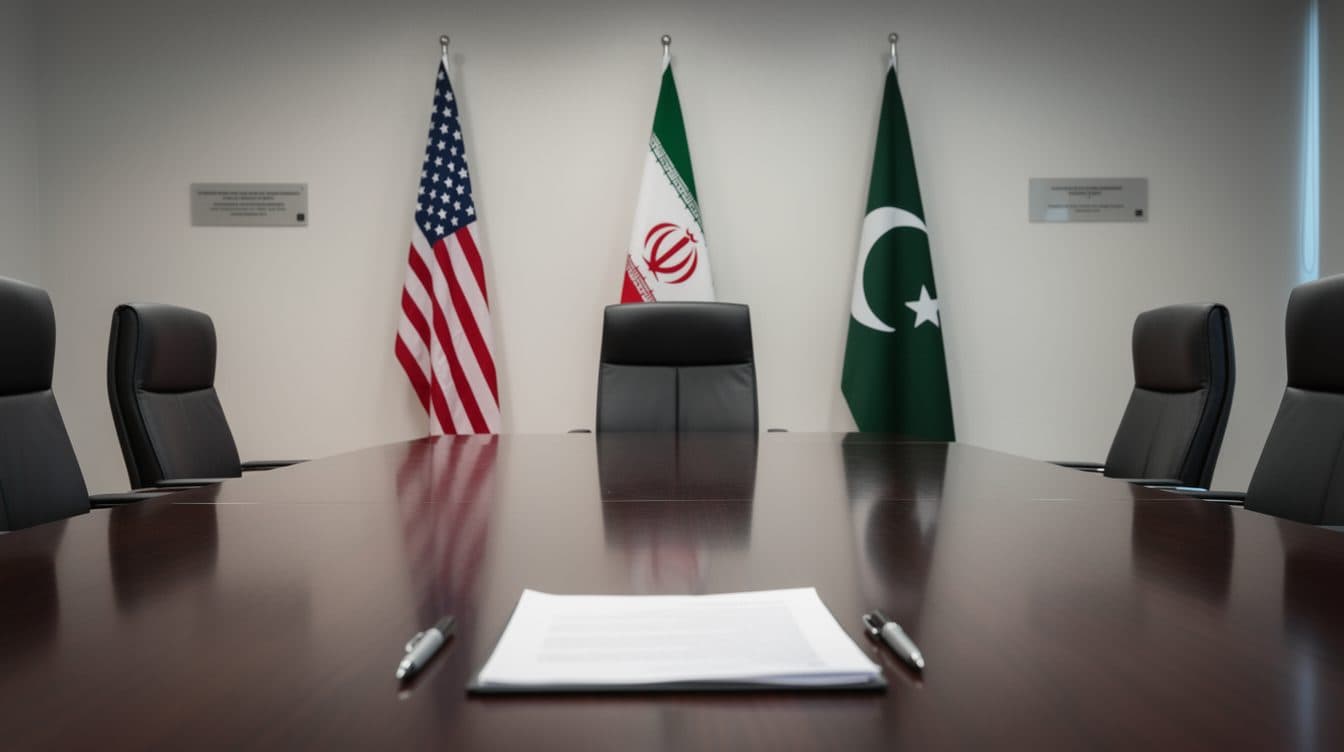
AI-generated image (flux-2/pro-text-to-image via Kie.ai)
Summary
The USA and Iran announced a framework agreement to end their conflict late on Sunday evening. It provides for the extension of the ceasefire by 60 days, the lifting of the US naval blockade, and the reopening of the Strait of Hormuz, and is to be signed in Geneva on Friday.
Geneva, June 13, 2026
The USA and Iran announced a framework agreement late on Sunday evening to end their war, which has been ongoing since late February, and which is to be signed on Friday in Switzerland.
Content and initial reactions
According to the mediating government of Pakistan, Washington and Tehran have agreed on a text that extends the existing ceasefire by 60 days, ends the US naval blockade of Iranian ports, and provides for the reopening of the strategically important Strait of Hormuz. US President Donald Trump confirmed the conclusion on his platform Truth Social: "Der Deal mit der Islamischen Republik Iran ist nun besiegelt. Gratulation an alle! Ich autorisiere hiermit die volle und gebührenfreie Öffnung der Strasse von Hormuz und parallel dazu die sofortige Beendigung der amerikanischen Seeblockade. Schiffe dieser Welt, startet eure Motoren! Lasst das Öl fliessen!"
Pakistan's Prime Minister Shehbaz Sharif stated on X that, following intensive talks, the peace agreement between the United States and the Islamic Republic of Iran had been achieved. Both sides had pledged the "sofortige und endgültige Beendigung der militärischen Operationen an allen Fronten, einschließlich im Libanon." The signing ceremony is planned for Friday, June 19, in Switzerland, initially via electronic means.
Contradictory accounts from both sides
The Iranian Foreign Ministry, by contrast, said a signing was not expected on Sunday but "in the coming days." Foreign Minister Abbas Araghchi called on the media for restraint: "Bis zur endgültigen Fertigstellung sollten sich die Medien mit Spekulationen über ihren Inhalt zurückhalten." Deputy Foreign Minister Kazem Gharibabadi, however, confirmed to the state news agency Tasnim the conclusion of the text and the planned signing on Friday in Geneva.
ZDF correspondent Claudia Bates reported from Washington that both sides have so far made "völlig widersprüchliche Angaben zum Inhalt des Abkommens, fast, als würde man über zwei verschiedene Abkommen reden." While the US side emphasizes that the Iranian nuclear program is to be dismantled and the enriched uranium removed from the country, Tehran stresses that the material is merely to be diluted within its own borders. Araghchi stated: "Unsere Position war stets, dass der einzige Weg, mit dem Vorrat an angereichertem Material umzugehen, darin besteht, ihn innerhalb des Iran zu verdünnen."
According to a senior US official, the agreement is to result in the Iranian nuclear program being rolled back and the United States receiving the enriched uranium that could otherwise theoretically be used to build nuclear weapons. The material is to be neutralized on site and subsequently brought out of the country. According to reports, Iran possesses more than 400 kilograms of highly enriched uranium, which could be converted relatively easily into weapons-grade material.
Disputed issues: Nuclear program and enriched uranium
Trump had at the same time emphasized in an interview with the Wall Street Journal that there was no rush to secure the uranium stockpiles: "Wir werden den nuklearen Staub später holen, sobald wir bereit sind, reinzugehen. Ich würde sagen, vielleicht im nächsten Monat oder so, aber es besteht keine Eile." With regard to Iran, he added: "Wir werden sehen, ob sie sich benehmen." Sina Toossi, a Middle East expert, interpreted Trump's formulation of the "ultimate alternative" in the event of a deal failure as sounding "sehr nach einer nuklearen Drohung."
According to Iranian statements, the agreement comprises 14 points, the content of which has not yet been officially confirmed. According to the Mehr news agency, these include the lifting of the US naval blockade, the suspension of oil sanctions for a specific period, the release of 25 billion dollars in frozen Iranian assets, the renunciation of new sanctions until a final agreement is reached, as well as extensive US reconstruction aid for Iran. The USA is thereby committed not to interfere in Iran's internal affairs and to withdraw the navy from the Strait of Hormuz 30 days after the opening of the waterway "under Iranian regulations."
The sanctions against Iran had been imposed, among other reasons, because of the nuclear program, because of human rights violations, and because of Iranian support for Russia's war of aggression against Ukraine. Sascha Lohmann, sanctions expert at the German Institute for International and Security Affairs (SWP) in Berlin, estimates the Iranian assets frozen abroad at 90 to 140 billion US dollars. Iran itself had most recently demanded the release of assets worth 24 billion dollars.
Sanctions and frozen assets
The US government does not intend, according to sources in Washington government circles, to release frozen Iranian funds directly with the signing of the framework agreement; such steps, as well as a relaxation of the sanctions, are to occur only once Tehran has provided corresponding counterperformances. The Reuters news agency had reported, citing insiders, that the United Arab Emirates had already released funds amounting to more than three billion dollars for Iran – the UAE denied this to the US broadcaster CNBC.
On Friday, both sides had signaled that an end to the fighting and an agreement were near. US media quoted an unnamed government official on Friday as saying they assumed a signing was near at "80 to 85 percent." On Saturday morning, the US military again reported several Iranian drone attacks on commercial ships in the Persian Gulf strait. A few hours after Araghchi's statement, US forces shot down several Iranian attack drones heading toward the strait, according to the US regional command Centcom: "Die US-Streitkräfte haben sie alle in den letzten Stunden abgeschossen, während der Schiffsverkehr durch die Meerenge ungehindert weiterfließt." In addition, a tanker off the coast of Oman was hit by a projectile of unknown origin; the crew remained unharmed according to the UK Maritime Trade Operations (UKMTO).
Israel, Hezbollah, and ceasefire in Lebanon
Notwithstanding the commitment to a ceasefire, a renewed escalation occurred on Sunday between Israel and the Lebanese Hezbollah militia, which is supported by Iran, after a drone attacked northern Israel. The Israeli government under Prime Minister Benjamin Netanyahu responded with heavy airstrikes on Beirut. Trump wrote on Truth Social: "Der Angriff auf Beirut von heute Morgen hätte nicht geschehen dürfen, vor allem an einem speziellen Tag, an dem wir einem Friedensabkommen mit Iran so nah sind." Israel is not directly involved in the American-Iranian negotiations; the portal Axios described a possible agreement as a "bittere Pille" for Netanyahu.
A ceasefire between Israel and Hezbollah is, according to the mediating state of Pakistan, already part of the ceasefire between the USA and Iran that has been in effect since April. The EU lists the armed wing of Hezbollah as a terrorist organization; the USA, Germany, and several Sunni Arab states also classify Hezbollah as a terrorist organization. Trump had encouraged the Iranian population at the beginning of the war to rid themselves of their government, but later stopped these calls.
International reactions
British Prime Minister Keir Starmer welcomed the agreement as an important step toward ending the conflict and reopening the Strait of Hormuz. German Chancellor Friedrich Merz also welcomed the US-Iran agreement and called for a "zielstrebige" implementation of the arrangement. France's President Emmanuel Macron declared that the full and toll-free resumption of maritime traffic was an indispensable prerequisite for regional stability and the global economy. Qatar's Prime Minister Mohammed bin Abdulrahman bin Jassim Al Thani also welcomed the agreement; Qatar had likewise mediated in the conflict.
Background of the conflict
The Iran war had begun on February 28, 2026, with joint American-Israeli attacks on Iran. On the first day of the war, Iran's supreme leader, Ayatollah Ali Khamenei, was killed in an Israeli airstrike on his official residence in Tehran. Khamenei had led the country since 1989. Thousands of people lost their lives in the war, the majority of them in Iran and Lebanon. The official burial of Khamenei is planned for July 9 in his birthplace Mashhad, during the Islamic month of mourning, Muharram. Iran responded to the attacks with missile and drone strikes, including against US bases in Bahrain, Jordan, and Kuwait.
Trump is under considerable domestic political pressure ahead of the important US congressional elections in November because of the crisis, which has long had global economic consequences, including rising energy prices. According to his own statements, a breakthrough would be a success on his 80th birthday. Trump had also called for impeachment proceedings against Democratic Senator Jack Reed, who had publicly compared the framework agreement to the nuclear deal negotiated in 2015 under Barack Obama. Trump had claimed that Obama's deal had been a direct path to an Iranian nuclear bomb, whereas his own agreement would block the path to nuclear weapons for Iran forever. The earlier major agreement with Iran, the 2015 Vienna nuclear deal, had required nearly two years of negotiations.
Questions & Answers
What does the framework agreement between the USA and Iran specifically provide for?
The agreement is to extend the ceasefire in effect since April by 60 days, end the US naval blockade of Iranian ports, and enable the reopening of the Strait of Hormuz. It forms the starting point for further negotiations on the Iranian nuclear program within a 60-day period, and is to be signed