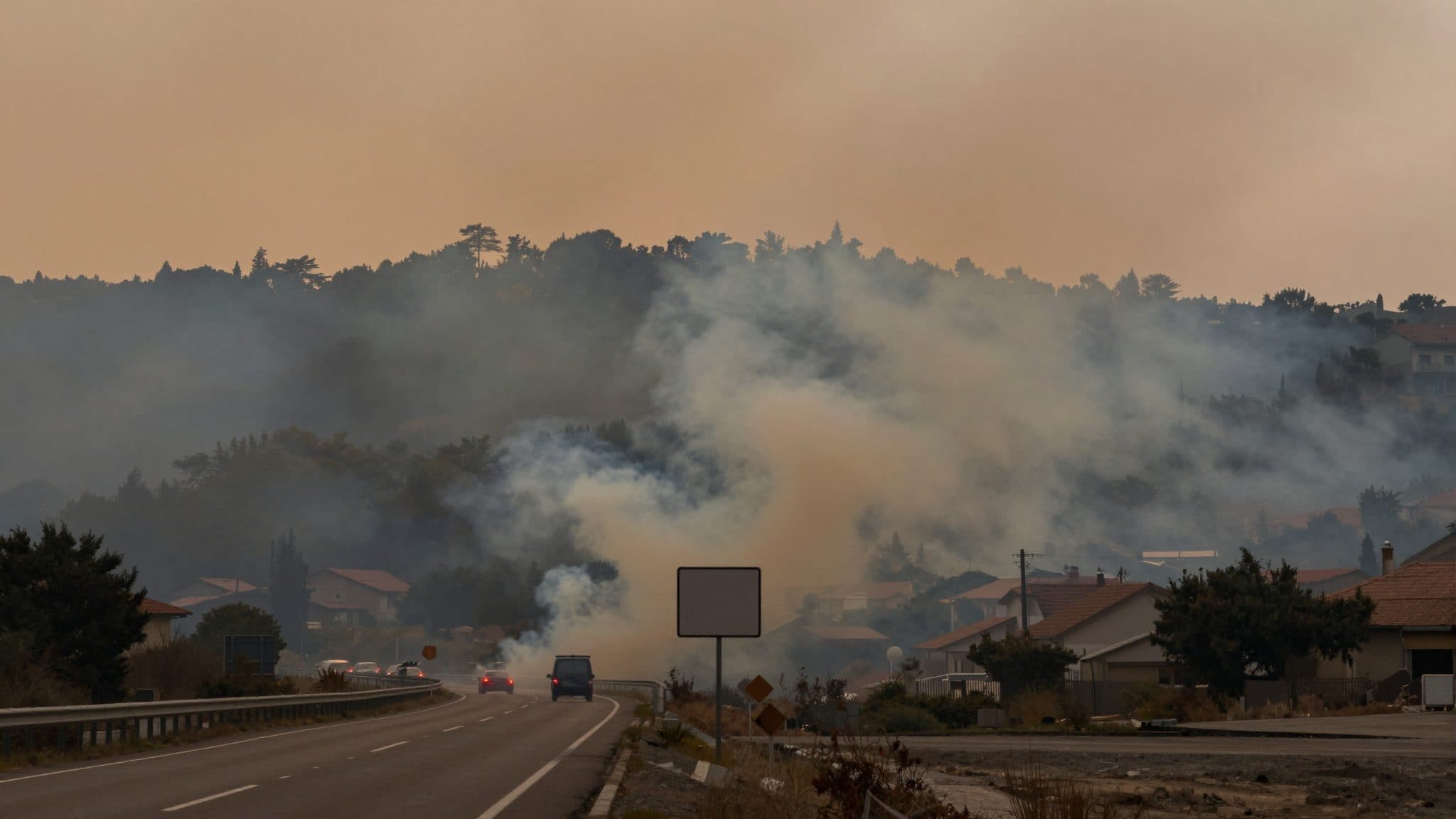
Southern Europe Wildfires: 270,000 Evacuated | allfacts360
Wildfires in Southern Europe: Over 270,000 People Forced to Leave Their Homes
Madrid/Bordeaux, July 26, 2026
AI-generated image (z-image via Kie.ai)
Summary
Unprecedented wildfires have forced more than 270,000 people to flee in Spain and France. Spain declared a national emergency, while France mobilized the military to fight the blazes and thousands of vacationers had to leave the Atlantic coast.
Madrid/Bordeaux, July 26, 2026
Unprecedented wildfires have forced more than 270,000 people to flee in Spain and France; the Spanish government declared a national emergency and France also mobilized the military, while tens of thousands of vacationers left the Atlantic coast near Bordeaux.
The wildfires in Southern Europe have reached a scale that even experienced disaster relief workers are calling historic. According to the relevant authorities, around 270,000 people had to leave their homes in the two hardest-hit EU countries, Spain and France. In France alone, Interior Minister Laurent Nuñez said approximately 167,000 people in the Gironde département and a further 30,000 in the neighboring Landes département were brought to safety. Nuñez spoke of an unprecedented situation: "The fires ravaging our country have reached an unprecedented scale," Prime Minister Sébastien Lecornu wrote on Saturday on the online service X.
Scale and Evacuations
In Spain, the government of Prime Minister Pedro Sánchez declared a "national-level emergency" for the Madrid region and the province of Ávila. According to the Spanish Interior Ministry, more than 63,000 people around Madrid were either brought to safety or ordered to remain inside their buildings; a further 28,000 people were unable to leave their homes at all because of the situation. In total, more than 115,000 hectares of forest have already been destroyed in Spain this year — five times as much as in the same period last year.
The fires near Madrid had, according to the assessment of the head of the regional government's civil protection agency, Carlos Novillo, "reached their peak" and were "impossible to extinguish." On Friday, two large fires near the capital merged into a single massive blaze that had devastated around 30 square kilometers by Friday afternoon. The flames moved toward the municipality of Navas del Rey, about 50 kilometers from Madrid, and were, according to local representatives, on the verge of merging with another major blaze in the neighboring region of Castile and León. With gusts of up to 60 kilometers per hour, the winds made firefighting efforts considerably more difficult.
Situation in Spain: National Emergency Declared
The regional president of Madrid, Isabel Díaz Ayuso, spoke of the "worst fire in the history" of the region and of a "catastrophe." Sánchez had previously described a "dramatic situation" in several Spanish provinces and in neighboring countries and, given the relatively early point in the year for such fires, warned of a "climate emergency." The national emergency mechanism was, according to broadcaster RTVE, activated for the first time due to wildfires; previously it had only been triggered once before, after a nationwide power outage in April of the previous year. By declaring the emergency, the state can provide more resources and the military assumes operational command.
In France, the fires were concentrated in the region around Bordeaux and the holiday peninsula of Cap-Ferret on the Arcachon Basin. The fire service was, according to official figures, deployed with more than 1,000 personnel, around 260 fire engines, five planes, and one firefighting helicopter. About 40 of the deployed firefighters were injured, according to the authorities, most of them slightly. The complete evacuation of Cap-Ferret affected around 44,000 residents and tourists, who left the area via the only road toward Bordeaux or by boat across the basin; more than 800 people reached the town of Arcachon by sea.
France: Fires on the Atlantic Coast
On the coast near Bordeaux, a further 24,000 people had to leave ten localities on the Arcachon Basin, according to the prefect of the Gironde département, Sophie Brocas. In total, emergency services in France were fighting 32 active wildfires of varying intensity, according to Interior Minister Nuñez; the burned area in the Gironde département now equals four times the size of the capital Paris. Defense Minister Sébastien Lecornu announced that the number of military personnel supporting the fire service would be increased from 500 to 1,000; in addition, an Airbus A400M military transport aircraft equipped to drop 20 tons of fire retardant would be deployed. The aircraft flew its first mission on Saturday afternoon.
The fires also spread to other parts of the country. In Biscarrosse, around 45 kilometers south of Cap-Ferret, another major fire broke out according to the authorities, leading to the evacuation of about 23,000 people; among them were also German tourists, as reported by NDR. Dramatic scenes unfolded at a stud farm in Biscarrosse: As shown in video footage by the newspaper "Le Figaro," the horses were released from their stables so they could gallop across the road to escape the approaching blaze. Eighty buildings fell victim to the flames, 50 of them completely destroyed, as was a campsite. In other French regions as well, including the Var département and the island of Corsica, firefighters battled the blazes.
Difficult Weather and Dramatic Scenes
According to the assessment of the head of the fire service in the Gironde département, Marc Vermeulen, the emergency services faced an "erratic fire." Interior Minister Nuñez warned that the flames sometimes jumped distances of up to one kilometer and were "extremely difficult to contain." Eyewitnesses reported an uncontrollable "monster of flames." The weather situation remained "particularly unfavorable": strong wind gusts could further fan the fires, while temperatures of up to 40 degrees were possible. Numerous people took refuge in the halls of the "Parc des Expositions" in Bordeaux, which are also used for trade fairs; one exhibition hall was opened to accommodate evacuated tourists and prepared to take in up to 10,000 people.
French President Emmanuel Macron called on the armed forces to mobilize and support civil protection "with maximum reinforcement." Defense Minister Catherine Vautrin stated that the military was to support the other forces in this "sudden, major, and unprecedented crisis." A total of 1,000 soldiers were deployed to fight the flames. French Interior Minister Nuñez stressed that the country had "never before experienced fires on this scale" and pledged to "do everything" to protect the city of Bordeaux. An evacuation of the entire city was, according to the authorities, not on the table; however, the government was working "on all possible scenarios, including an evacuation of Bordeaux," as Nuñez told the newspaper "Le Monde."
Military and International Assistance
International support was announced: the EU Commission declared in Brussels that four Canadair aircraft would be sent to Spain and three to France; in addition, both countries would be provided with satellite imagery from the EU Earth observation program Copernicus. Help also came from Germany: Chancellor Friedrich Merz stated that Germany was ready to support France within the framework of the European Civil Protection Mechanism; Foreign Minister Johann Wadephul added: "In times of crisis, Europe stands together." 1.5 million FFP2 masks were delivered to the Gironde region to protect emergency personnel and the population from the harmful smoke. Italy was also battling numerous fires, particularly in Sicily and Calabria.
The fire near Cap-Ferret may have been caused, according to the public prosecutor's office, by a brush cutter used during work on a high-voltage power line, whose use was still permitted at that time. In Spain, meanwhile, a man was arrested who, according to the authorities, had set a forest on fire with a delivery van. The damage to buildings and forests had not yet been definitively tallied; the US facility in Robledo, around 65 kilometers west of Madrid, reported that the flames had swept across its grounds, with potential damage being assessed as soon as it could be done safely. France recorded, according to the Interior Ministry, a new record of nearly 100,000 hectares burned since the beginning of the year.
Investigations and Initial Returns
Prime Minister Sánchez planned to visit the operations center in Cenicientos near Madrid on Sunday together with Interior Minister Fernando Grande-Marlaska and take part in a crisis meeting there. Sánchez announced that the priority was to "save lives." The Spanish government also stated that the declaration of the emergency made more money available. The spread of the flames had recently slowed considerably due to "significantly" better conditions, according to government circles. In Spain, residents of 14 municipalities were already returning to their homes, and the military emergency unit partially withdrew; the fire had, according to the emergency services, affected around 32,000 hectares, but was losing intensity.
The situation on the French Atlantic coast remained tense in the meantime. The German tourist Jaak Beil from the Hannover region, who was staying in Biscarrosse, told NDR: "For now our campsite is safe, but everyone keeps nervously checking their phones and looking at the sky" to see which direction the wind might drive the fire. The broadcaster France Info reported thousands of stranded people of all ages sitting or lying on camp beds, long lines at the food distribution points, and a constantly growing number of arrivals at the emergency shelters. Many were waiting with family members or friends to be able to return — without a concrete date.
Economic and Social Consequences
Economic consequences also began to emerge: the Cap-Ferret peninsula and the Arcachon Basin are among France's most popular vacation regions; following the devastating fires of 2022 in the same area, residents such as Cindy Charpentier warned of the emotional consequences: "It will be difficult to see the burned landscapes." Spanish regional president Ayuso drew, with her appeal for help, not least on the