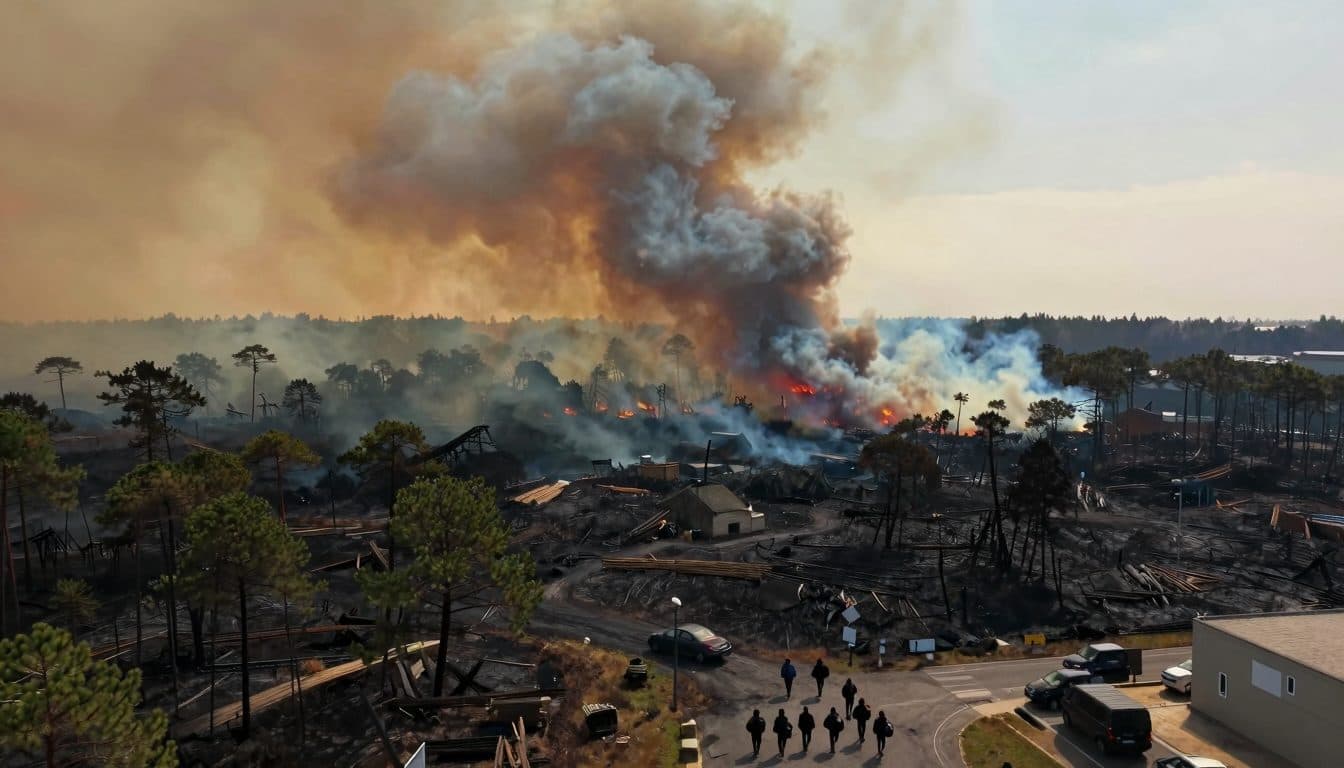
Unprecedented Wildfires Force More Than 300,000 People to Flee in Southern Europe
Paris/Madrid, 27 July 2026
AI-generated image (z-image via Kie.ai)
Summary
Unprecedented wildfires in France, Spain, and Italy have forced more than 300,000 people to flee. Particularly affected is the region around Bordeaux, where the flames are now only 15 kilometers from the city center.
Paris/Madrid, 27 July 2026
Devastating wildfires in France, Spain, and Italy have forced more than 300,000 people to evacuate; in the Gironde department, the flames advanced to within 15 kilometers of the greater Bordeaux area on Sunday, while the Spanish government declared a national emergency for Madrid and Ávila.
The scale of the wildfire disaster in southwestern Europe exceeds all previously known dimensions. In the French Gironde department alone, in the southwest of the country, around 220,000 people were brought to safety, according to Interior Minister Laurent Nuñez – more than at any time since World War II. In Spain, according to government figures, around 75,000 people had to leave their homes in the greater Madrid area, near Valencia, and in the provinces of Ávila and Castellón. All told, more than 300,000 people in the three Mediterranean countries are fleeing the flames.
Scale of the Disaster
The major blaze raging in Gironde since Wednesday has destroyed around 42,000 hectares of forest and brushland, according to authorities – an area estimated to be equivalent to roughly 60,000 football fields. The prefecture classified the situation as "unfavorable" on Sunday evening. On Monday morning, the authority reported that the situation had remained "overall stable," but emphasized at the same time that the emergency and rescue forces were "still fully deployed" and that there had been "no notable developments."
France's Interior Minister Nuñez spoke on Sunday of a "very unfavorable" situation at the gates of Bordeaux. The fire had regained intensity overnight, generating its own wind and spreading "uncontrollably toward the greater Bordeaux area." The flames were in some places only 15 to 30 kilometers from the city limits. Several neighborhoods of the municipalities of Marcheprime and Cestas, less than 30 kilometers southwest of Bordeaux, were affected, said the mayor of the suburb of Cestas, Jerome Steffe: "Das ist ein so großer Brand, wie man ihn noch nie gesehen hat."
Situation near Bordeaux remains tense
Prime Minister Sébastien Lecornu announced after a meeting of the interministerial crisis unit that the number of soldiers supporting the firefighters would be increased from 500 to 1,000. Some 2,500 firefighters and roughly 1,500 soldiers are currently battling the flames. In the air, 18 aircraft and helicopters are deployed, according to Nuñez, including four Canadair firefighting planes, two Dash aircraft, several helicopters, and a converted military transport plane of the type Airbus A400M. President Emmanuel Macron wrote on the platform X that his country was mobilizing "alle zivilen und militärischen Mittel."
The authorities expected wind gusts of up to 30 kilometers per hour during the day, which would further complicate firefighting efforts. For the coming week, temperatures in the Bordeaux region are forecast to climb again to highs of up to 41 degrees. According to the state weather service Météo France, the heat eased only briefly; temperatures have been rising again since Monday.
Military and Aircraft in Major Deployment
France's President Emmanuel Macron had originally promised 16 new Canadair firefighting aircraft after the major blaze of 2022. Due to empty state coffers, however, the funds for the acquisition were cut in 2024. According to the newspaper "Le Monde" on Monday, only four new aircraft are now planned by 2033, two of which will be financed with EU funds. The deployment of the A400M since Saturday was apparently intended to silence the criticism over the insufficient number of available Canadair aircraft.
In the neighboring department of Landes, where a wildfire is also raging, the situation has eased somewhat according to the Interior Minister; the flames there have so far destroyed about 3,600 hectares of land. As a precaution, 3,000 people were brought to safety. In the southern French Mediterranean region of Var, near Gros Bessillon, as well as on the island of Corsica, further forests are burning, according to authorities. The fire near Gros Bessillon has affected around 4,500 hectares.
Health Minister Stéphanie Rist had 2.5 million respiratory protection masks distributed against the smoke that has reached Bordeaux. The 75-year-old Michèle told the newspaper "Tribune du Dimanche": "Wir sind Klimaflüchtlinge." Reports from the suburbs of Bordeaux also indicated that residents were wearing FFP2 masks for the first time since the coronavirus pandemic. "Das sticht in der Nase, in den Augen, im Hals," said a person named Charles.
Spain Declares National Emergency
In Spain, the government of Prime Minister Pedro Sánchez declared a "national-level emergency" for the greater Madrid area and the Ávila region in order to speed up the deployment of resources. Three fires – in Ávila, in the Sierra Oeste in the Madrid region, and in the province of Toledo – have together devastated around 77,000 hectares of forest and brushland. The fire in the province of Ávila alone, which is raging less than 100 kilometers west of Madrid, has already affected an estimated 47,000 hectares. If these official estimates are confirmed, it would be the largest wildfire since central recording began in 1968.
Prime Minister Sánchez, during a visit to the fire-affected Ávila region on Sunday, anticipated "difficult hours" but also saw positive developments: "Die Informationen, die wir hier erhalten haben, deuten darauf hin, dass die Nacht hinsichtlich des Brandverlaufs, der Eindämmung des Feuers und der Löscharbeiten sehr positiv verlaufen ist." Interior Minister Fernando Grande-Marlaska, however, warned against premature optimism: "Die Lage bei den Bränden verbessert sich, aber nur langsam" and the coming night would be "nicht einfach."
According to Spain's Military Emergency Unit (UME), the main fronts of the fires in Madrid and the neighboring provinces had been brought under control; however, several fire sites remained active. In the province of Castellón in the east of the country, another major fire has been raging since Saturday, having already destroyed 6,500 hectares; around 16,000 people were evacuated from various towns. The General Directorate of Traffic has closed 39 roads in the provinces of Ávila, Madrid, and Castellón. In the Madrid region, around 90,000 people were affected by evacuations or curfew measures, according to authorities; the Spanish Interior Ministry put the total at around 120,000.
Italy and the Mediterranean Region also Affected
King Felipe VI and Queen Letizia visited an emergency shelter on Sunday to express their support to those affected. For Monday, the reopening of a campsite in El Escorial west of Madrid was planned, from which 4,500 people had been evacuated; residents of a nursing home in San Martín de Valdeiglesias were also expected to be able to return. Twenty-one residents of another nursing home had previously been taken to a church and neighboring municipal rooms.
In Italy, a major wildfire broke out on Sunday in the area between the resorts of Peschici and Vieste in the Adriatic region of Apulia. Around 200 beachgoers were brought to safety by sea using coastguard boats and excursion vessels; around 300 campers were led to Vieste and housed in sports halls and other public facilities. More than 1,000 people, including tourists and residents, had to be evacuated in total. The Adriatic State Highway SS16 and the railway line along the Adriatic coast were temporarily closed. In addition, a retirement home had to be evacuated in Sardinia due to a rapidly spreading fire; a major blaze has also been raging in the Pollino National Park in Calabria for more than two days.
The ongoing heatwave is further aggravating the situation. In France, moderate heat warnings (Yellow Level) are in effect for several regions, and for some southern areas even high warning levels (Orange); the highest level, Red, was not issued until the middle of the week. In Spain, yellow and orange warning levels are in effect for the next three days until 29 July, also without red. In Italy, the Civil Protection agency is currently issuing only yellow warnings. The state weather service Météo France reported a historic record: since the beginning of the year, nearly 100,000 hectares of land have burned in France.
Impact on Travel and Transport
According to authorities, around 140 residential buildings were destroyed by the flames in Spain. In France, the prefecture ordered the precautionary evacuation of a further 55,000 people in several municipalities west and southwest of Bordeaux overnight; this pushed the number of evacuees in the Gironde department well past the 200,000 mark. Some of the 30,000 people previously evacuated were allowed to return to their homes on Saturday evening.
At Bordeaux Airport itself, no irregularities were reported until Monday morning; however, bus and tram services to and from the airport are affected. Public transport currently does not run between Merignac Soleil and the airport, and according to information, the hotel zone is being evacuated. Rail traffic south of Bordeaux is interrupted, which also affects the TGV high-speed trains. The A63 motorway was closed for a length of 60 kilometers for safety reasons.
Heatwave Continues
For travelers in the wildfire areas, the situation is precarious. According to the assessment of ÖAMTC legal expert Verena Pronebner, the following generally applies to package holidaymakers: "Wenn aufgrund unvermeidbarer und außergewöhnlicher Umstände – etwa Naturkatastroph
Wildfires Europe: 300,000 evacuated near Bordeaux & Madrid | allfacts360