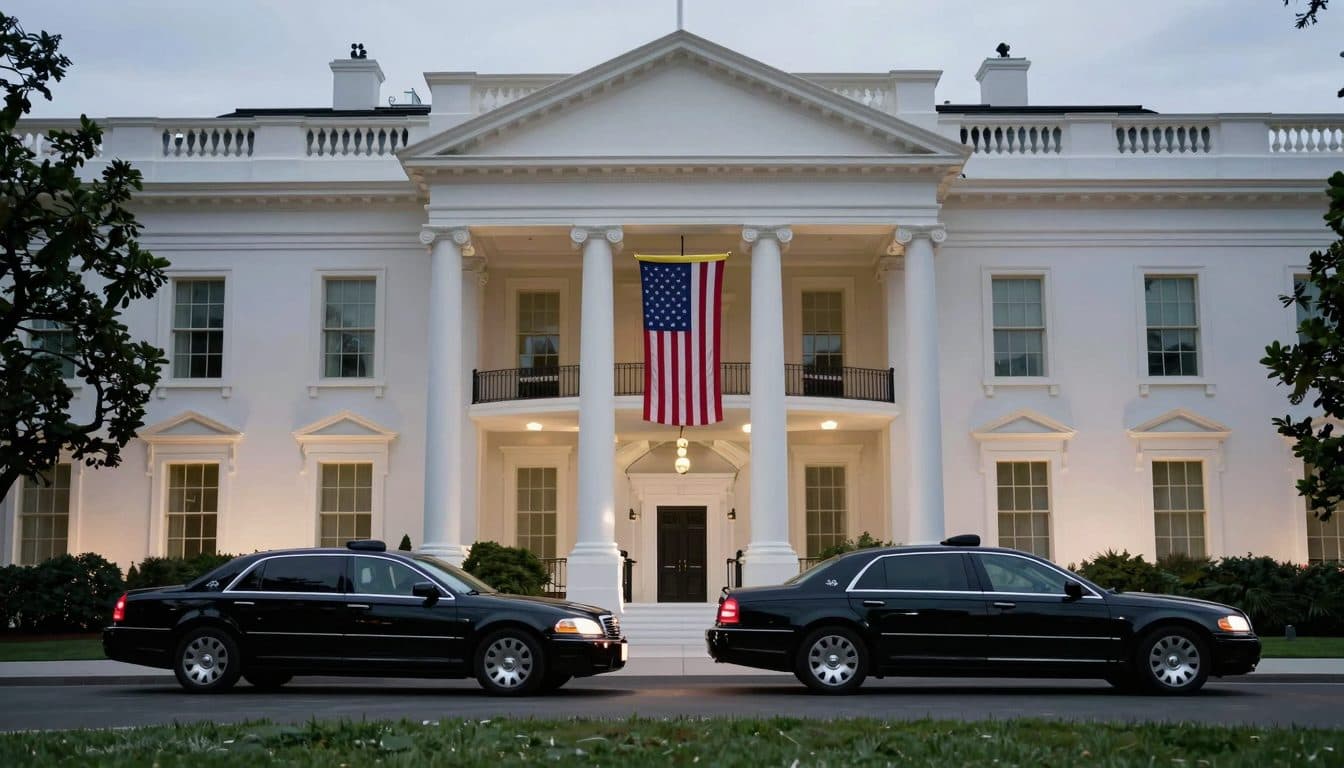
Zelensky and Netanyahu Guests at the White House: Trump Promises Ukraine Patriot Licenses
Washington, July 29, 2026
AI-generated image (z-image via Kie.ai)
Summary
During his visit to Washington, Ukrainian President Volodymyr Zelensky said he received from US President Donald Trump a commitment for licenses to produce Patriot interceptor missiles. Prior to that, Israeli Prime Minister Benjamin Netanyahu had also been received at the White House; both meetings took place ahead of the memorial service for the late US Senator Lindsey Graham.
Washington, July 29, 2026
Ukrainian President Volodymyr Zelensky met with US President Donald Trump at the White House on Tuesday and, according to his own account, received a commitment for licenses to produce Patriot interceptor missiles; immediately afterward, Trump also received Israeli Prime Minister Benjamin Netanyahu — both meetings taking place before the memorial service for US Senator Lindsey Graham, who had died a few days earlier.
Zelensky described his meeting with Trump as "very good" in a subsequent conversation with Fox News host Sean Hannity. On the X platform, he wrote: "The president and I discussed licenses for the production of Patriot interceptor missiles and other things that can help". Trump had promised him that he would issue the licenses to Ukraine, Zelensky added: "He promised to give us the licenses". Hours before the television interview, Zelensky had still been more reserved on the Patriot issue. The White House initially did not respond to a dpa inquiry regarding the reported license commitment.
Patriot Licenses and Air Defense at the Center
According to Zelensky, the discussion also focused on strengthening Ukraine's air defense against Russian missile attacks. "I am grateful to the United States for its firm support," the Ukrainian president wrote. Patriot systems are considered one of the few effective tools Ukraine has in the conflict against Russian ballistic missiles. Back in the spring, Zelensky had complained that his country was running low on ammunition for the Patriot systems. With the licenses, he hopes to be able to ramp up production of urgently needed interceptor missiles more quickly.
Trump had already rated his meeting with Zelensky as "very good" on Monday on his Truth Social platform. A few hours after the conversation, Trump received Israeli Prime Minister Benjamin Netanyahu on Tuesday — it was Netanyahu's first meeting at the White House since the start of the war with Iran at the end of February. According to US media, the meeting lasted about an hour and a half and, like the meeting with Zelensky, took place behind closed doors. Both meetings together lasted just over an hour.
Meeting with Netanyahu: Iran and the Nuclear Program
White House spokesperson Karoline Leavitt wrote on X after both encounters: "Both meetings went positively and productively!". In terms of content, Netanyahu said the focus with him was primarily on the shared goal of preventing Iran from building a nuclear weapon. In a video message after his visit, Netanyahu said: "It was one of the best conversations I have ever had with the President of the United States, our friend Donald Trump". Trump, for his part, said in a conversation with Fox News about the Iran war: "Well, I don't need Bibi to tell me that. Bibi is telling me that because he wants me to stay involved".
Significant differences between the two sides loom in the background of the talks: according to media reports, Israel wanted to continue the war against Iran, while Trump pushed for a diplomatic solution. In a conversation with Fox News, Trump indicated he preferred an agreement with Iran over heavier strikes. The late Senator Lindsey Graham had also seen an agreement with Iran as the better path in the weeks before his death, Trump said. A poll cited in the article found that more than two-thirds of Americans reject the war with Iran.
Differences over the Next Course against Iran
According to Israeli broadcaster N12, Netanyahu wanted to present US intelligence findings about alleged Iranian efforts to rebuild military capabilities, including information about alleged aspirations of Iran's Supreme Leader, Ayatollah Mojtaba Khamenei, to develop a nuclear weapon. Netanyahu also reportedly spoke about a suspicious nuclear facility in Iran known as "Pickaxe Mountain". The New York Post reported, citing an Israeli source, that Netanyahu wanted to present Trump with intelligence findings about this facility. Tehran has rejected such characterizations for years and denies plans to build nuclear weapons.
Before the memorial service, Trump and Zelensky had already met several times in recent weeks on the margins of international summits. In mid-June they came together at the G7 summit in the French city of Évian, and most recently at the beginning of the month at the NATO summit in the Turkish city of Ankara. Trump had emphasized at the meeting in Ankara that he had a good relationship with his Ukrainian counterpart. At both summits, the US had agreed on common positions on the Ukraine war, it was said. However, American mediation efforts to end Russia's war of aggression have recently faded into the background due to the US's own war against Iran.
Diplomatic Efforts to End the Ukraine War
According to the Ukrainian president, another topic in the conversation between Trump and Zelensky was the revival of diplomatic efforts to end Russia's war of aggression. After the memorial service, Zelensky went to the Capitol to brief senators on the course of the war. According to The Hill, all 100 US senators were invited to a subsequent meeting with Zelensky.
The memorial service for Lindsey Graham, the long-serving Republican senator from South Carolina, fell right in the middle of these diplomatic activities. Graham died on July 11 at the age of 71 from the effects of a vascular disease. He had represented the US state of South Carolina starting in the mid-90s, first in the House of Representatives; in 2003 his first term as senator began. Graham was regarded as an experienced foreign policy figure who dealt with the major hotspots of conflict and had made a name for himself in Congress as an important supporter of both Ukraine and Israel.
Memorial Service for Lindsey Graham
A few days before his death, Graham had visited the Ukrainian president in Kyiv and delivered the message that the White House supported a new sanctions law. Since the start of Russia's full-scale invasion of Ukraine in February 2022, Graham had traveled to Kyiv a total of ten times. Most recently, on July 9 — his 71st birthday — he had attended the NATO summit in Turkey. Graham had also advocated for a change of power in Iran.
On Tuesday morning, a remembrance ceremony took place at the US Capitol, followed in the afternoon by the memorial service at the National Cathedral in Washington. In addition to Israeli Prime Minister Benjamin Netanyahu, Zelensky also attended the memorial service on Tuesday. Among the two state guests, attendees at the remembrance ceremonies included Finnish President Alexander Stubb, cabinet members Marco Rubio (State), Scott Bessent (Treasury), and Pete Hegseth (Defense), Democratic Senate caucus leader Chuck Schumer, the Senate's Republican majority leader John Thune, as well as Vice President JD Vance. Reza Pahlavi, son of the last Shah of Iran, was also spotted in the audience at the National Cathedral.
Honoring a Senator with a Long Career
Trump honored Graham in his eulogy as a respected statesman who had shaped US politics. "Graham made it from humble beginnings to worldwide recognition," Trump said. In an obituary, Trump called the deceased "a beloved friend, a faithful brother, a highly esteemed statesman, a defining figure of the US Senate, and a true American original". He also said: "There really was no one like Lindsey Graham" and of Graham: "He never saw a war he didn't like". Trump went on: "Nowhere in the world" had anything happened without Graham having an opinion on it, and no law had been passed without his involvement.
Trump, TV host Sean Hannity, and Senate majority leader John Thune delivered speeches at the memorial service at the National Cathedral. Thune became emotional as he recalled Graham's sense of humor. Trump described Graham as an "American original" and as a "force of nature". Vice President JD Vance also delivered a brief speech at the remembrance ceremony in the Capitol; Vance and other Republican "America First" politicians had previously criticized Graham for focusing too little on domestic policy issues. Trump, in turn, recalled that Graham had publicly criticized him during the 2016 campaign and that he had then published Graham's mobile phone number; Graham's phone had been flooded with calls, after which he had called Trump repeatedly for the next ten years.
New Sanctions Package against Russia
Even before the memorial service, the US Senate passed, by 86 to 12 votes, a procedural motion for a bill on new sanctions against buyers of Russian crude oil and natural gas. According to media reports, the bill could still be passed by the Senate this week and then move to the House of Representatives. It would authorize the US president to impose tariffs of up to 100 percent on the five largest buyers of Russian crude oil and natural gas, as well as on the five countries that most help Russia circumvent energy sanctions. Since the House of Representatives is already in recess, the law is unlikely to enter into force before September at the earliest. According to newly published amendments, the sanctions package is to bear Lindsey Graham's name.
For Netanyahu, an election described as decisive is coming up in Israel in October. According to his own statements and reports from Israel, the prime minister is trying against this backdrop to secure Washington's support for the course against Iran. The US war against Iran has further tightened global supplies of Patriot interceptor missiles — which are also intended for Ukraine — a circumstance that adds to the significance of the licenses now announced for Zelensky.
Questions & Answers
What did Trump promise Zelensky at the White House meeting?
Ukrainian President Volodymyr Zelensky said afterward that US President Donald Trump had promised him licenses for the production of Patriot interceptor missiles. The White House initially did not comment on the commitment when asked.
Why did Netanyahu come to Washington and what did he discuss with Trump?
Benjamin Netanyahu was received at the White House as the first Israeli prime minister since the start of the Iran war at the end of February. He said
Zelensky: Trump Promises Patriot Licenses for Ukraine | allfacts360