Zelensky returns Order of the White Eagle – Poland's protest | allfacts360
Zelensky returns Poland's highest honor – history dispute escalates
Warsaw/Kyiv, June 20, 2026
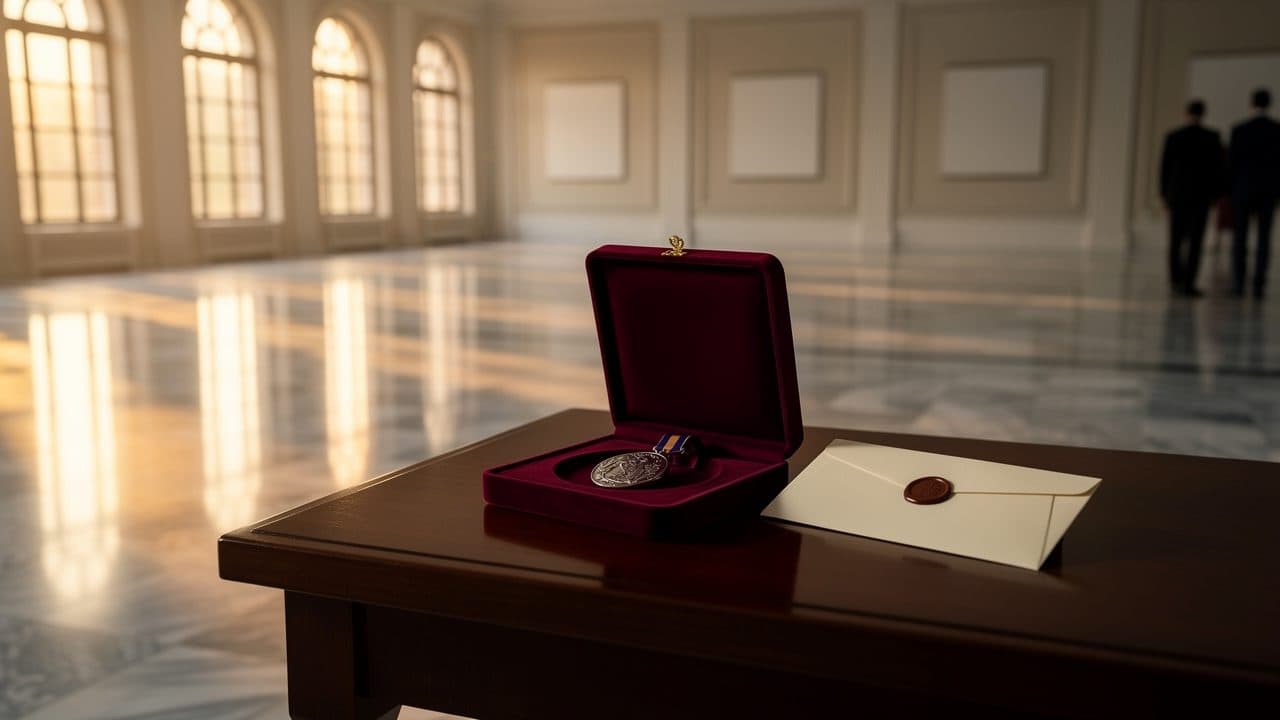
AI-generated image (flux-2/pro-text-to-image via Kie.ai)
Summary
In the dispute over the naming of a Ukrainian army unit after the UPA, Volodymyr Zelensky has sent the Order of the White Eagle back to Warsaw. Polish President Karol Nawrocki had previously revoked the award, after which other Ukrainian politicians also returned their Polish decorations.
Warsaw/Kyiv, June 20, 2026
Ukrainian President Volodymyr Zelensky has sent the Order of the White Eagle, Poland's highest state honor, back to Polish President Karol Nawrocki, further intensifying the historically charged dispute between the two countries.
Background: The UPA and the dispute over memory
Zelensky announced the return on Saturday via the X platform. In a post written in German, he wrote: "Heute habe ich den Orden dem polnischen Präsidenten zurückgeschickt." Photos from the post office of the Presidential Office in Kyiv show the packaged decoration, addressed to Nawrocki. Zelensky declared that the Order of the White Eagle was a special honor and a symbol of the highest trust of the Republic of Poland. However, such a symbol required merit and respect for the values that formed the foundation of society.
The background to the conflict is Zelensky's decision at the end of May to award a Ukrainian army unit the honorary title "Heroes of the UPA." The Ukrainian Insurgent Army (UPA) was in the 1940s the military arm of the Organization of Ukrainian Nationalists (OUN). The UPA fought against Soviet rule after World War II and is venerated in today's Ukraine as a symbol of resistance against Soviet domination. In the struggle for Ukrainian independence from the Soviet Union, the OUN and UPA temporarily collaborated with Nazi Germany during World War II.
During World War II, armed UPA members committed massacres of tens of thousands of Poles and Jews in the area of what is now western Ukraine. According to Polish figures, Ukrainian nationalists killed around 100,000 ethnic Poles in the Volhynia massacres between 1943 and 1945. Thousands of Ukrainians also died in retaliatory actions. In Poland, the actions of the OUN and UPA are classified as genocide. Volhynia belonged to Poland until 1939 and was assigned to the Ukrainian Soviet Republic through the Hitler-Stalin Pact.
Nawrocki's decision and Warsaw's reasoning
Polish President Karol Nawrocki, who has taken a critical stance toward Ukraine since taking office in 2025, revoked the order awarded to Zelensky in 2023 on Friday. The then-president Andrzej Duda had presented Zelensky with the award to underscore the friendship between Poland and Ukraine in the face of Russian aggression against Kyiv. In a statement, however, Nawrocki insisted that the revocation was "not directed against the Ukrainian nation" and would not change the strategic direction of Polish security policy.
Zelensky responded to the decision with sharp irony. In his X post, he wrote: "Wenn daher die Ansicht besteht, dass dieses besondere Symbol bei (Zarin) Katharina II., bei (Italiens Diktator) Benito Mussolini und (Ex-Bundeskanzler) Gerhard Schröder verbleiben darf, dann haben wir dem in der Ukraine nichts entgegenzusetzen." With this allusion, he referred to previous recipients of Polish honors. At the same time, he declared himself open to further cooperation: his country would continue to be open to "alle sinnvollen Formate der Zusammenarbeit" to avoid contradictory interpretations of the difficult and painful chapters of the shared past.
Reactions in Kyiv: Ambassador, ministers, ex-presidents
Sharp criticism of the Polish decision came from Kyiv. The Ukrainian ambassador in Warsaw, Vasyl Bodnar, described Nawrocki's move as a "gesture directed against the entire Ukrainian people." The head of the Presidential Office, Kyrylo Budanov, wrote in a Telegram post of an unfriendly gesture toward the Ukrainian people and a gift to aggressor Russia. "This is a gift to the Moscow aggressor, which it will certainly use against both our countries," he wrote. Budanov announced that he would renounce the Gold Officer's Cross of the Order of Merit of the Republic of Poland with which he had been awarded the previous year.
Ukrainian Foreign Minister Andriy Sybiha also announced the return of a Polish decoration. Sybiha called Nawrocki's decision a strategic mistake and declared that no foreign president would dictate Ukraine's history to it. Former Ukrainian President Leonid Kuchma declared in the evening that he would renounce the Order of the White Eagle, which he had received in 1997. He expressed his conviction that this "unfriendly step" by President Nawrocki could not destroy the friendship between the two countries. Ex-President Viktor Yushchenko (2005-2010) also announced that he would renounce the award. His successor Petro Poroshenko (2014-2019) described Nawrocki's decision as "wrong and unjust toward the Ukrainian people."
Tusk calls for restraint
Polish Prime Minister Donald Tusk, a political rival of Nawrocki and a strong supporter of Ukraine, called on both sides for restraint. "The frontline lies elsewhere," Tusk wrote on X. The conflict between Poland and Ukraine "pleases Putin and shocks our allies." It was the task of Nawrocki and Zelensky to "calm tempers and not further fuel tensions." Tusk had already appealed to Nawrocki and Zelensky on Friday to exercise restraint.
Stress test ahead of the conference in Gdansk
The dispute comes at a time when Poland plays a central role in Western support for Ukraine. The country has taken in hundreds of thousands of Ukrainian refugees, is one of the most important military and humanitarian supporters of Kyiv in the defensive war against Russia, and serves as a logistical hub for Western aid to Ukraine. The conflict is escalating about a week before a Ukraine reconstruction conference in the Polish city of Gdansk.
A different reaction came from Russia. Former Russian President Dmitry Medvedev declared on X that Moscow welcomed the decision, saying that "finally" Zelensky had been stripped of the order. Russia justifies its war against Ukraine, among other things, with the claim that "neo-Nazis" are in power in Kyiv – an argument that, from Poland's perspective, is further fueled by the symbolic honoring of UPA units.
The war continues: attacks in Kharkiv and the Black Sea
Parallel to the diplomatic dispute, the Russian war of aggression against Ukraine continues. According to regional governor Oleh Syniehubov, nine people were injured in a Russian airstrike on the city of Kharkiv in northeastern Ukraine. Mayor Ihor Terekhov said one person had been recovered dead from the rubble of a destroyed residential building. Local authorities in the southern Ukrainian region of Kherson reported four injured. In the Black Sea, according to the Panamanian maritime authority, a cargo ship flying the Panamanian flag was damaged in a drone attack, killing one crew member and injuring two others, one of them seriously. The ship was able to continue its voyage.
The war also continued on other fronts. Russian forces, according to governor Alexander Moor, repelled a drone attack on an oil refinery in the West Siberian Tyumen region. The facility is considered one of Russia's most modern and, according to industry estimates, has a capacity of about eight million tons per year. Tyumen lies more than 2,500 kilometers east of the Ukrainian border and is one of Russia's most important oil and gas producing regions. Zelensky meanwhile accused Belarus of installing signal amplifiers for Russian drones at the border with Ukraine, used to direct shelling against the Ukrainian population. He called on Belarusian ruler Alexander Lukashenko to dismantle the installations within a week: "If he doesn't do it, we will."
International talks on ending the war are meanwhile continuing. US President Donald Trump expressed optimism: "We are trying to end this war – between Ukraine and Russia. I would like to see it ended," he said. In Berlin, a meeting in the expanded E5 format is planned for the coming week, with Germany, France, Great Britain, Italy, and Poland set to participate to discuss the war in Ukraine. Polish Foreign Minister Radosław Sikorski criticized the leading role of Germany, France, and Great Britain in the Ukraine talks in the Frankfurter Allgemeine Sonntagszeitung and demanded a seat for Poland at the negotiating table. Poland lies on the frontline and is a transport route for weapons deliveries. German government spokesman Stefan Kornelius stated that the time was currently not suitable to discuss formats or participants, and that no negotiations were currently being conducted.
Diplomatic efforts and the search for a format
The IAEA meanwhile reported that the Zaporizhzhia nuclear power plant, controlled by Russia since March 2022, had lost external power for the 20th time since the war began. The cause was a problem with the internal power lines, which had affected the only remaining 330-kilovolt connection, Ferosplavna-1. Emergency diesel generators had maintained reactor cooling and other critical safety functions.
The return of the order marks a new low point in the relations between two countries that cooperate closely in the defense against Russia. While Tusk called for de-escalation and Zelensky reaffirmed his fundamental willingness to engage in dialogue about the shared past, the symbolic charge of the conflict remains high. Ukraine insists on its right to interpret its own history, Poland on its commemoration of the victims of the Volhynia massacres. How the dispute could still be resolved before the reconstruction conference in Gdansk remained initially open.
Questions & Answers
Why has Poland's president revoked the Order of the White Eagle from Zelensky?
Polish President Karol Nawrocki revoked the award from Zelensky after Zelensky had given a Ukrainian army unit the honorary title "Heroes of the UPA" at the end of May. The UPA is held responsible in Poland for massacres of the Polish civilian population during World War