Airfares from Germany rise sharply: Ryanair cuts Berlin service, Lufthansa cancels more flights
Berlin, July 13, 2026
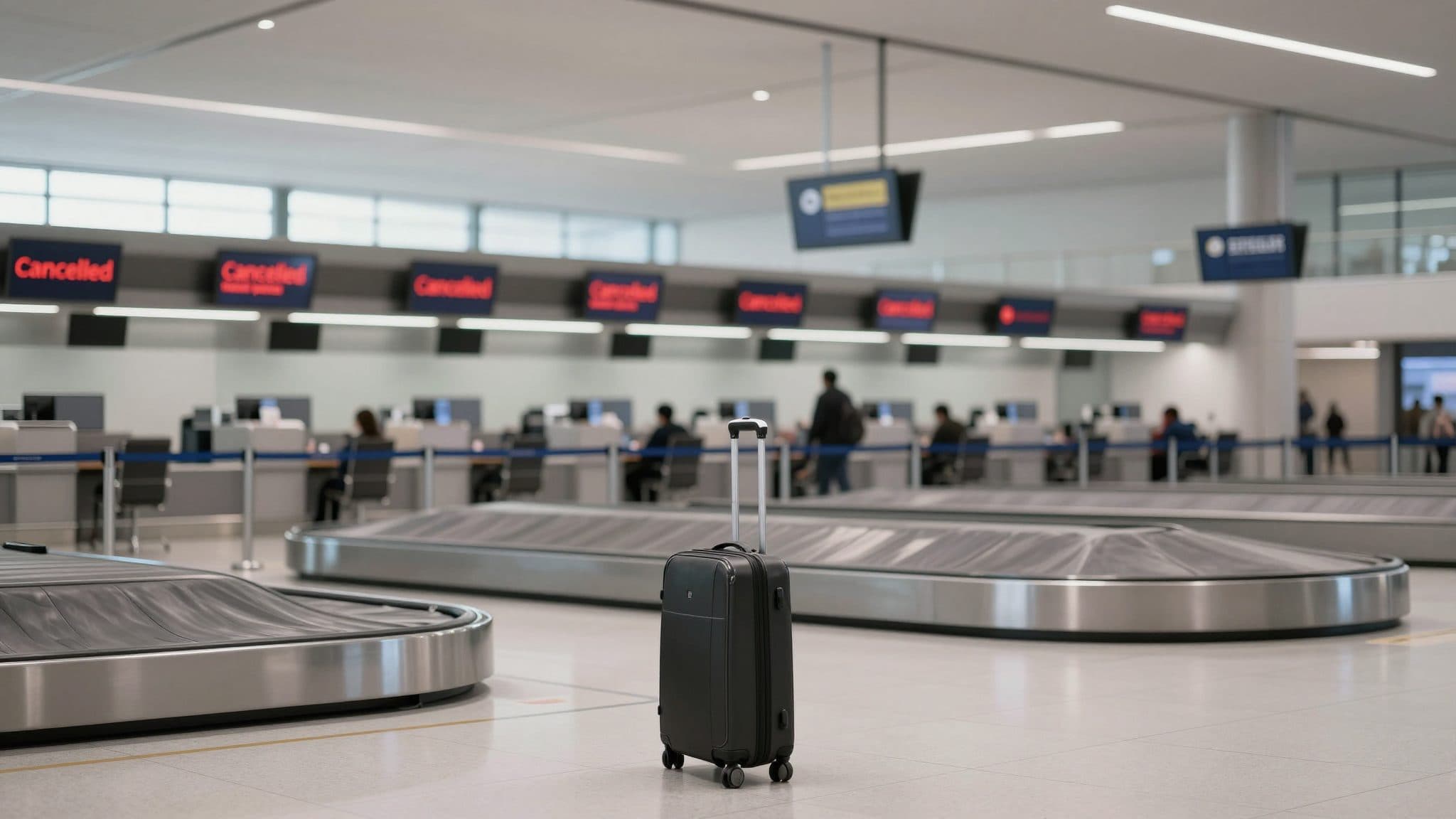
AI-generated image (z-image via Kie.ai)
Summary
Air tickets from Germany have become significantly more expensive in the first half of 2026, while Ryanair is abandoning its Berlin base and the Lufthansa Group under Carsten Spohr is announcing further cancellations. A current study by the German Aerospace Center and data from the Federal Statistical Office show price increases of 8.5 percent on average and 11.5 percent for European flights.
Berlin, July 13, 2026
Flights departing from German airports became on average 8.5 percent more expensive in the first half of 2026 compared to the same period last year, according to data from the Federal Statistical Office, while Ryanair is closing its Berlin base and the Lufthansa Group under CEO Carsten Spohr is announcing further cancellations for 2027.
Statistics confirm trend: Eight percent more on average
Prices for air tickets rose significantly in the first half of 2026. According to figures from the Federal Statistical Office published on Monday, international flights became on average 8.5 percent more expensive compared to the same period of the previous year. Increases were particularly steep on popular European routes, which rose by 11.5 percent, and on domestic flights, which climbed by 9.5 percent.
The German Aerospace Center (DLR) in Cologne confirms this trend in a regular market study based on a broad analysis of European connections as of April 14, 2026. Four different booking lead times ranging from one day to three months were examined. This survey also showed that flights have again become more expensive for German consumers, including on so-called low-cost carriers.
Low-cost carrier supply shrinks, elsewhere it grows
According to figures from the German Aviation Association (BDL), low-cost carriers maintained only a skeletal 82 percent of their pre-Corona capacity in the German market in 2025. In the rest of Europe, instead of a decline there was growth of more than 30 percent, as industry giant Ryanair in particular continues to take delivery of new Boeing aircraft.
The reasons for the higher airfares are, in the assessment of experts, manifold. Rising kerosene costs are considered one reason for the higher airfares. These had risen sharply as a result of the temporary blockade of the Strait of Hormuz during the Iran war. In addition, numerous airlines had raised their fares and suspended routes for security or economic reasons.
Taxes and kerosene as price drivers
Reasons for the high fares include a persistently tight flight supply as well as high fees and taxes for departures from German airports. High state fees and taxes in Germany are also considered a burdening factor. The recent reduction in the national air travel tax has done little to change this. For most flights, the levy is now 2.50 euros less, but the remaining tax and other fees for air traffic control, passenger screening and more keep German costs among the highest in Europe. A reduction in the air travel tax only came into force at the start of the second half of the year.
Ryanair CEO Eddie Wilson sharply criticized German policymakers: „Während andere europäische Länder die Luftverkehrsteuer abgeschafft und die Zugangskosten gesenkt haben, wird Deutschland zunehmend zu teuer für Wachstum. Die Entscheidung von Ryanair, ihre Berliner Basis ab dem Winterflugplan 2026 zu schließen, sowie die Streichung tausender Flüge durch Lufthansa sind klare Konsequenzen dieser verfehlten Politik.“ The Irish airline is sticking to its plan to relocate the seven remaining aircraft from Berlin to other locations. Germany's capital will be served significantly less frequently by the Irish carrier from autumn onward.
Ryanair withdraws from Berlin
The Lufthansa Group is also responding to the economic framework conditions with a drastic capacity reduction. The Lufthansa Group, which also includes Eurowings, scrapped tens of thousands of flights over the summer with the discontinuation of regional subsidiary Cityline, citing unprofitability. CEO Carsten Spohr has already announced further cancellations internally for the coming year.
Lufthansa cancels thousands of flights
The Frankfurt hub is already suffering from declining passenger numbers. Germany's most important airport hub is thus losing further significance, while low-cost carriers are expanding their activities elsewhere in Europe. easyJet, currently the focus of a bidding war between U.S. investment firms Castlelake and Apollo, operates a fleet of 210 aircraft and holds tangible and intangible assets that could significantly exceed its current market capitalization.
The DLR study shows considerable price differences between providers. The carriers Ryanair (89.73 euros) and Easyjet (107.32 euros) landed in the middle of the field. The four largest direct-flight airlines charged on average between 81 euros (Wizz Air) and 141 euros (Eurowings) for a one-way ticket without baggage in day-to-day business. The cheapest ticket in the DLR comparison was offered for a Ryanair flight from Karlsruhe to London the following day at 15 euros.
Price differences in the DLR comparison
The most expensive individual price range was found on an Eurowings connection: the highest single-ticket price of 494.99 euros was determined by the DLR researchers for an Eurowings flight from Düsseldorf to Bilbao booked the day before. The same flight was supposed to cost only 154.99 euros six days later. Tickets booked one day before departure cost on average between 118 euros (Wizz Air) and 201 euros (Eurowings).
With a three-month booking window, average prices range from 71 euros (Ryanair) to 97 euros (Wizz). A year earlier, the price range in the sample was still between 67 euros and 130 euros. Those who book early can therefore still save, but must pay noticeably more overall than in the previous year.
Surcharges and failed EU rule
For the prices mentioned, customers receive only the bare ticket and are allowed to take a small bag on board, which would at best suffice most people for a day trip. For every additional piece of baggage, self-selected seats or a small snack, the airlines additionally hold out their hand and thus generate considerable ancillary revenue. The EU Parliament recently failed in its attempt to include an additional piece of cabin baggage in the cheapest ticket price.
Package holidays also became more expensive, albeit less sharply than flights alone. The largest price increases were for trips to Egypt, at 5.2 percent. For Greece, prices remained almost unchanged with an increase of 0.2 percent. Prices for flights to South America were barely changed, rising 0.3 percent. Trips to Turkey became 1.3 percent more expensive, and the Balearic Islands (3.6 percent) as well as domestic trips within Germany (2.8 percent) were in the middle of the field. Overall, the price increase for package holidays abroad was described as more moderate compared to airfares.
Package holidays: Egypt more expensive, Greece stable
Among long-haul destinations, flights to Central America posted the steepest increases at 12.5 percent, while tickets to Asia and Australia became 4.9 percent more expensive. Flights to Africa, by contrast, became cheaper, with prices falling 12.0 percent. The analyses cited come from the Federal Statistical Office, which presented its current price statistics on flights and package holidays on Monday.
Analysts divided on Lufthansa stock
Analysts assess the situation with Lufthansa shares unevenly. Barclays Capital rated Lufthansa „Underweight“ on July 8, 2026, Bernstein Research rated the stock „Market-Perform“ on July 6 and 7, 2026, DZ Bank rated it „Hold“ on July 10, 2026, while UBS issued a buy recommendation („Buy“) on July 3, 2026. The share price development is likely to depend on whether the announced cancellations under CEO Carsten Spohr bring the hoped-for financial relief, or whether Ryanair and easyJet further reduce the resulting supply in Germany.
For travelers, the development means above all: those wishing to fly from Germany in summer 2026 or winter 2026/27 must reckon with significantly higher prices and a shrinking range of services – especially from Berlin and on domestic German routes. Those who are flexible and book early can mitigate the surcharges; those who fly at short notice pay the highest prices, which in individual cases can amount to nearly 500 euros for a single short-haul flight.
Questions & Answers
Why is Ryanair closing its base in Berlin?
Ryanair CEO Eddie Wilson justifies the closure of the Berlin base from the winter 2026 flight schedule with Germany's taxes and fees, which are high by European comparison. The seven remaining aircraft are to be relocated to other locations, so that Berlin will be served significantly less frequently from autumn onward.
What impact does the closure of Lufthansa subsidiary Cityline have?
The Lufthansa Group announced the discontinuation of its regional subsidiary Cityline in summer 2026 and scrapped tens of thousands of flights, citing unprofitability. CEO Carsten Spohr has already announced further cancellations internally for the coming year.
How have airfares from Germany developed in the first half of 2026?
According to data from the Federal Statistical Office, air tickets from Germany became on average 8.5 percent more expensive in the first half of 2026 compared to the same period of the previous year. European flights rose by 11.5 percent, domestic flights by 9.5 percent, and flights to Central America by as much as 12.5 percent.