Austria–Jordan: Rangnick issues warning ahead of World Cup | allfacts360
Austria begins its World Cup return against Jordan, an "unpleasant opponent" according to Rangnick
Santa Clara, 16 June 2026
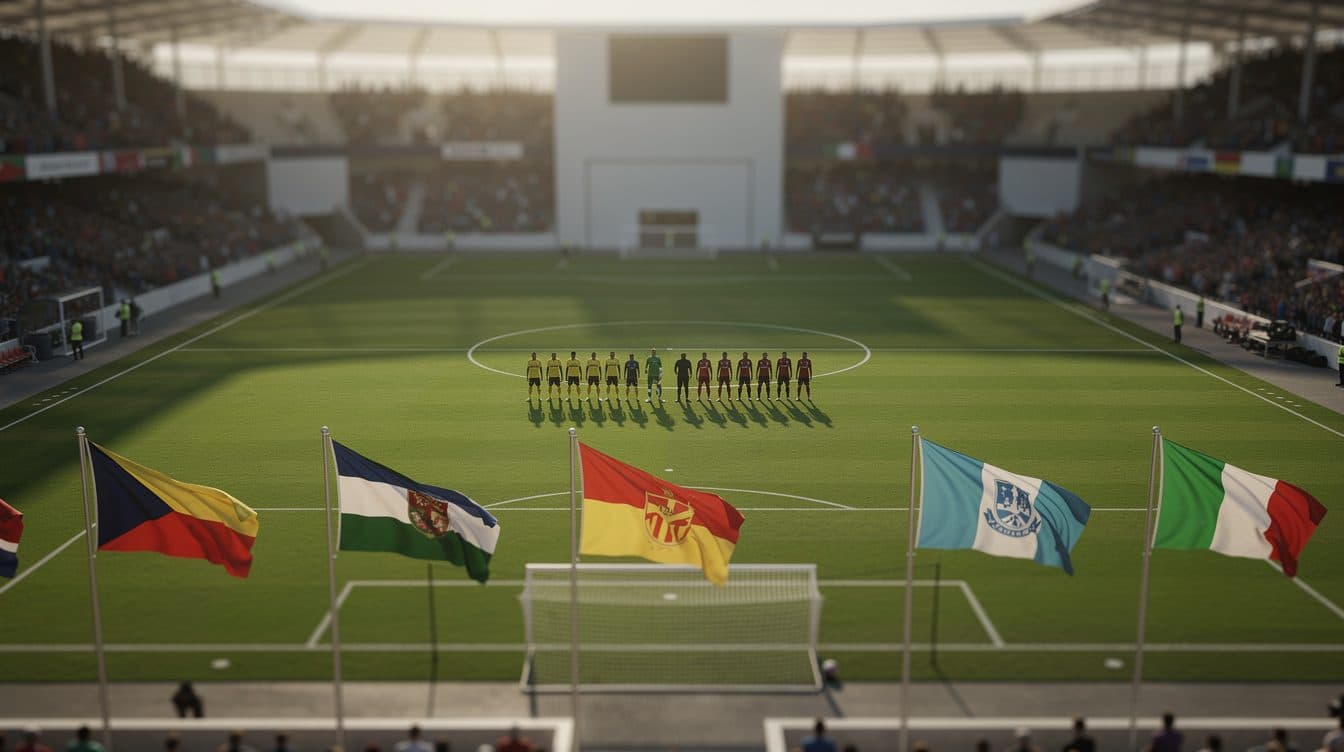
AI-generated image (flux-2/pro-text-to-image via Kie.ai)
Summary
The Austrian national football team plays its first World Cup match in 28 years on Wednesday against Jordan, in Santa Clara. Coach Ralf Rangnick has warned that the opposition, "no walkover," must be taken very seriously despite its status as a newcomer to the tournament.
Santa Clara, 16 June 2026
The Austrian national football team returns to the World Cup stage on Wednesday by facing Jordan in Santa Clara, twenty-eight years after its last participation in a World Cup, with the stated objective of advancing to the knockout stage.
What's new since 15 June
Update of 16 June 2026: on the eve of kick-off, the Austrian staff met the press after a visit to the San Francisco 49ers' stadium and provided new details on the match approach, pitch conditions and adjustment to the time difference, as reported below.
This return to the highest level, almost three decades after the 1998 edition in France, has been meticulously prepared. Coach Ralf Rangnick, whose contract extension was announced on Saturday, hammered home on Monday that his group "knows how important this match is and that it will be decisive." The German tactician notably cited the opening match lost against France 0:1 in 1990 in Italy, to recall how surprising World Cup debuts can be: "Italy, four-time world champions, is not there, but we are," observed the Jordanian captain Ihsan Haddad on his part.
What's new since 15 June
Since the previous summary, the main new information concerns the Austrian delegation's visit to Levi's Stadium and the statements that accompanied it. Captain David Alaba gave his impressions of the pitch: "It's still a little hard," he said, hoping it would be watered before the match. Ralf Rangnick added that "the turf looks like a golf course." The two men also agreed on the relative ease with which the time difference had been handled: "I think nobody has jet lag anymore," Alaba smiled.
Another notable element: the drawing of a parallel with an NBA finals game to justify the group's concentration. "We also watched the last game of the NBA finals," said Rangnick, referring to the finals game stopped on 18 June 1998 after overtime, when "28.8 seconds remained on the clock and, because of the interruptions, it lasted twenty minutes." The coach drew a tactical lesson from it: "It simply shows that you have to be on your guard from the start."
The Jordanian opposition scrutinized closely
The coach also detailed his approach to the cooling breaks imposed by the organizers under the American schedule. "Cooling breaks can have advantages and disadvantages," Alaba commented, while Rangnick explained that he wanted to use these stoppages as a tool of influence on his players, in the way it has been done "for a long time in handball or basketball." Midfielder Xaver Schlager agreed: "The important thing is to stay calm and be effective in counter-pressing."
Finally, the coach appeared to factor in the results of other favorites who fell the previous day. Spain, a title contender, could do no better than 0:0 against Cape Verde, Turkey lost 0:2 to Australia, and Switzerland was held to a 1:1 draw by Qatar. "If the results showed one thing, it is how much we can still rely on favorite roles these days," Rangnick stressed, though he refused to see it as a warning sign: "I don't think my team needed a warning."
The Jordanian opposition scrutinized closely
Against the backdrop of these statements, the profile emerges of an opponent taken very seriously by the Austrian staff. "Jordan is anything but a pushover against whom you win in passing," Rangnick had already warned, echoing one of his first repeated cautions throughout the preparation. The coach developed his tactical analysis: "The Jordanians have a clear approach and very compact, collective behavior. They want to lure the opponent in and then use the open spaces." This tendency to drop back and then pierce the lines with long balls was a focal point of the training week. "That is exactly the theme that has accompanied us during the last ten days of training," Rangnick acknowledged.
A World Cup at "a special moment"
The coach also warned against the Jordanian side's ability to break forward quickly on the counter, having observed that the coverage of these transitions had not been optimal in the last warm-up against Tunisia on 1 June. "We saw how much Scotland suffered against Haiti (1:0)," Schlager slipped in by way of warning. The Austrian added: "If we had to chase a deficit, the whole affair would be even trickier."
The Austrian captain for his part stressed the historic significance of the occasion. "It means a lot to us that Austria is back after nearly thirty years," David Alaba emphasized, in a tournament where the Red and Whites hope to reach the knockout stage for the first time since their participations in 1954, 1978, 1982, 1990 and 1998. The coach, who will become only the second coach to lead Austria in both a World Cup match and a European Championship match after Josef Hickersberger, promised to treat this fixture "as if it were a final."
Jordan, between pride and learning
A World Cup at "a special moment"
A date to follow in the early morning in Europe
Beyond the tactical analysis, the Austrian speakers repeatedly expressed enthusiasm at the idea of stepping onto NFL pitches for the first time. "These are really three cathedrals of American Football, of the NFL," exclaimed a staff member, referring to the venues of the San Francisco 49ers, Dallas Cowboys and Kansas City Chiefs, where the three Group J matches will be played. Striker Michael Gregoritsch, a self-declared 49ers supporter, said he could not wait: "I thought I would only ever experience that as a supporter." The forward, who will mark the occasion in his own way, added: "I would like to be able to celebrate that a little bit inside too."
Schlager for his part put the wait in perspective: "The older you get, the less often you experience first moments, which is why the World Cup is very special." His teammate summed up the group's philosophy by quoting the motto set by Rangnick: "We really have to enjoy ourselves between 9 and 11 pm as well." The coach, who is also living his own "first time" at a World Cup, promised to savor the moment, while staying focused on the sporting objective.
Jordan, between pride and learning
On the Jordanian side, the approach is noticeably different. For the Gulf side, runners-up in the 2023 Asian Cup and quarter-finalists in the 2024 Asian Cup, this is the very first match at a World Cup, and the stakes are as much about learning as about the result. Coach Jamal Sellami, who played in the 1998 World Cup with Morocco, offered a clear-eyed assessment: "We are here to learn and enjoy it." His captain, Ihsan Haddad, added: "What we are feeling right now is not pressure, but rather pride."
The Jordanian squad, which has not played a single competitive match since the end of the qualifying phase, has shown signs of inconsistency in its recent warm-ups: a 1:4 defeat in Switzerland, two defeats in a row, and five international matches without a win. Rangnick however warned against reading too much into these results. "Nobody in our camp is taking this match lightly," he hammered home, calling on his players to "reach their absolute limit" to avoid any bad surprise. The coach, who reiterated that he wanted to make "no decisions out of gratitude for past services," expects an opposition that is "tactically disciplined," whose three- or five-man defense is described as "hard to break down."
A date to follow in the early morning in Europe
Kick-off, set for 9:00 pm local time Tuesday (Tuesday 16 June), will correspond to 6:00 am Wednesday in Central Europe, an early hour that broadcasters ZDF and MagentaTV will carry in Germany, and ORF 1 in Austria. Some 65,000 spectators are expected in a venue that holds nearly 69,000, which will make it one of the biggest atmospheres of the tournament. Alaba and Rangnick however felt that this evening slot suited the players well, as they are "used to playing in the evening." The match looks set to be the first full-scale test of an Austrian team that dreams of repeating 1954 — the only victorious campaign beyond the group stage — and of breaking through the glass ceiling of first-round eliminations. The match will also be the first World Cup appearance of Musa Al-Tamari, a 28-year-old winger from Stade Rennais, described as "the Messi of Jordan" and the only European club player in the opposing squad. With seven goals and eleven assists in Ligue 1 last season, he will be the offensive weapon the Austrian defense will need to watch closely.
Whatever happens at the final whistle, the Austrians have already warned: "And we are keen that we can also celebrate after the match."
Questions & Answers
When and where is Austria facing Jordan in the World Cup?
Austria meets Jordan on Wednesday at 9:00 pm local time (6:00 am Central European Time) at Levi's Stadium in Santa Clara, California, home of the San Francisco 49ers.
Why is Ralf Rangnick warning against Jordan?
The Austrian coach has repeatedly said that Jordan is "not a pushover" and that it deploys a particularly compact three- or five-man defensive system capable of springing