Berlin Charité Discharges Ebola Patient After Successful Treatment
Berlin, 09 June 2026
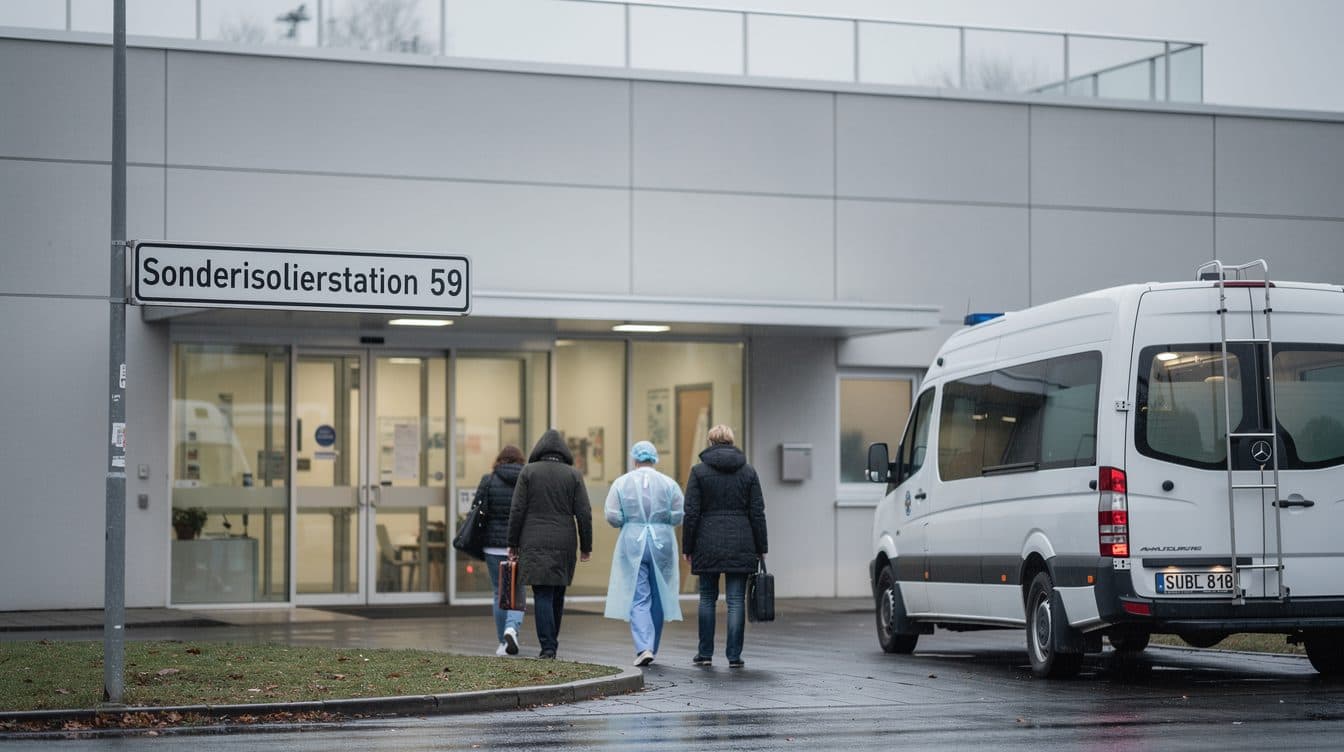
AI-generated image (flux-2/pro-text-to-image via Kie.ai)
Summary
A 39-year-old US doctor who contracted the Ebola virus in the Democratic Republic of Congo has been discharged from Berlin's Charité special isolation ward after approximately two weeks of treatment. According to the treating physicians, his condition was at times life-threatening; his wife and four children remained symptom-free.
Berlin, 09 June 2026
A 39-year-old American doctor who contracted the rare Bundibugyo strain of the Ebola virus during a relief mission in the Democratic Republic of Congo has been discharged from Berlin's Charité special isolation ward after approximately two weeks of treatment.
According to the treating physicians, the patient was at times in a life-threatening condition. Leif Erik Sander, Chief Infectious Disease Specialist at Charité, explained that the critical phase had occurred between the doctor's departure from Uganda and his arrival in Germany: "Those are hours during which we were concerned that his condition could deteriorate so rapidly that he would not survive the transport." The patient was escorted by police at Berlin's BER airport and brought to Charité in a special ambulance.
The US doctor was treated on special isolation ward 59 at the Virchow Campus, which is one of the few German facilities of its kind. The ward has 20 beds, its own laboratory, an operating room, as well as separate access routes, airlock systems, negative-pressure ventilation, and a closed wastewater treatment system. In an emergency, it can be fully activated within 90 minutes, according to Charité.
Special Isolation Ward 59: High-Tech Protection Since the 1970s
In addition to the patient, his wife — who is also a doctor and had treated the same patient in the Congo — as well as their four children were quarantined as high-risk contacts in a separate section of the ward. According to the hospital, the family members showed no symptoms of Ebola. The ward is now empty again, according to Charité.
Treatment included the experimental antibody preparation MBP134, which is still in clinical trials and at the time of treatment had only been tested on six healthy people worldwide. The patient also received remdesivir, which is also used to treat COVID-19. However, Sander cautioned: "However, with the caveat: we don't know what would have happened if these drugs had not been administered — that's the nature of individual healing attempts."
Treatment with Experimental Antibody Preparation
The chief infectious disease specialist nevertheless expressed confidence that the patient's condition had stabilized quickly under the combination therapy. Regarding the costs of the complex treatment, Charité chief Heyo Kroemer cited a figure: "Possibly a low seven-figure sum." The patient "was insured"; according to Kroemer, there are corresponding agreements between Berlin and Washington for such cases.
Charité is part of the STAKOB network, in which German special isolation wards exchange information on highly pathogenic agents. In regular operation, ward 59 treats patients with routine infections; patients enter the ward from outside via special balcony doors without crossing interior corridors.
Ebola Outbreak in the Congo and the Limits of Aid
In an emergency, 15 doctors and at least 30 nursing staff would be deployed on the ward, according to Charité, reinforced by personnel from the Mitte Campus and on-call services. Staff work in protective suits that are destroyed after use; a maximum of three hours at a stretch is possible in them, with workers losing around 1.5 liters of sweat per shift. A buddy system with radio communication in the suits is designed to allow mutual monitoring of risks. Activation of the ward is practiced at least once a year.
The ward was built in the 1970s during the Cold War out of concern about smallpox and chemical warfare agents and was comprehensively modernized in 2010. It was most recently activated in December 2024, when a Russian exiled opposition figure with symptoms of poisoning was treated; an attack with a biological warfare agent was not confirmed at the time. The ward is funded from public funds and funds from statutory health insurance via the state-owned Charité.
The background to the case is an Ebola outbreak in the Democratic Republic of Congo, in which, according to Sander, more than 100 deaths and hundreds of infections have been confirmed. The outbreak went undetected for a relatively long time because suitable tests for the rare pathogen type were lacking. Charité virologist Christian Drosten was, according to Sander, significantly involved in the development of a suitable PCR test, which has since been made available to laboratories worldwide.
Sander was also cautious regarding the use of the antibody preparation in the Congo itself: "That is why my hope that the drug will actually be made available on the ground would not be very high." In the outbreak areas, which are partly controlled by militias, there is a lack of "partially everything." However, it is important to make such средства available, particularly for aid workers in endemic areas. There are currently no further requests for the admission of Ebola patients in Berlin, Sander said. In principle, the following applies: "If patients need help again, we are of course available."
Questions & Answers
Who was treated at Charité?
Treated was a 39-year-old American doctor who had contracted the rare Bundibugyo strain of the Ebola virus during his relief work in the Democratic Republic of Congo; his wife and four children were cared for as contact persons.
Which medications were used?
The patient received the experimental antibody preparation MBP134, which had only been tested on six healthy people worldwide, as well as remdesivir; according to Leif Erik Sander, an effect could not be clearly demonstrated.
Why did the outbreak in the Congo prove so severe?
According to Sander, the outbreak went undetected for a relatively long time because suitable tests for the pathogen were initially lacking; in addition, parts of the affected areas are controlled by militias, so that medical care on the ground is severely limited.
Ebola Patient Charité Berlin: Discharge After Two Weeks | allfacts360