Ebola patient from the Congo admitted to Frankfurt University Hospital
Frankfurt am Main, July 13, 2026
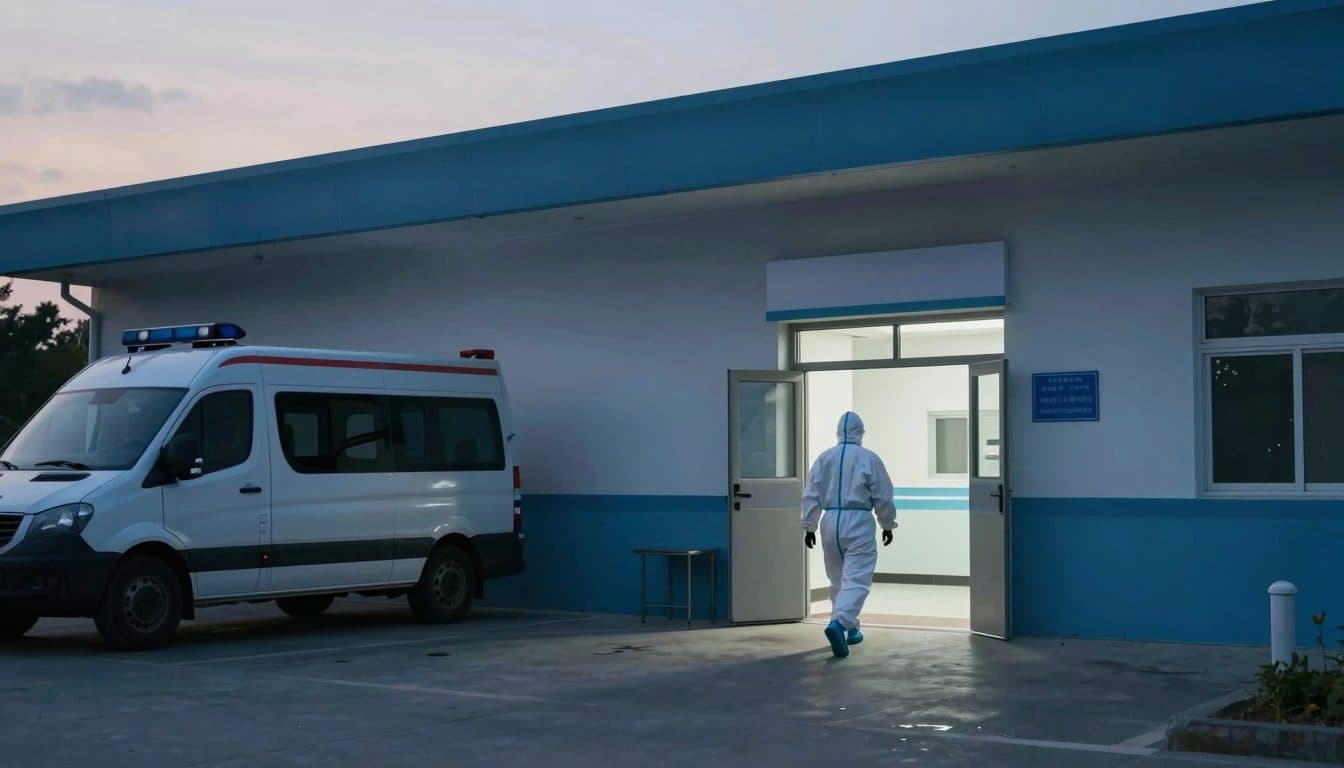
AI-generated image (z-image via Kie.ai)
Summary
A US-American employee of an aid organization has tested positive for the Bundibugyo variant of the Ebola virus at Frankfurt University Hospital. The special isolation unit is treating the person in complete isolation; according to the hospital, there is no danger to the public.
Frankfurt am Main, July 13, 2026
A US-American employee of a humanitarian organization who became infected with the Bundibugyo variant of the Ebola virus in the Democratic Republic of the Congo was brought overnight to the special isolation unit of Unimedizin Frankfurt for treatment.
The patient arrived at the special isolation unit of Frankfurt University Medicine at around 3 a.m. in the morning, as the hospital announced. The person is showing "entsprechende Krankheitssymptome" (corresponding disease symptoms), Unimedizin Frankfurt stated in the morning in response to a query from the German Press Agency. According to the attending physician Timo Wolf, head of the special isolation unit, "der Zustand der Person […] derzeit stabil" ("the condition of the person […] is currently stable"). The person tested positive for the Bundibugyo variant of the virus currently spreading in the Congo.
Ebola patient in Frankfurt: US aid worker from Congo at | allfacts360
The gender of the affected individual was initially unclear. "Ob es sich um einen Mann oder eine Frau handelt, blieb zunächst offen" ("Whether it is a man or a woman remained initially open"), the statement said. The US health authority CDC had previously announced that a US citizen was affected who works for a humanitarian organization in the Democratic Republic of the Congo. An overview of the person's age, name, or exact activity was initially not released.
Background: Second US patient in Germany
The Frankfurt University Hospital emphasized that there is no danger to the public and other patients. The person is being treated in complete isolation. "Diesmal übernimmt eine andere Isolierstation den Fall" ("This time another isolation unit is taking the case"), the dpa reported further – an indication that it was not Frankfurt but the Hamburg treatment facility from 2014 that was called upon again. An official confirmation from the Frankfurt hospital on this was initially pending.
Back in 2014, a US citizen sick with Ebola had been brought to Germany for treatment. At that time, the Charité in Berlin was in action. "Wieder hat sich ein US-Mediziner im Kongo mit dem gefährlichen Ebola-Virus angesteckt, wieder geht es zur Behandlung nach Deutschland" ("Again a US medic has become infected with the dangerous Ebola virus in the Congo, again the person is going to Germany for treatment"), the dpa wrote. The parallel shows that German high-specialty medicine continues to play a central role in international Ebola cases.
Ebola fever is a contagious and life-threatening disease. A vaccine or an approved standard therapy is not yet available. Treatment focuses on stabilizing circulation, fluid administration, and relieving symptoms. The first US doctor who came to Germany in October 2014 also barely survived. His case is considered evidence that early intensive medical care can significantly increase the chances of survival.
Ebola therapy: no vaccine, hardly any standard remedies
Meanwhile, the situation in the Congo continues to escalate. According to the Congolese government, there are now 702 confirmed deaths; 1,926 cases were laboratory-confirmed by Sunday. 318 patients are considered recovered. 753 people are currently being treated in hospitals or isolation units. The WHO and aid organizations are trying to contain the spread through education, contact tracing, and vaccination campaigns.
Situation in the Congo: over 700 dead
In children, Ebola can lead to death "sehr rasch" ("very quickly"), according to Leif Erik Sander, Director of the Department of Infectious Diseases and Intensive Care Medicine at the Charité. Back in 2014, there was already great concern about children and contact persons: the wife and four children of the US patient at the time also came to the Charité as "Hochrisikokontakte" ("high-risk contacts"), but had no symptoms and were quarantined in a separate part of the ward.
The experience of 2014 shows how important specialized infection wards are. In Germany, two centers are available: the special isolation unit in Frankfurt am Main and the special isolation unit at the University Medical Center Hamburg-Eppendorf (UKE), both equipped for treating patients with highly dangerous pathogens. Both units have negative-pressure rooms, airlock systems, and specially trained staff.
Special wards: Frankfurt isolation unit in use
For the coming days, the attending physicians expect initial findings about the course of the illness. "Der Zustand der Person ist derzeit stabil" ("The condition of the person is currently stable"), Wolf emphasized. Whether the infection was detected early and whether the patient is still in an early phase of the disease was initially open. The question of whether there are further contact persons and whether they need to be medically monitored in Germany also remained unanswered initially.
The Robert Koch Institute (RKI) and the Federal Ministry of Health are involved in the coordination, according to government circles. The ministry had taken note of the matter, it was said from informed circles. A formal statement was initially not available. The Foreign Office is also examining whether further German citizens in the Congo could be affected.
The Bundibugyo variant is one of the five known Ebola subtypes. It was first detected in 2007 in the Ugandan district of Bundibugyo. Compared to the Zaire Ebola virus, the disease often takes a milder course according to studies, but is still life-threatening. The current epidemic in eastern Congo is considered the second most severe since the outbreak in West Africa in 2014/2015.
Bundibugyo variant: milder course, still dangerous
In the most severe Ebola epidemic in West Africa in 2014/2015 alone, more than 11,000 people died. At the time, the World Health Organization had classified the outbreak as a "Public Health Emergency of International Concern" only after months. From this experience, international emergency mechanisms were revised, which are now expected to take effect faster.
The Frankfurt University Hospital set up a telephone hotline for concerned citizens. Callers could obtain information about the clinical picture, transmission routes, and the procedures in Frankfurt, it was said. The hospital also pointed out that infection with Ebola is only possible through direct contact with body fluids of a sick person. Transmission through the air or through everyday encounters is ruled out.
Ebola 2014/2015: lessons from West Africa
For the aid workers in the Congo, the new case means an additional burden. Since the beginning of the epidemic, dozens of employees of aid organizations have become infected, according to the World Health Organization. The WHO has repeatedly pointed to the difficult working conditions in the eastern Congolese provinces of North Kivu and Ituri, where armed conflicts hamper containment efforts.
The next steps in Frankfurt depend on the course of the illness. Medical professionals assume that the incubation period – the time between infection and the onset of symptoms – is usually two to 21 days. Since the infected person quickly received specialized treatment after returning from the Congo, experts consider the chances of recovery to be comparatively good.
Should the patient's condition worsen, all the resources of modern intensive care medicine are available at the Frankfurt hospital. These also include experimental therapies developed against Ebola in recent years. Two active substances – ansuvimab and inmazeb – showed a significant reduction in mortality in clinical studies during the Congo epidemic.
Questions & Answers
Who is being treated in Frankfurt?
At the special isolation unit of Unimedizin Frankfurt, a US-American employee of a humanitarian organization who became infected with Ebola in the Congo is being treated.
Which Ebola variant does the patient have?
The person tested positive for the Bundibugyo variant of the Ebola virus, which is currently spreading in the Congo.
Why was Frankfurt specifically chosen as the treatment location?
Frankfurt has its own special isolation unit for highly dangerous pathogens, which, like the Hamburg unit, has been used in previous international Ebola cases.