Trump's Tariff Threat: Canada Rejects Criticism Over | allfacts360
Canada Rejects Trump's Tariff Threat Over Wildfire Smoke
Ottawa, July 18, 2026
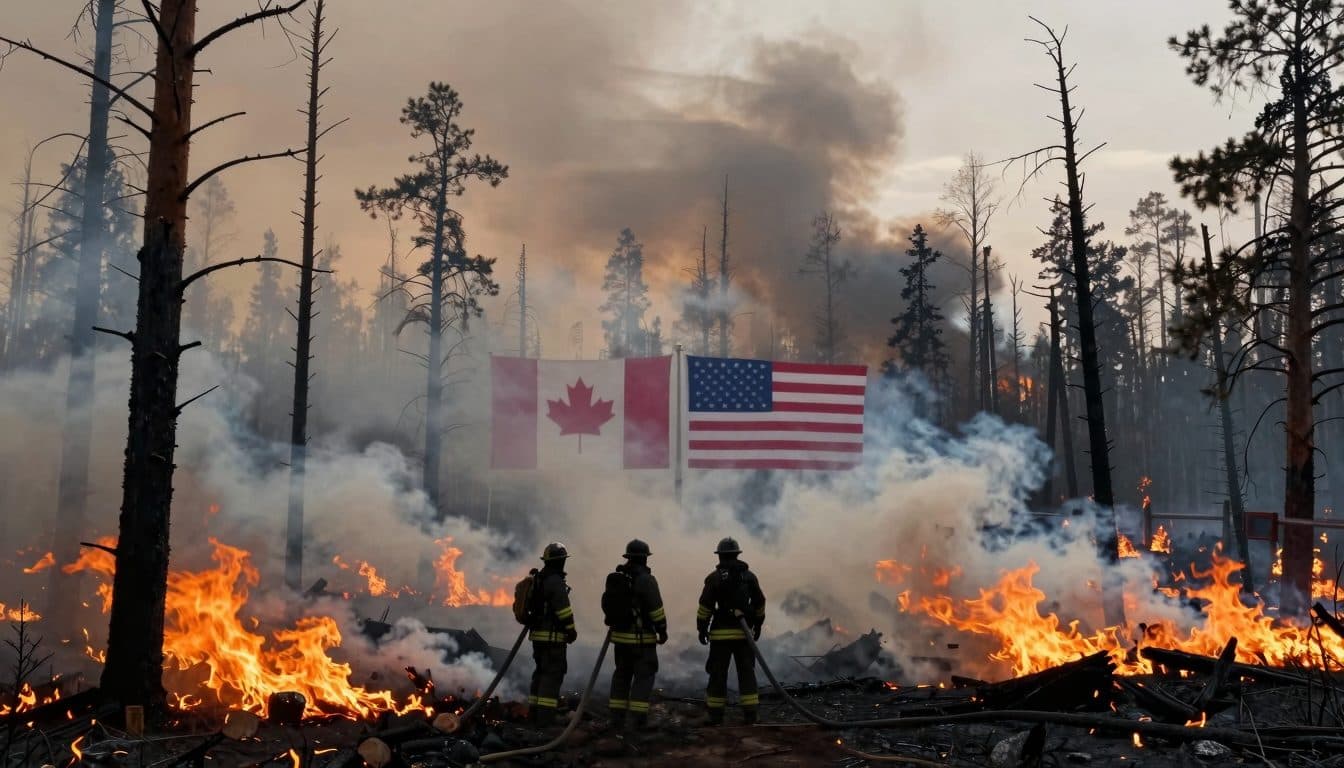
AI-generated image (z-image via Kie.ai)
Summary
Canada has rejected accusations from US President Donald Trump that the country is investing too little in protecting its forests. Trump had threatened additional punitive tariffs on Canadian imports should the smoke pollution from Canadian wildfires continue. Canadian Emergency Preparedness Minister Eleanor Olszewski pointed to decades of cooperation between the two countries in firefighting.
Ottawa, July 18, 2026
Canada's government has rejected criticism from US President Donald Trump of the country's wildfire policy, stating that both nations are in constant contact regarding the fight against cross-border fires.
Canadian Emergency Preparedness Minister Eleanor Olszewski responded on Saturday to a series of messages from Trump in which he had accused Canada of failing to properly manage its forests. She noted that Canada and the United States were in constant contact and could look back on a long history of cooperation in the fight against wildfires. "This is a challenge that knows no borders," Olszewski said. Canada has invested billions in more sustainable forests and fire prevention since 2020, she added.
On Friday (local time), Trump declared on his platform Truth Social that the US was being "burdened needlessly by dirty, polluted, and unhealthy air, the quality of which is dangerous and totally unacceptable." He accused Canada of failing to carry out basic forest management or the necessary removal of debris and brush. "This is gross negligence and is becoming an annual event that costs the United States billions of dollars," the US president wrote. He announced his intention to call Canadian Prime Minister Mark Carney "to find out what they intend to do about the smoke."
Trump's Accusations and Tariff Threat
The costs arising from the smoke pollution would "necessarily" have to be added to the existing tariffs on Canadian imports, Trump declared on Truth Social. The Canadian government firmly rejected this characterization. "Because that is exactly what we have done for our American friends as well," Olszewski said, referring to the mutual assistance in firefighting. The Premier of the Province of Ontario, Doug Ford, had previously stated that instead of "chattering and complaining," politicians should send concrete support.
The current wildfire season is significantly impacting air quality in several major US cities. According to Canadian authorities, around 950 fires were active on Saturday, with the vast majority classified as "out of control." In the Province of Ontario alone, home to the metropolis of Toronto, approximately 200 fires were raging, according to the BBC. Canada's wildfire information system reported over 900 active fires across the country on Saturday morning (CEST).
In recent days, smoke from the Canadian fires has reached major cities such as New York and Chicago, causing particulate matter levels to rise significantly. Christopher Carlsten, Head of the Division of Pulmonology at the University of British Columbia (UBC), told the news agency AFP that the expected pollutant exposure was "by no means extreme." He anticipated values between 10 and 20 micrograms per cubic meter. The guideline recommended by the World Health Organization for general health is around 5 micrograms.
Situation in Canada: Hundreds of Fires Active
"It's not exactly optimal either," Carlsten continued. He was more concerned about the audience: "Regarding the fans, my main concern is the short-term impact, because among tens of thousands of people there will inevitably be some who are more health-vulnerable." Their performance could, however, be "impaired." According to expert assessments, the poor air could also affect the final of the football World Cup.
Atmospheric scientist Greg Evans from the University of Toronto told the BBC that he expects such events to occur more frequently in the coming decades. "I expect this to happen more often in the coming decades, so cities and residents will need to prepare for it in the future," Evans said. Political scientist Patrick James from the University of Toronto also emphasized: "Weather does not care about international borders."
Health Risks and World Cup Final
The dispute comes at a time when relations between the two neighbors are already strained. According to the BBC, Republicans have used the issue to underscore Trump's call for Canada to become the 51st US state. Four Republican representatives from the border region — John James, John Moolenaar, Jack Bergman, and Lisa McClain — addressed Canadian government officials in an open letter. They wrote that their "patience had run out": "We are tired of accepting apologies instead of action." The representatives warned that the US could consider direct involvement in cross-border wildfire prevention and firefighting if Canada did not act.
The Canadian government counters that this year's wildfire season started more slowly than in the two previous worst years, 2023 and 2025. Nevertheless, investments in prevention and sustainable forestry have been significantly increased. Observers noted that the smoke development is cross-border in nature and that a purely national solution to the problem would be insufficient.
As diplomatic tensions grow, authorities in the affected US border regions are preparing for a possible worsening of air pollution. Health departments recommended that particularly vulnerable groups reduce strenuous outdoor activities and wear protective masks if necessary. The coming days will show whether wind and weather continue to carry the smoke plumes southward or whether the situation eases in the short term.
Political Dimension: Republicans Harden Their Tone
Parallel to the political disputes, firefighting operations in Canada are in full swing. Thousands of firefighters are deployed, supported by firefighting aircraft and helicopters from the US and other countries. Coordination takes place through joint operations centers, as Olszewski emphasized. The minister also made clear that Canada was ready to further intensify its efforts in fire prevention.
The Trump administration has already raised tariffs on Canadian imports several times recently. An additional burden linked to the wildfires would further strain trade relations. Canadian business associations warned of consequences for both sides, as many industries are closely intertwined.
For residents of the affected areas, the immediate concern remains air quality. Monitoring stations in several US states reported significantly elevated particulate matter levels in recent days. Schools and authorities responded with warnings and, in some cases, by moving sporting events indoors.
According to meteorologists, the further development depends primarily on wind conditions. Should the smoke plume weaken or shift northward in the coming days, the situation in US metropolises could ease quickly. Otherwise, the political and health burdens threaten to continue throughout the summer months.
Economic Consequences for Both Countries
Both governments emphasized that they wished to continue the dialogue. Olszewski spoke of an ongoing exchange at the working level that would be continued. Whether there would be a phone call between Trump and Carney remained unclear as of Saturday. The Canadian side signaled readiness to continue talks on firefighting at the highest level.
In the long term, experts see both countries as having a responsibility. The causes of increasing wildfires — drought, higher temperatures, and changing precipitation patterns — do not stop at borders. A joint strategy for adapting to climate change and strengthening the resilience of forests is urgently needed, according to the unanimous assessment.
Outlook: Weather and Diplomacy
The incident also illustrates how climatic events are increasingly triggering interstate conflicts. While Ottawa points to existing cooperation, Washington is seeking rapid political levers. How this summer's smoke is handled could become a litmus test for the relationship between the two neighbors.
Questions & Answers
Why is Trump threatening Canada with additional tariffs?
Trump accuses Canada of failing to adequately manage its forests and blames the smoke from Canadian wildfires for poor air quality in major US cities. He announced that the costs of this burden would be added to existing tariffs on Canadian imports.
How is Canada responding to the accusations?
Emergency Preparedness Minister Eleanor Olszewski rejected the criticism and pointed to decades of cross-border cooperation in wildfire firefighting. Canada has invested billions in sustainable forestry and fire prevention since 2020.
How bad is the current wildfire season in Canada?
According to Canadian authorities, around 950 fires were active on Saturday, most of them out of control. However, the season started more slowly than in the record years 2023 and 2025.