
Singapore, 30 May 2026
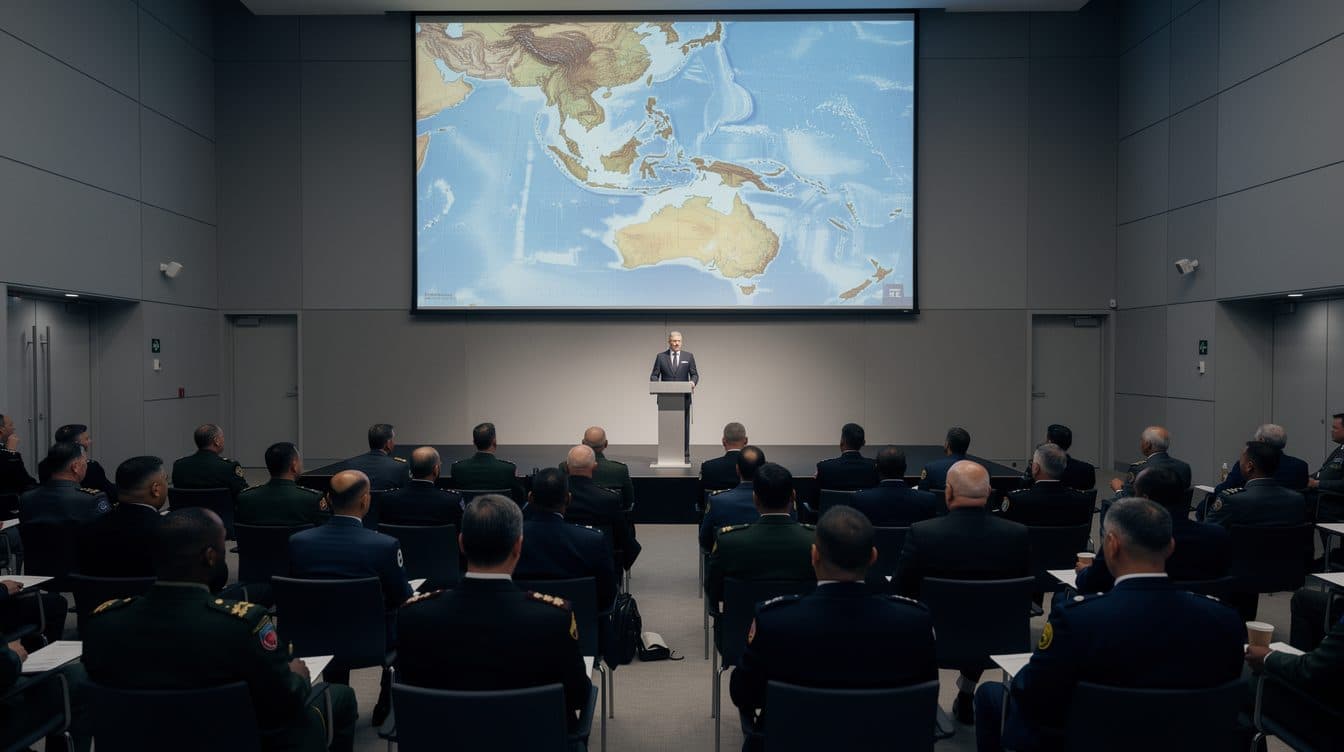
US Defense Secretary Pete Hegseth addressed the annual Shangri-La Dialogue in Singapore on Saturday, calling on Asian allies to boost defense budgets and striking a notably measured tone on China just two weeks after a summit between Presidents Donald Trump and Xi Jinping.
Hegseth told the gathering of ministers, military officials and experts that the United States expects partner nations to spend around 3.5 percent of their gross domestic product on defense going forward. The demand extends a long-standing Trump administration push for fairer burden-sharing among allies.
The Pentagon chief said the US itself plans to invest roughly $1.5 trillion in its military and declared that 'the era in which the United States subsidizes the defense of wealthy nations is over.' He added that Washington needs 'partners, not protectorates.'
A new defense spending benchmark
On China, Hegseth adopted a dual-track message. He referred to Beijing's 'historic military build-up' and reaffirmed that US strategy in the Pacific centers on 'deterrence by denial' along the first island chain — a posture widely seen as aimed at countering the People's Liberation Army in a potential Taiwan Strait conflict.
At the same time, he said US-China relations are 'better than they have been in many years' and praised the Xi-Trump talks in Beijing last month as 'historic.' The Trump administration, he said, seeks 'stable peace, fair trade and respectful relations' with Beijing.
Balancing deterrence and diplomacy on China
Hegseth stressed that the United States is not interested in 'unnecessary confrontation in the region' but rather in a balance of power in Asia 'that works for Americans as well as our allies.' That means, he said, 'a favorable but durable balance of power in which no state, including China, can impose its hegemony and challenge the security or prosperity of our nation and those of our allies.'
The defense secretary did not directly address the contentious issue of Taiwan, which Beijing repeatedly calls a 'red line' in US-China relations. He said US relations with Taiwan remain unchanged, but that 'any decisions on future arms sales to Taiwan' rest with President Trump.
A think tank had warned ahead of the speech about the risks of a Taiwan conflict, noting that 'even a limited nuclear exchange would be catastrophic for the region.'
Mixed reactions from Beijing and Washington
Hegseth's remarks drew mixed reactions. Chinese delegate Da Wei, director of the Center for International Security and Strategy at Tsinghua University in Beijing, said Hegseth's tone this year was 'much more moderate.' But he also called the US defense secretary's framing 'ironic,' saying: 'Everyone in the room must have thought: Who is the hegemon here?' Given US actions in Iran and Venezuela, he added, the answer was 'clear to everyone.'
US Senator Tammy Duckworth, a Democratic delegate and vocal Trump critic, said she was 'somewhat disturbed' by Hegseth's overly conciliatory tone toward China. 'I am concerned that this administration is distracted by wars it has started in other parts of the world, at the expense of our engagement here in the Indo-Pacific region,' she said.
Hegseth also pressed Asian allies to move beyond dialogue and invest in hardware. 'We don't need more conferences, we need more combat power,' he said. 'Less Shangri-La, more ships, more submarines.'
'Less Shangri-La, more ships'
The Shangri-La Dialogue, held annually in Singapore, brings together hundreds of ministers, military leaders and experts from around the world to discuss current flashpoints and threat scenarios.
China did not send its defense minister Dong Jun to the dialogue for the second consecutive year, instead dispatching a delegation of military experts from academia and practice. Hegseth expressed regret, saying: 'I wish my counterpart were at this conference, but I look forward to other opportunities where we can meet.'
The speech was widely seen as a barometer of the outcomes from the Xi-Trump summit. Hegseth later spoke of 'fantastic' trade talks but offered few details, and previously hinted that the US could use arms sales to democratically governed Taiwan as a bargaining chip in negotiations with Beijing.
Taiwan and the arms-sales question
Hegseth also had a message for Western allies. 'When our interests diverge, we adapt pragmatically — without drama or moralizing,' he said. 'I think Western Europe could take a leaf out of that book.'
The defense secretary reiterated that the US aims for an order in which 'no state, including China, can impose its hegemony.' He framed the American approach as 'clear-eyed' and grounded in a realistic assessment of great-power competition.
A message for Western Europe
The address marked one of the most detailed public outlines of the Trump administration's Indo-Pacific security doctrine since the Beijing summit, blending demands for allied burden-sharing with a calibrated rhetorical stance toward China.