Digital Skills Initiative: Government and 30 Partners Consolidate Free Training on One Platform
Vienna, 14 July 2026
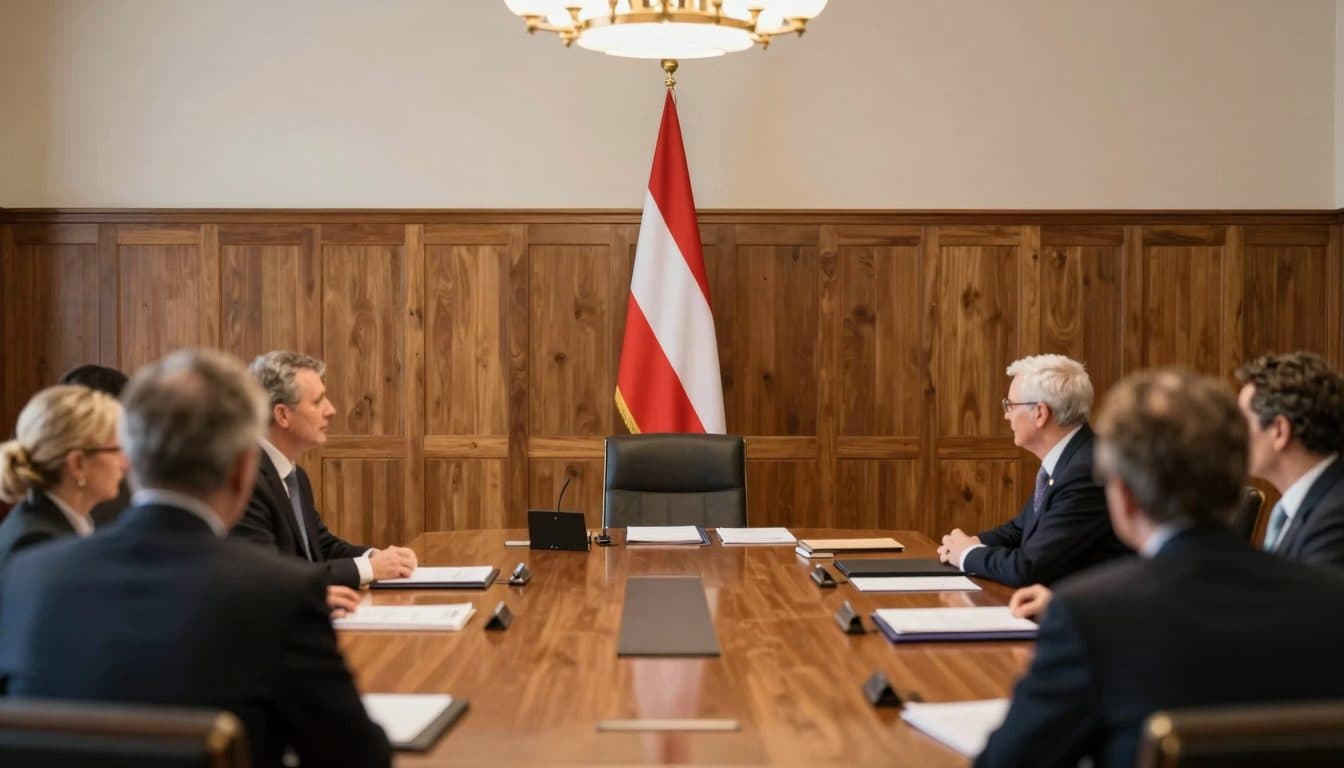
AI-generated image (z-image via Kie.ai)
Summary
The Austrian government has launched a free online platform for digital continuing education together with 30 companies and organizations. The first package of measures comprises around 60 educational offerings with over 1,200 hours of learning content.
Vienna, 14 July 2026
State Secretary for Digitalization Alexander Pröll (ÖVP) signed the pact for the "Digitale Kompetenzoffensive" (DKO – Digital Skills Initiative) together with 30 companies, institutions and social partners on Tuesday at the Federal Chancellery and presented a central platform for free digital continuing education.
The new economic platform of the Digital Skills Initiative consolidates educational offerings from the state and business in one place for the first time. At the address digitalaustria.gv.at/kompetenzen/wirtschaftsplattform, interested parties can find the first package with around 60 free educational offerings, more than 145 courses, modules and learning games, as well as a total of over 1,200 hours of digital learning material. The aim is to make it easier for everyone in Austria to access practical digital education.
At the presentation, Pröll emphasized the initiative's significance for society as a whole: "Digitale Kompetenz entscheidet über gesellschaftliche Teilhabe, berufliche Chancen und die Wettbewerbsfähigkeit unseres Standorts." He described digital education as "der Erfolgsfaktor für unseren Wirtschaftsstandort Österreich" and said: "Wir machen digitale Bildung für jeden in Österreich zugänglich."
Content and Scope
The platform covers a broad range of topics. The focus is on key digital skills: AI, cybersecurity, basic digital skills, programming, IT and data literacy. The offering is supplemented by content on digital accessibility, financial education and sustainability. According to the State Secretariat, more than 70 percent of the offerings are available online regardless of location and time; webinars, supervised courses and in-person offerings, including school workshops, are also available.
Among the 30 partners are, alongside ministries and social partners, major domestic companies such as A1, ÖBB and Dynatrace, as well as international US tech corporations like Google, Microsoft, Amazon, Apple, IBM, Oracle, Cisco and Samsung. Many of the programs contributed, such as IBM SkillsBuild and the Google Zukunftswerkstatt, already existed and are now being consolidated under the state umbrella. 15 of the initial 30 partners have contributed specific educational offerings to the first package of measures.
A1, Samsung and IBM have already been offering IT skills programs for years and can now integrate them through the platform. Thomas Arnolder, Vice President of the telecommunications group A1, said at the Federal Chancellery: "Digitale Kompetenzen sind heute so wichtig wie Lesen und Schreiben und wir dürfen die Menschen dabei nicht alleine lassen." He thus pointed to the comprehensive educational mandate that business and government must shoulder together.
Partners from Business and Government
Pröll announced that additional companies would join: "Wir werden weitere Unternehmen gewinnen – die 30 sind quasi Gründungsmitglieder." He described the agreement as a first "Commitment" and formulated the goal of appearing before the public again in one year with additionally acquired partners. "Dieser Pakt ist das erste 'Commitment' und das Ziel ist es, dass wir in einem Jahr wieder dastehen und weitere Unternehmen dazugewonnen haben werden."
The initiative is explicitly aimed at all age and population groups: pupils, teachers, working people, IT professionals, senior citizens and people with disabilities and migration backgrounds. This is intended to counteract the finding that around one third of 14-year-olds in Austria have only very low digital skills. At the same time, digitalization has long since arrived among the older generation: three quarters of pensioners in Austria are online, according to the data.
Target Groups and Reach
As a concrete new commitment, Google announced through the platform The Female Factor 2,000 additional scholarships for Google Career Certificates. A central information office on IT career profiles is planned for September, linking training pathways with practical offerings such as internships and school visits. In addition, nationwide action days on AI skills with workshops and Open Company Days are to take place in November.
The DKO Economic Platform forms the framework for cooperation between business, administration, social partners and interest groups. It is oriented towards the National Reference Framework for Digital Competences, the European framework DigComp and the Austrian AI Basic Curriculum. Three goals are at the center: raising the digital basic skills of the population, attracting more people to IT professions, and making digital skills comparable on the basis of common standards.
At the same time, Pröll made clear that the mere availability of technology is not enough: "Die beste technologische Lösung bringt nichts, wenn man sie nicht anwendet." The platform is therefore more than a declaration of intent: "Die DKO-Wirtschaftsplattform ist damit nicht nur ein Bekenntnis, sondern eine gemeinsame Arbeits- und Umsetzungsplattform."
The Three Goals of the Initiative
The economic platform sees itself as the first of three implementation steps of the Digital Skills Initiative. With the pact, the state and business are assuming "gemeinsam Verantwortung für die Zukunft des Standorts," as Pröll emphasized. The offerings can be used free of charge by the entire Austrian population and are to be made visible nationwide through existing structures of the Digital Skills Initiative.
Overall, those involved see the platform as an answer to a dual challenge: the shortage of skilled workers in the IT sector and the unequal distribution of digital skills in society. Through the cooperation between the state and business, a central access point to high-quality and practical offerings from business is being created, which will become visible throughout Austria via the structures of the Digital Skills Initiative, Pröll explained.
With the launch of the platform, the first stage of a longer-term program has been inaugurated. Whether the self-set goals – more basic digital education, more IT specialists and comparable competence standards – will be achieved should become apparent in the coming months and with a view to the anticipated next expansion of partners in one year.
Outlook on Further Steps
Participation in the courses is voluntary and is aimed at learners with very different levels of prior knowledge. The spectrum ranges from beginner courses on handling smartphones and the cloud to specialized training for IT professionals. The platform is intended to be attractive both for private individuals and for companies and public administrations that want to further qualify their employees.
Alongside the online platform, in-person formats are a firm part of the offering. These include school workshops, supervised courses and information events, which are primarily intended to reach those target groups that are harder to reach online. Special formats for people with disabilities are also part of the program, as are offerings in multiple languages to specifically address people with migration backgrounds.
With the Digital Skills Initiative, the government is pursuing a comprehensive approach that links technological, economic and social aspects. The close involvement of international corporations is intended to ensure that the content meets international standards, while domestic companies ensure practical relevance and regional anchoring.
Questions & Answers
Who is Alexander Pröll and what role does he play in the Digital Skills Initiative?
Alexander Pröll (ÖVP) is State Secretary for Digitalization in the Austrian federal government. He initiated the pact for the Digital Skills Initiative (DKO) and signed it together with the 30 partners on Tuesday at the Federal Chancellery.
What content does the new platform digitalaustria.gv.at offer in concrete terms?
The platform consolidates around 60 free educational offerings with more than 145 courses, modules and learning games totaling over 1,200 hours. The focus is on AI, cybersecurity, basic digital skills, programming, IT and data literacy; supplemented by digital accessibility, financial education and sustainability.
Which companies and organizations are involved in the DKO Economic Platform?
The 30 partners include ministries, social partners and domestic companies such as A1, ÖBB and Dynatrace. International tech corporations such as Google, Microsoft, Amazon, Apple, IBM, Oracle, Cisco and Samsung are also part of the initiative.
DKO Platform: Free Education on AI and IT in Austria | allfacts360