Drone Strike Damages Turbine Building at Europe's Largest Nuclear Plant in Ukraine
Vienna, 31 May 2026
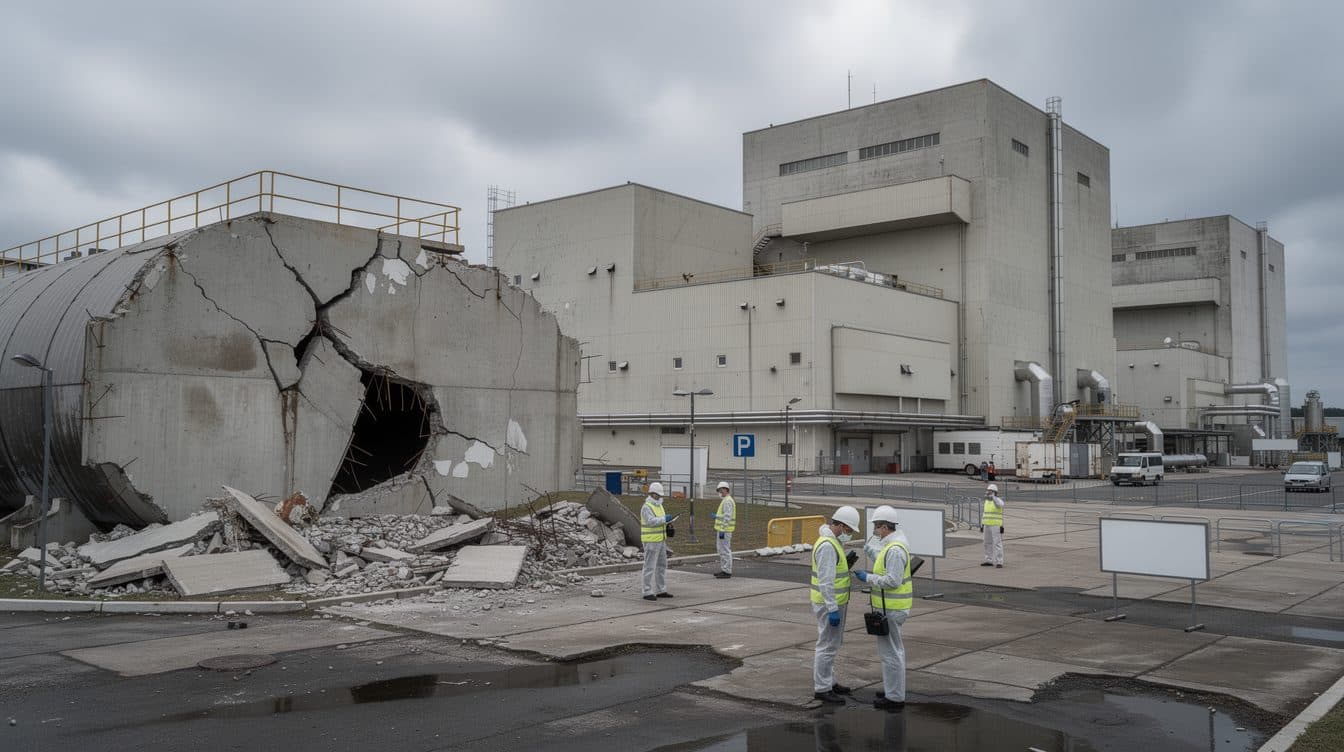
AI-generated image (flux-2/pro-text-to-image via Kie.ai)
Summary
The International Atomic Energy Agency confirmed damage to a turbine building at the Russian-occupied Zaporizhzhia nuclear power plant in Ukraine. Both sides trade accusations over the drone strike, while radiation levels remain normal.
Vienna, 31 May 2026
The International Atomic Energy Agency (IAEA) confirmed on Saturday that a drone strike damaged the wall of a turbine building at the Russian-occupied Zaporizhzhia nuclear power plant in southeastern Ukraine, Europe's largest nuclear facility.
What the IAEA Confirmed
IAEA Director General Rafael Grossi expressed deep concern over the incident, which the agency described as a serious event endangering fundamental principles of nuclear safety. "Attacking nuclear facilities is playing with fire," Grossi said, according to a statement released from the IAEA's headquarters in Vienna.
The plant management, installed by Moscow, informed the IAEA about the possible drone strike. IAEA experts stationed at the site subsequently requested access to the affected building and confirmed that the damage was consistent with a drone strike. No elevated radiation levels were measured following the incident, and the IAEA team on site confirmed normal radiation levels at the facility.
Russia's state nuclear corporation Rosatom and its chief Alexei Likhachev accused Ukraine of a deliberate attack on the plant. Likhachev stated that the drone was controlled via a fiber-optic cable, which he argued ruled out an accidental hit. He added that no critical facilities were damaged in the explosion, but that a hole was torn in the wall of a turbine hall.
Accusations and Denials
The turbine building is located directly next to one of the plant's six reactors. All six reactors are currently shut down, but the plant still requires electricity for its cooling and safety systems. Radioactive material remains on site, heightening the stakes of any military activity near the facility.
The Ukrainian Foreign Ministry rejected the accusations, calling them disinformation and propaganda. "It is incomprehensible why Ukraine would attack a plant on its own territory that it intends to bring back under its control," the ministry stated. The Ukrainian military described the Russian claims as a propaganda trick and characterized the incident as an attempt at "nuclear blackmail" by Russia.
The IAEA generally does not comment on which warring party is responsible after such incidents. Grossi reiterated that there must be no attacks originating from or directed against the plant. "Es dürfe keinerlei von dem Kraftwerk ausgehenden oder gegen das Kraftwerk gerichteten Angriffe geben," he said.
This marks the first drone attack on the Zaporizhzhia plant site since April 2024, according to the IAEA. In that earlier incident, Russian authorities reported that one employee — a driver — was killed in the transport area of the plant during a Ukrainian drone attack.
A History of Danger at the Plant
The Zaporizhzhia nuclear power plant has been under Russian control since March 2022, shortly after Russia launched its full-scale invasion of Ukraine. The plant is located near the front line of the war, and both sides have repeatedly accused each other of risking a nuclear catastrophe with attacks on the facility.
On the same weekend, a separate drone attack targeted a transport hub at the plant where employee transport vehicles are parked, according to the Moscow-installed plant management. Six buses and two minibuses were destroyed, but no employees were harmed and operations continue normally.
The incident at Zaporizhzhia occurred against the backdrop of a wider escalation in long-range drone strikes. According to Russian reports, Ukraine attacked industrial and energy facilities in several Russian regions on the night leading to Sunday.
Wider Drone War Escalates
A spokesperson for the Russian Defense Ministry reported drone strikes in the regions of Saratov, Kirov, Rostov-on-Don, Voronezh, and Belgorod. Several injuries were reported, including three civilians injured in Belgorod. The governor of Kirov region, Alexander Sokolov, reported a drone attack on a facility in the Urzhumsky district, located approximately 1,300 kilometers from Ukrainian-controlled territory.
The Ukrainian military stated it attacked a Russian oil refinery in Saratov, causing a large fire. The Russian side confirmed the attacks on the Saratov oil refinery. Civilian infrastructure was also damaged in the Saratov region, according to governor Roman Busargin. The region hosts several oil refineries that have been targeted by Ukrainian attacks before.
According to the online newspaper Ukrainska Pravda, an oil depot near the city of Taganrog in the Rostov region on the Sea of Azov also came under fire. The governors of Rostov, Voronezh, and Belgorod regions — all bordering Ukraine — also reported attacks.
On the Russian-controlled Crimean peninsula, Moscow-appointed governor Sergey Aksyonov announced restrictions on gasoline sales. Aksyonov did not provide a reason for the restrictions, and it is unknown whether they are connected to the ongoing Ukrainian attacks on Russia's fuel infrastructure. Fuel shortages have occurred in Crimea, leading to the introduction of restrictions.
Air Defenses and Warnings
Ukrainian President Volodymyr Zelenskyy stated that Ukraine received another air defense system from Germany — a new Iris-T air defense launcher, which can be used against flying targets. Zelenskyy added that Ukrainian forces also need missiles for the air defense systems. He also renewed his warning of a massive Russian attack, with Ukrainian forces reporting approximately 300 Russian missiles.
Rosatom chief Likhachev issued a stark warning following the turbine building strike. "Heute sind wir einem Ereignis einen Schritt näher gekommen, das mit hoher Wahrscheinlichkeit auch diejenigen betreffen wird, die weit jenseits der Grenzen Russlands und der Ukraine leben," he said — "Today we have come one step closer to an event that will most likely also affect those living far beyond the borders of Russia and Ukraine."
IAEA inspectors at the plant had to seek safety on Saturday after hearing drone noises and gunshots, underscoring the precarious conditions under which international monitors operate at the site. The IAEA subsequently demanded access to the turbine building to assess the damage.
The war, started by Russia more than four years ago, has seen drone attacks become routine on both sides. The Zaporizhzhia plant, as the largest nuclear power plant in Europe, remains a focal point of international concern due to its proximity to active combat zones and the catastrophic consequences any major incident could trigger.
Questions & Answers
What happened at the Zaporizhzhia nuclear power plant?
A drone strike damaged the wall of a turbine building at the Russian-occupied Zaporizhzhia plant, according to the IAEA. No radiation was released and all six reactors remain shut down.
Who does Russia blame for the drone strike?
Russia's state nuclear corporation Rosatom and its chief Alexei Likhachev accuse Ukraine of a deliberate attack, claiming the drone was guided by a fiber-optic cable.
Why is the Zaporizhzhia plant so significant?
It is the largest nuclear power plant in Europe, located near the front line of the war, and has been under Russian control since March 2022. Any damage raises fears of a nuclear catastrophe.
Zaporizhzhia Nuclear Plant Drone Damage Confirmed by IAEA | allfacts360