Drone Hits Spent Fuel Storage Facility in Chernobyl Exclusion Zone
Kyiv, 07 June 2026
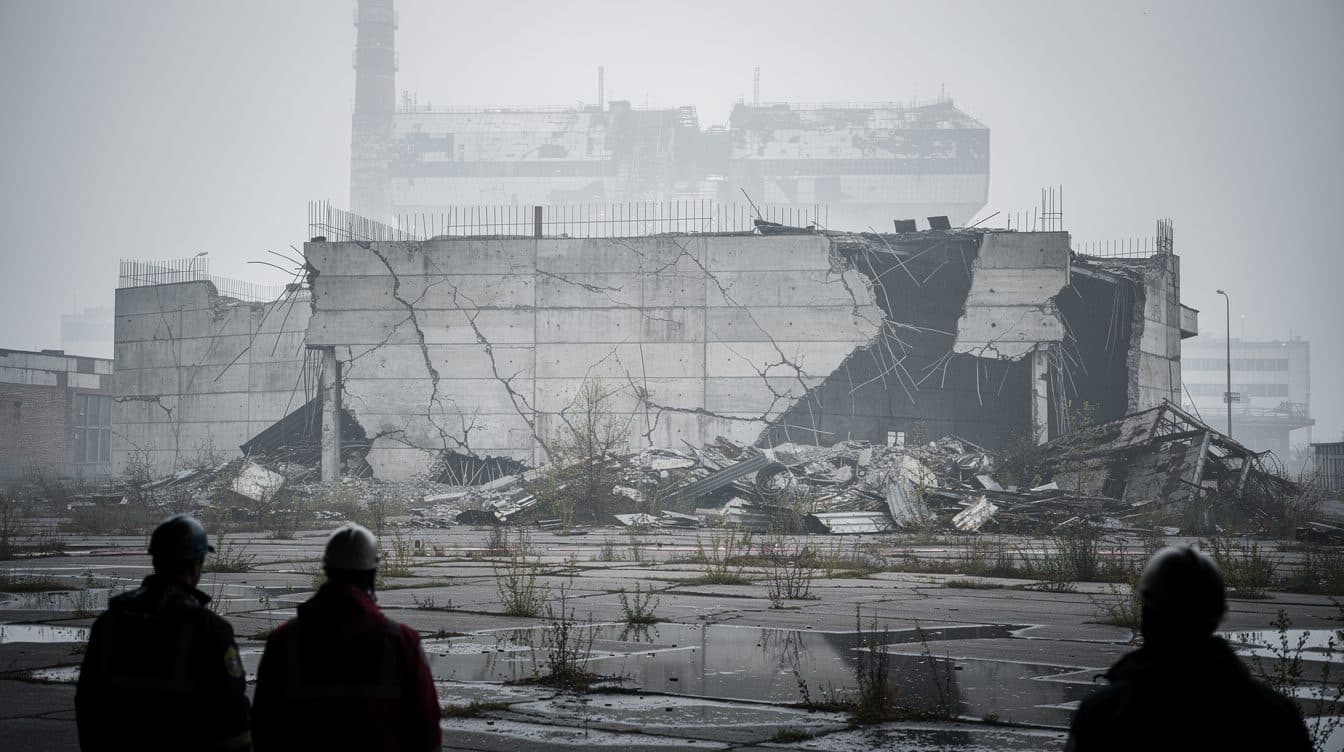
AI-generated image (flux-2/pro-text-to-image via Kie.ai)
Summary
In a nighttime drone attack, a building of the central spent fuel storage facility in the exclusion zone around the decommissioned Chernobyl nuclear power plant was hit and partially destroyed. Ukraine's state-owned enterprise Energoatom and the IAEA stated that radiation levels remain within established limits.
Kyiv, 07 June 2026
According to Ukrainian officials, a Russian drone hit and partially destroyed a building of the central spent fuel storage facility in the exclusion zone around the decommissioned Chernobyl nuclear power plant overnight into Sunday.
Background: Facility in the Exclusion Zone
Ukraine's state-owned enterprise Energoatom reported that the container reception building was partially destroyed in the nighttime attack. According to the report, a fire spread over an area of 40 square meters but was extinguished. "Das Gebäude für die Annahme von Behältern sei bei dem Angriff in der Nacht teilweise zerstört worden, teilte der Staatskonzern Energoatom mit. Die Strahlenwerte lägen innerhalb der festgelegten Grenzwerte, hieß es.
The damaged building is located approximately 15 kilometers from the reactor block of the former Chernobyl nuclear power plant, according to Ukrainian officials. The central storage facility in the exclusion zone around the Chernobyl nuclear power plant, which suffered a disaster 40 years ago, is used for the long-term storage of spent fuel from other Ukrainian nuclear power plants. Energoatom stated that the hit building was empty at the time of impact and that no spent nuclear fuel had been stored there.
The International Atomic Energy Agency (IAEA) announced that it had been informed by the Ukrainian side of "significant damage" to the building. "Betroffen sind demnach die Fassade, die Fenster und Türen. Auch benachbarte Gebäude seien durch die Druckwelle in Mitleidenschaft gezogen." According to the IAEA, significant damage occurred to parts of the spent fuel storage building. The agency announced it would send a team of experts to inspect the damage.
IAEA Response
IAEA Director General Rafael Grossi wrote on X that the incident was extremely concerning because it occurred at a site where large quantities of nuclear material are stored—just a few meters from the attacked building. Attacks on nuclear facilities are completely unacceptable and constitute a direct violation of fundamental principles of nuclear safety during armed conflict, Grossi said. The agency described the incident as "deeply troubling."
Ukrainian President Volodymyr Zelensky stated on Telegram and the platform X that it was an "extraordinarily insidious Russian attack." Russia had deliberately targeted a "critical infrastructure" facility. He emphasized that the relevant ministries and services had informed Kyiv's partners about the incident. At the same time, he said: "So far," there were no elevated readings. He also said it was evidence of Russia's "audacity." "Russland habe das Gebiet gezielt attackiert, schrieb er auf X. Es handele sich um eine äußerst kritische Infrastruktureinrichtung.
Response from Kyiv
In a later statement, Zelensky put it sharply: "There may be no exceedance of radiation limits, but there is an exceedance of Russia's already sky-high cruelty." Elsewhere, he spoke of an "exceedance of the already sky-high impertinence." Zelensky once again called on the international community to take action against Russia. The Ukrainian General Staff in Kyiv and the state nuclear regulatory authority stated that radiation levels had remained stable and that there were no reports of injuries.
According to the IAEA, an inspection of the facility determined that levels remained normal; no radioactive contamination was detected. In fact, it remains unclear whether the nuclear waste storage facility was intentionally targeted. No information was initially provided by the Russian side. The Russian Ministry of Defense stated only that attacks had been carried out on targets associated with the Ukrainian military.
Repeated Incidents at Nuclear Facilities
Ukrainian Foreign Minister Andriy Sybiha stated on X that "this is not the first time Russian forces have endangered Ukrainian nuclear facilities." Last year, the new sarcophagus of the disaster reactor was hit by a Russian drone, causing lasting damage. These are repeated incidents at nuclear facilities during the course of Russia's war of aggression, which has now lasted more than four years.
On 26 April 1986, a test at the Chernobyl nuclear power plant in what was then the Soviet republic of Ukraine went out of control, resulting in the worst possible accident (a major nuclear incident). Radioactive clouds spread in attenuated form as far as Northern and Western Europe. The plant has been decommissioned for decades. The Russian-occupied Zaporizhzhia nuclear power plant in southeastern Ukraine has also been repeatedly affected.
Situation in Zaporizhzhia
At the Zaporizhzhia plant, an important power line had previously been restored after a 15-hour power outage, according to the IAEA. Prior to that, the facility had to rely on emergency diesel generators to cool its six shutdown reactors, according to the IAEA. Kyiv is demanding that Moscow return Europe's largest nuclear power plant. Russia repeatedly accuses Ukraine of attacks near the Zaporizhzhia complex.
According to the Russian state corporation Rosatom, a Ukrainian combat drone had hit the Russian-controlled Zaporizhzhia nuclear power plant. Rosatom head Alexei Likhachev said on Saturday that important facilities had not been damaged in the explosion, but a hole had been torn in the wall of a turbine hall. The IAEA announced on Saturday evening on the platform X that it had been informed of an attack that had torn a hole in a wall—the first drone impact within the plant grounds since April 2024.
Grossi expressed that he was "seriously concerned" about the incident. "Attacks on nuclear facilities are like playing with fire," he said. The agency announced that a team would visit the facility shortly to assess the impact. This is intended to provide an independent review of the situation both at Chernobyl and at the Zaporizhzhia site.
Parallel to the attack on the exclusion zone, authorities in the embattled Zaporizhzhia region reported in the morning that a Russian glide bomb had killed three people in a village. According to regional governor Ivan Fedorov, one person was killed and two others injured in Balabyne, and three more people were injured near a local transit stop. In the central Ukrainian region of Dnipropetrovsk, a 59-year-old man was killed in Russian drone and missile attacks, and a 35-year-old man was injured. In the southern Zaporizhzhia region, a 56-year-old minibus driver was killed in a drone attack. Dnipropetrovsk governor Oleksandr Hanscha reported this on the Telegram online service.
Diplomacy and London Meeting
The incident is expected to be the subject of a meeting in London, to be attended by Zelensky, German Chancellor Friedrich Merz, French President Emmanuel Macron, and British Prime Minister Keir Starmer. A meeting is scheduled for the evening in London—with British Prime Minister Keir Starmer, French President Emmanuel Macron, German Chancellor Friedrich Merz, and Ukrainian President Volodymyr Zelensky. According to sources in Paris, the meeting was also to discuss increased pressure on Russia.
Efforts to end the war, which has lasted more than four years, under US mediation have stalled. Kremlin chief Putin rejected a summit proposed by Zelensky on Friday. Zelensky said Putin simply "does not want to end" the war. At the same time, Putin received former German Chancellor Gerhard Schröder (SPD) in the Kremlin; the meeting was described by the Kremlin as a "good" and friendly one-on-one conversation, the content of which was not disclosed. Putin had recently brought Schröder into play as a possible mediator for talks between Russia and Europe.
SPD foreign policy expert Ralf Stegner told the "Tagesspiegel": "Egal, was man von Gerhard Schröder hält, muss doch jeder anerkennen: Es ist eher eine Chance als ein Risiko, wenn der frühere Bundeskanzler Schröder mit Präsident Putin redet." He added: "Was bitte soll ein solches Vier-Augen-Gespräch schaden? Ob es am Ende nützen wird, lässt sich heute kaum abschätzen."
Further Attacks and Russian Response
German Foreign Minister Johann Wadephul has assured Ukraine of further support after Russia rejected a direct meeting. Germany's support for Ukraine remains unwavering, Wadephul said during a visit to Mexico City. At the same time, he again called on Putin to enter negotiations to end the war. Zelensky had previously offered Putin direct talks in a third country. Moscow is once again choosing war, Zelensky said, while also calling for stronger international pressure on Russia.
The Ukrainian General Staff in Kyiv meanwhile reported attacks on targets in Russia: an oil terminal in Russia's Leningrad region was hit. Zelensky stated that the military had also struck a military base near St. Petersburg as well as another Russian oil depot in the southern Russian Krasnodar region. Russia, in turn, claimed to have intercepted hundreds of Ukrainian drones, including dozens near the city of St. Petersburg, where an international economic forum is currently taking place. The attacks occurred on the final day of the forum, at which Putin had spoken.
Since the beginning of the week, Russia has used 88 missiles, more than 3,250 combat drones, and approximately 1,800 glide bombs, Zelensky said. "In dieser Nacht gab es russische Angriffe auch auf andere zivile Objekte in 13 unserer Regionen." The Ukrainian Air Force stated that Russia had deployed 236 drones overnight into Sunday, of which 215 were intercepted. The Russian Ministry of Defense reported intercepting 95 Ukrainian drones overnight into Sunday. The Russian figures cannot be independently verified according to the report.
This news was broadcast on 07.06.2026 on the Deutschlandfunk program.
Drone Attack on Chernobyl Facility: IAEA Sends Team | allfacts360