
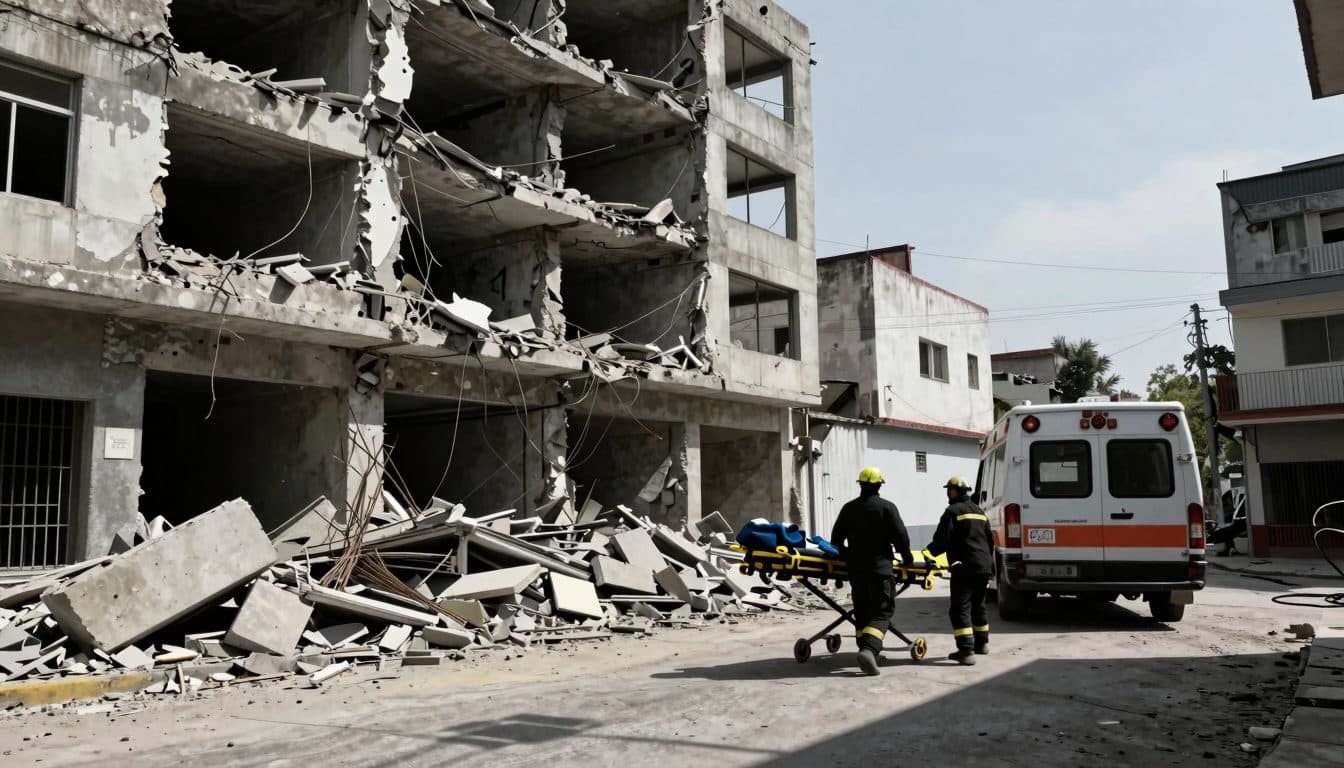
More than eight days after a severe double earthquake, 43-year-old Hernán Gil has been rescued alive from the rubble of a collapsed seven-story building in Catia La Mar, Venezuela.
The rescue succeeded on Thursday after three days of concentrated recovery work involving teams from Venezuela, El Salvador, Chile, the United States, Portugal, Mexico, and Costa Rica. Salvadoran President Nayib Bukele declared on the platform X that it was a miracle. "Thank God for making this miracle possible," Bukele wrote, also announcing: "We finally managed to rescue Hernán."
Gil was a security guard at the collapsed building and was trapped beneath the rubble in his guard booth after the collapse. After his liberation, he was carried out of the debris on a stretcher to the applause of rescuers and residents, as videos of the scene show. AFP reporters said the on-site crews embraced each other.
Cristian Vera, head of the Chilean rescue team, described the recovery operation as "rather complicated," explaining: "It was not easy to reach the exact point where the victim was located." The rescuers had to repeatedly change their strategy and create a new access route to the trapped man because a neighboring building was at acute risk of collapse from aftershocks.
Race Against Time
Gil was approximately nine meters beneath the building's rubble. Rescue workers established contact with him days before the actual extraction and supplied him with water and oxygen through a tube. According to eyewitnesses, he received more than ten liters of water in this manner in order to stay hydrated. By Thursday morning, the helpers were less than one meter from Gil before they broke through the final concrete slab with a pneumatic hammer.
The survivor's wife, Gusbimar González, expressed to AFP how deeply moved she was by the rescue of her husband. It was "truly a miracle" that he was still alive, and she was "completely overwhelmed" that people from so many countries had come together to save a single individual. Transitional President Delcy Rodríguez stated via the platform X: "Today we celebrate the life of Hernán Gil" and thanked the national and international rescue teams.
Scale of the Disaster
The extraordinary recovery takes place against the backdrop of a devastating natural catastrophe. On the Wednesday approximately one week earlier — reports date the quakes to June 24 — two strong tremors struck the country in rapid succession, including, according to consistent media reports, a magnitude 7.2 quake. According to official figures, 189 buildings were destroyed; the total death toll was last put at 2,595.
More than 11,000 people were injured by the tremors, and tens of thousands are still considered missing. International experience shows that the chances of survival for those trapped drop significantly after just a few days — making Gil's rescue after eight days beneath the rubble all the more remarkable.
In the particularly affected coastal areas around La Guaira and Catia La Mar, the situation is devastating, according to aid workers. Daniella Inojosa, director and co-founder of the local aid organization Tinta Violeta, described the situation this way: "The situation in La Guaira is far more dramatic than we initially thought. Everything is destroyed. It doesn't look as if a city ever stood there." She expects a further rising humanitarian need, as she said: "The scale of the destruction, the human losses, and the trauma is absolutely heartbreaking. Search and rescue operations are still ongoing. We continue to expect that humanitarian needs will increase."
Hope and Despair at the Port
Erich Fenninger, director of Volkshilfe Österreich, warned of the hygienic conditions in the emergency shelters: "The emergency shelters in La Guaira are completely overcrowded, and the sanitary conditions there are catastrophic. There is an elevated risk of the spread of infections and gastrointestinal diseases." The organization is therefore distributing hygiene packages as an initial aid measure. The German Technisches Hilfswerk is also involved in the rescue operations.
Meanwhile, an improvised gathering point for relatives and a makeshift identification site has been established at the port of La Guaira. Forensic specialist and police officer Johann Pérez coordinates the improvised area and summarizes the hope of many relatives: "We are waiting for miracles" — a phrase that, in light of Gil's rescue, found a real-world counterpart. Only difficult-to-identify bodies are photographed and numbered. The bodies are initially gathered in a hospital, "But since it is a health facility, we tried to move them here afterward so that the hospital wouldn't be contaminated," Pérez explained.
Criticism of Crisis Management
Amid the masses of mourners and searchers, new private aid deliveries keep arriving at the port. Pickups carrying food and water for the homeless pass through the port grounds. An 80-year-old woman left the port without having found her son among the victims; others, like Mariela Corpas, continue to wait to identify the mortal remains of her grandparents. She described the situation as "It is terrible. It is exhausting, frustrating. You feel so powerless." The waiting is like "You ask at one place and are sent to the next" — an odyssey through the authorities without a functioning mobile network.
While López's description illustrates the bureaucratic battle, the military cordon around the earthquake zone is coming under criticism. Authorities justify the roadblocks with security concerns and the prioritization of rescue vehicles. Carmen Alejandra, whose name was changed for safety reasons because she criticizes the Venezuelan government and fears reprisals, described the situation on the day of the quake from the capital, Caracas: The quake was "a horizontal, jerky back-and-forth swaying. But with a force such that we had to hold on." She experienced the first moments as "First I felt fear, then panic. My whole body was shaking."
The criticism of the government's crisis management, according to residents, does not let up. Carmen Alejandra said: "People were asking for shovels, pickaxes, and ropes — even the fire department came but didn't even have a ladder. The only ones who helped were neighbors, relatives, and other volunteers." Her personal conclusion is devastating: "What we are experiencing right now is devastating: It is a second earthquake, a human one." She also accused the authorities of major rescue and security forces not being on hand at the crucial moment, stating: "People literally died in the arms of the rescue workers."
International Aid Pledges
Her account points to a central supply problem: During the first hours after the tremors, neither mobile phone networks nor electricity were available. Aftershocks during the night also took a toll on the people; Carmen Alejandra stated for the record: "If the wind blows strongly at the window, it really makes you nervous." Other rescue teams, including one from southern Spain, were unable to enter the country "due to bureaucratic hurdles," according to SRF South America correspondent Teresa Delgado.
International financial aid is meanwhile taking shape: Rodríguez stated that the International Monetary Fund and the World Bank had offered loans for reconstruction. The transitional president also assured that the search for survivors and victims beneath the rubble would continue. The rescue of Hernán Gil, a security guard who was buried while at work, is seen as a sign of hope amid an unprecedented catastrophe.