Ebola outbreak DR Congo: 1,624 cases, WHO in expansion phase
Kinshasa, July 7, 2026
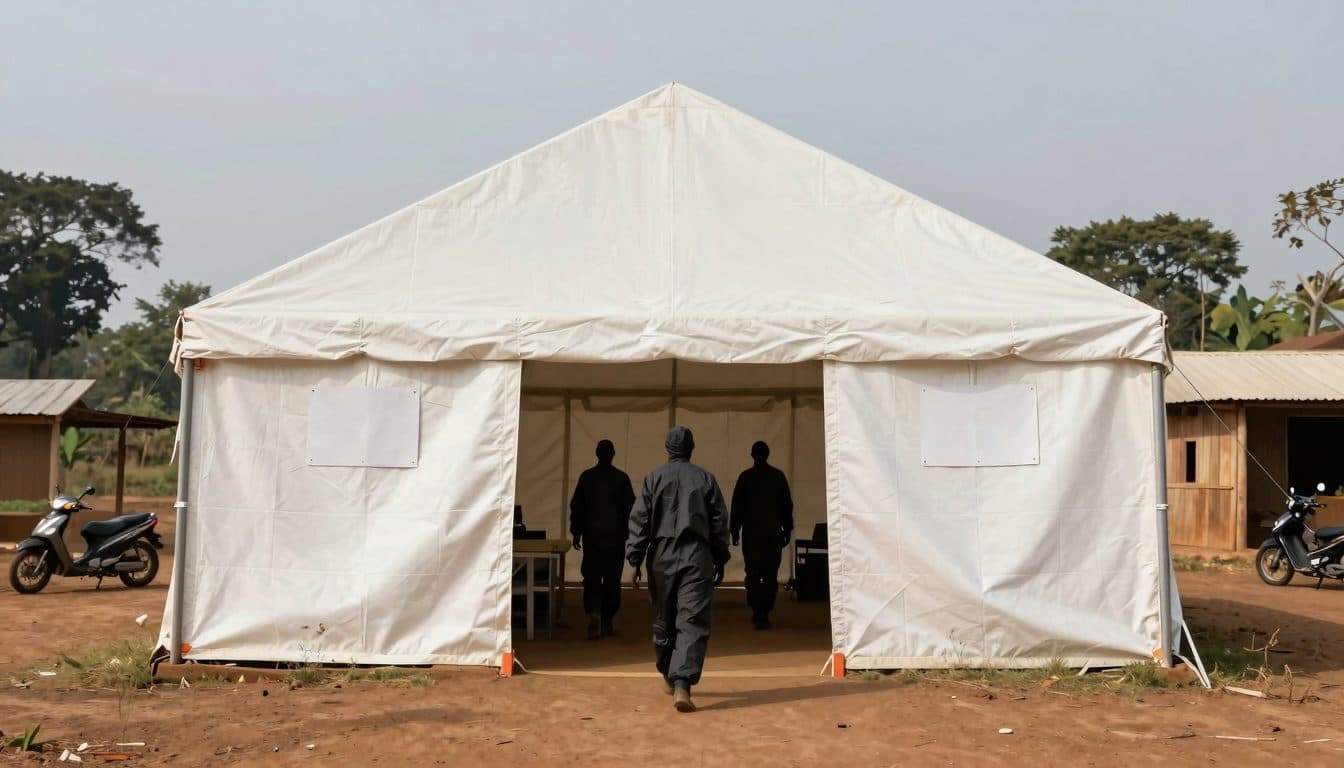
AI-generated image (z-image via Kie.ai)
Summary
The Ebola outbreak in the Democratic Republic of Congo has reached 1,624 confirmed cases according to government data released on Tuesday, including 521 deaths. The World Health Organization continues to view the outbreak as being in an expansion phase, while treatment centers are operating at 90 percent capacity.
Kinshasa, July 7, 2026
The Ebola outbreak in the Democratic Republic of Congo has continued to spread according to the World Health Organization (WHO); the government reported 1,624 confirmed cases on Tuesday, including 521 deaths.
The World Health Organization assesses the situation in eastern Democratic Republic of Congo as remaining critical. They are „leider immer noch in der Expansionsphase“ („unfortunately still in the expansion phase“), WHO representative Anne Ancia stated on Tuesday. According to government data released on Tuesday, 1,624 Ebola infections have now been confirmed in the Central African country. Among them are 521 deaths.
Bundibugyo variant without proven therapy
The outbreak is the most consequential epidemic to date of the rare Bundibugyo variant of the virus, for which there is no proven treatment or cure. The WHO had previously warned that the situation is likely to worsen without decisive countermeasures. „Als ein Grund für die Ausbreitung gilt die hohe Mobilität der Bevölkerung“ („High population mobility is considered one reason for the spread“), Ancia said.
The situation is particularly tense in the treatment centers. As the WHO representative further explained, the treatment centers for Ebola patients are 90 percent full. This high occupancy limits the possibilities for admitting new patients and monitoring contact persons. Given the lack of a proven therapy for the Bundibugyo variant, caring for the sick represents an enormous logistical and personnel challenge.
Ituri province under pressure
Ituri province is officially the most severely affected area. In the most severely affected province of Ituri, health workers had recently gone on strike due to outstanding salary payments. The strike by health personnel has further exacerbated the already tense situation, the WHO said. Without functioning treatment structures, the risk rises that infections remain undetected and continue to spread.
An additional problem is the insufficient protective equipment for health workers. Many of the victims are health workers who became infected in some cases due to a lack of protective equipment. Infections among medical personnel are considered particularly serious because they undermine trust in the aid services on offer and further reduce containment capacity.
Mongbwalu as the starting point of new infection chains
Population mobility also plays a central role in the spread. For example, sick workers from the mining town of Mongbwalu do not seek treatment on site but travel home and thereby carry the disease into new regions, Ancia described. Mongbwalu is located in Ituri province and is an economic center with high commuter traffic; the homeward journeys of sick workers significantly enlarge the geographic risk area.
International aid and vaccinations
The WHO is coordinating its response together with Congolese authorities and international partners. Vaccinations are being administered using the Ervebo vaccine, which is approved against the Zaire variant, as well as experimental vaccines that are also being used in part against Bundibugyo. International aid organizations such as Doctors Without Borders and the International Red Cross report that they have personnel and materials deployed on the ground.
The supply situation is further complicated by logistical problems. The affected provinces are partly located in hard-to-access areas marked by conflict. Roads are often impassable during the rainy season, which hinders the transport of patients, samples, and protective equipment. Aid workers must in some cases deploy by motorcycle or helicopter.
The German federal government has announced that it will support the international measures with additional funds. The amount and timing of the pledged assistance have not yet been publicly specified. The WHO has repeatedly pointed out that additional financial resources are urgently needed in order to maintain and expand ongoing operations.
The economic consequences for the region are already being felt. Cross-border trade in the provinces of North and South Kivu as well as Ituri has partially come to a halt according to observations by aid organizations. Small retailers report sharply declining revenues because supply chains have been disrupted and fear of infection is restricting mobility.
Economic and social consequences
Schools and public facilities in the most severely affected health zones are partially closed according to local authorities. Vaccination campaigns against other diseases such as measles or polio also had to be suspended according to UNICEF, because personnel and resources are tied up in the Ebola response. This increases the risk of further outbreaks.
Outlook: further rising numbers expected
At the border with Uganda, Rwanda, and Burundi, neighboring countries have tightened their controls. At border crossings, travelers are being screened for fever and other symptoms, and mobile screening units are in operation. The WHO recommends that travel to the affected areas be avoided where possible and that travelers inform themselves about the current situation before departure.
For the coming weeks, the WHO expects case numbers to continue rising. According to Ancia, it is still too early to predict a turnaround. The decisive factor is that health personnel can resume their work and that the supply of protective equipment be secured. Educating the population about hygiene and safe burial practices also remains a central pillar of containment.
International observers emphasize that supporting local structures will be crucial in the long term. „Wir können die Epidemie nur gemeinsam mit den kongolesischen Behörden, mit dem Gesundheitspersonal vor Ort und mit den Gemeinden stoppen“ („We can only stop the epidemic together with the Congolese authorities, with local health personnel, and with the communities“), Ancia said. The WHO is calling on the international community for sustained solidarity and financial support.
The Democratic Republic of Congo has already experienced several Ebola epidemics in recent years. The current outbreak is, however, considered the most consequential to date. If the epidemiological situation does not stabilize in the coming weeks, experts warn that one of the largest humanitarian crises of the decade threatens the region.
The WHO intends to further expand its deployment teams in the coming days. Mobile laboratories and additional cold chains for vaccines are also to be relocated to Ituri province. Whether this will suffice to break the dynamics of the outbreak will be shown by the case numbers of the coming weeks.
Questions & Answers
How many confirmed Ebola cases are there in DR Congo?
According to government data from Tuesday, 1,624 Ebola infections have been confirmed, including 521 deaths.
Why is the outbreak continuing to spread according to the WHO?
WHO representative Anne Ancia cites high population mobility as well as sick workers from Mongbwalu who travel to their home villages for treatment as central reasons.
What role does Ituri province play in the outbreak?
Ituri is the most severely affected province, where health personnel recently struck due to outstanding salary payments and where the treatment centers are 90 percent full.
Ebola outbreak DR Congo: 1,624 cases, WHO in expansion phase | allfacts360