Ebola Outbreak in DR Congo Surpasses 900 Suspected Cases, Over 200 Dead
Bunia, 29 May 2026
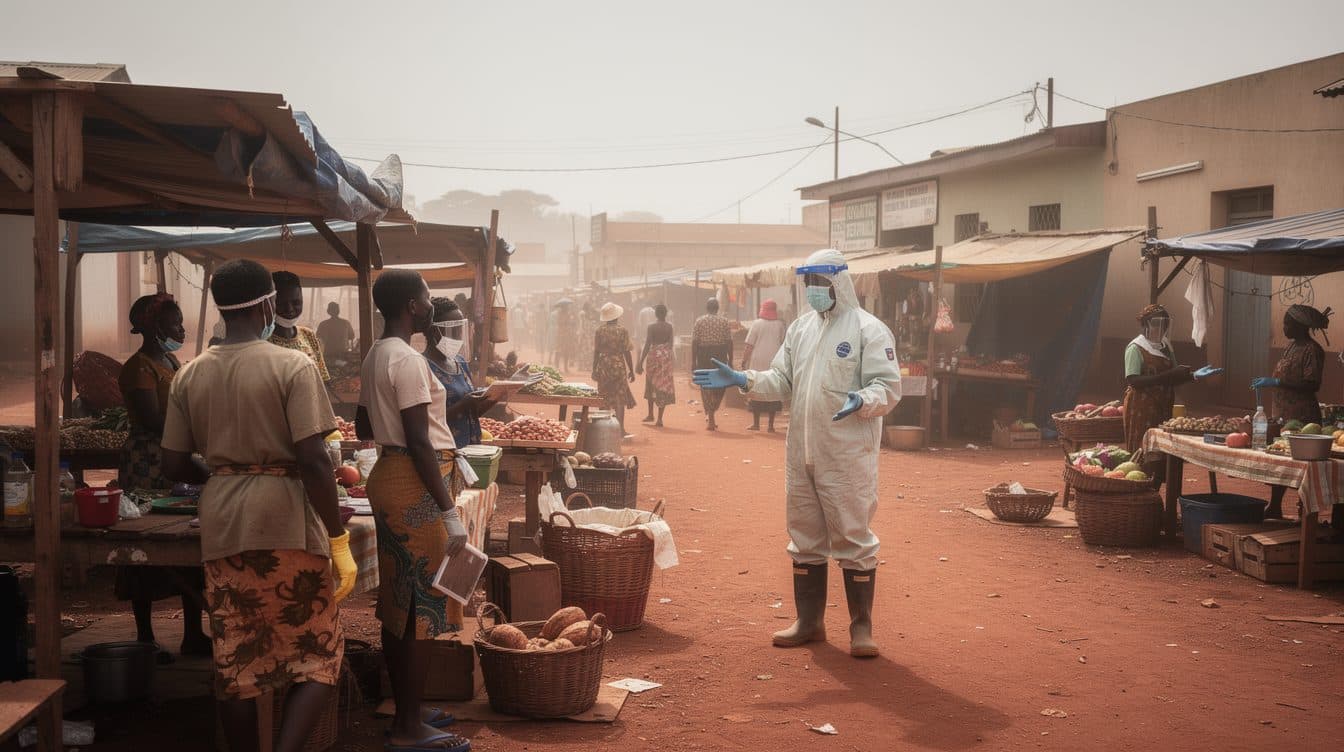
AI-generated image (flux-2/pro-text-to-image via Kie.ai)
Summary
An Ebola outbreak in the Democratic Republic of the Congo has now recorded more than 900 suspected cases and claimed over 200 lives. The World Health Organization has raised the national spread risk to 'very high' as volunteers work to overcome deep public mistrust.
Bunia, 29 May 2026
The World Health Organization (WHO) has confirmed that the Ebola outbreak in the Democratic Republic of the Congo's eastern provinces has surpassed 900 suspected cases and caused more than 200 deaths, with the risk of national spread now assessed as 'very high.'
A Delayed and Dangerous Response
The current epidemic, centered in the Ituri province and affecting urban hubs like Bunia, is driven by the Bundibugyo variant of the Ebola virus, a strain first identified in 2007. This variant has a mortality rate of approximately 30 to 50 percent, according to health officials.
WHO Director-General Tedros Adhanom Ghebreyesus announced the updated figures on Sunday, confirming that over 900 suspected cases have been registered. The announcement came just two days after the WHO elevated the risk of national spread within the DRC to 'very high.'
The regional risk is considered 'high,' while the global risk remains 'low,' the WHO stated. However, the rapid spread into densely populated urban centers is a major concern for health authorities.
Conflict Zone Complications
The outbreak is unfolding against a backdrop of severe instability. For years, the Congolese army has been fighting the M23 militia, which is supported by Rwanda, in the eastern Kivu regions. Last year, the M23 seized territory in North and South Kivu and has attempted to establish its own administration.
This conflict has severely complicated the humanitarian response. The delayed detection of the outbreak has also been a critical factor. 'Normally we start countermeasures as soon as the first few cases become known. Never as late as this time, when there were already several hundred cases,' a health official explained.
'We are therefore dealing with a large outbreak that has already reached several regions,' the official added. The high mobility of the population in Ituri and the virus's arrival in cities with hundreds of thousands of inhabitants have further accelerated transmission.
Scouts on the Front Lines of Education
On the front lines, volunteers like Francois Kasereka are working tirelessly to educate the public. Kasereka, a member of the local Scouts, spends his days explaining how to prevent infection.
'I am a member of the Scouts. We are currently working as volunteers to warn people about Ebola and educate them on how to protect themselves from infection,' Kasereka explained.
His message is direct and urgent. 'Do not touch!' Kasereka tells his listeners, instructing them that they must not touch a sick family member. 'We do everything we can to ensure that the population observes hygiene measures such as hand washing, does not touch the sick, and under no circumstances touches the dead.'
This public health messaging is met with deep-seated mistrust of authorities, making the volunteers' work extremely delicate, especially when discussing the handling of deceased relatives. 'Talking to people about the disease and such measures requires a lot of tact,' the report noted.
'We want to talk to people and explain to them what Ebola is and how the virus is transmitted,' Kasereka said. 'We want to keep the risk of infection in our city and our province as low as possible.'
A Crisis of Trust
The challenge of overcoming misinformation and fear is immense. Many people in the affected areas do not know how to protect themselves, which has allowed the virus to spread further. The work of Kasereka and his fellow volunteers is seen as crucial to breaking the chain of transmission.
Health experts warn that the coming weeks will demand the full energy not only of the Scouts but of all aid workers in the region. The combination of a volatile security situation, urban spread, and community resistance creates a uniquely difficult environment for containment.
The Bundibugyo variant, while less deadly than the Zaire strain that caused the 2014-2016 West Africa epidemic, still poses a severe threat. Its 30 to 50 percent fatality rate means that without immediate supportive care, a significant portion of those infected will die.
The Path Forward
International health agencies are coordinating with local authorities to scale up the response, but access to some conflict-affected zones remains limited. The M23 militia's presence in North and South Kivu adds a layer of complexity to an already dire public health emergency.
For now, the focus remains on community engagement. Volunteers are going door-to-door to explain that the virus is spread through direct contact with bodily fluids of an infected person, and that safe burial practices are essential to prevent further infections.
The WHO and other organizations are working to supply personal protective equipment, set up isolation units, and trace contacts of confirmed cases. However, the late start to the response means the outbreak has a significant head start.
As the number of cases continues to climb, the resolve of local volunteers like Kasereka offers a glimmer of hope. Their ability to build trust within their own communities is considered one of the most effective tools available to stop the outbreak's spread.
Questions & Answers
What Ebola strain is causing the outbreak in the DR Congo?
The outbreak is caused by the Bundibugyo variant of the Ebola virus, which was first identified in 2007 and has a mortality rate of about 30 to 50 percent.
Why is the response to this outbreak considered so late?
Health officials stated that countermeasures normally begin with the first few cases, but this time the response did not start until there were already several hundred cases, allowing the outbreak to grow significantly.
Who is Francois Kasereka and what is his role?
Francois Kasereka is a Scout volunteer in the DR Congo who educates local communities about Ebola prevention, teaching them not to touch sick or deceased people and to practice hand hygiene.
DR Congo Ebola Outbreak: 900+ Cases, WHO Raises Risk Level | allfacts360