Federal Network Agency Wants to Reserve Tracks on ICE Corridors for Competitors
Bonn, 30 June 2026
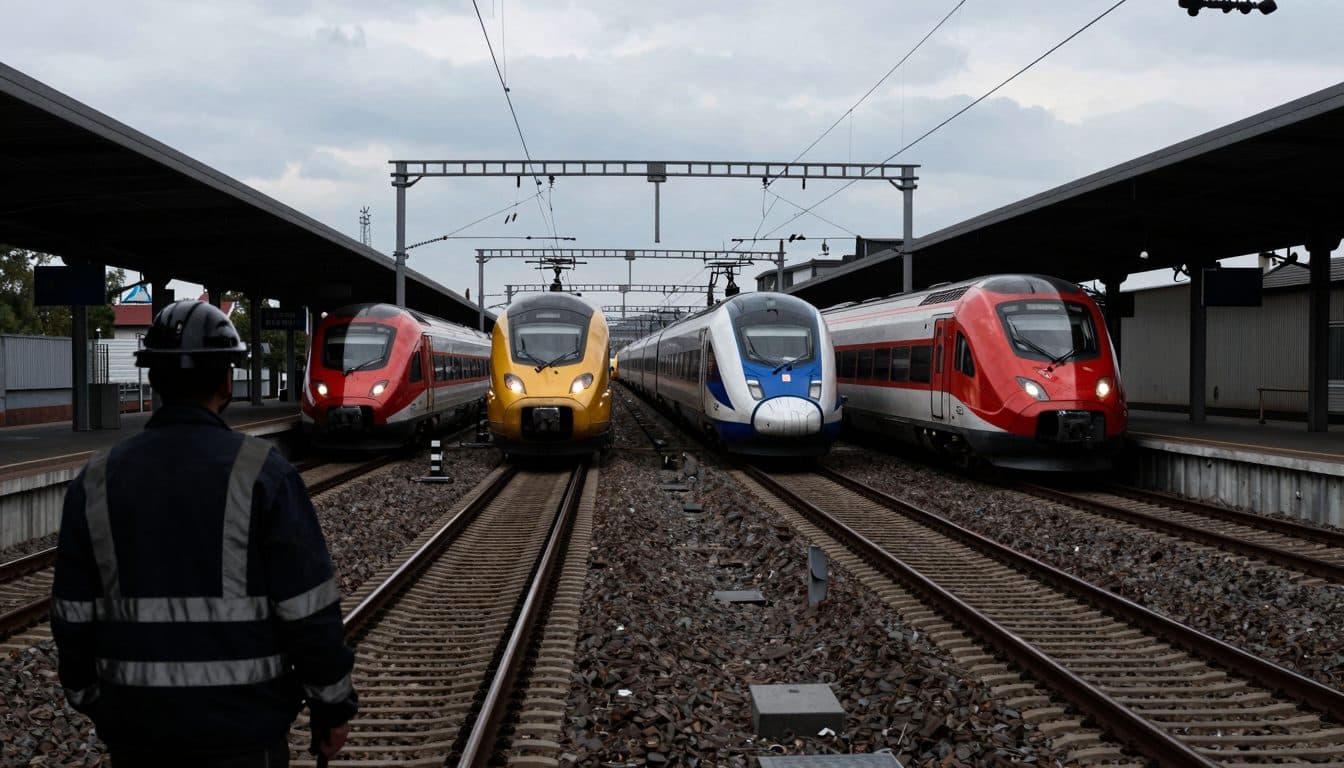
AI-generated image (z-image via Kie.ai)
Summary
The Federal Network Agency wants to oblige DB InfraGo to allocate 25 to 40 percent of slots on highly utilized long-distance corridors to competitors such as Italo and Flixtrain. Klaus Müller justifies the move with greater competition; Deutsche Bahn warns of cuts in regional services.
Bonn, 30 June 2026
The Federal Network Agency wants to oblige the rail subsidiary DB InfraGo to allocate 25 to 40 percent of slots on highly utilized corridors to competitors such as Italo and Flixtrain in order to strengthen competition in long-distance rail.
Italo as the Trigger for Regulation
The Federal Network Agency has presented a decision that could fundamentally alter Deutsche Bahn's position in German long-distance rail. The core of the decision: On heavily utilized corridors, 25 to 40 percent of slots – that is, the exact timetable slots a train operator requires for a specific route at a specific time – should no longer go to Deutsche Bahn in the future, but rather to competing providers. Per route, a single company may receive only 60 to 75 percent of the capacities. With this, the authority is responding to the long-standing complaint that long-distance rail has so far been 95 percent dominated by the state-owned group.
The background is the planned market entry of the Italian rail company Italo in Germany in spring 2028. The company wants to put 30 high-speed trains on the tracks for 56 daily train connections. A total of 56 daily trips are planned, in part at hourly or two-hour intervals. Specifically, Italo initially wants to operate the Munich-Frankfurt-Cologne-Dortmund route at hourly intervals and the Munich-Berlin-Hamburg route every two hours. To make the investment worthwhile, Italo wants to change the competitive conditions and has called on the Federal Network Agency, which oversees slot allocation.
The Authority's Reasoning
Klaus Müller justifies the intervention with the expectations of passengers. „Für Bahnkunden bedeutet Wettbewerb bessere Qualität und niedrigere Preise“, sagte der Bundesnetzagentur. The Federal Network Agency justifies the step with the goal of strengthening competition in long-distance rail. The authority hopes this will lead to lower ticket prices and more quality for long-distance travelers. Müller further said: „Sie garantiert ein Mindestmaß an Zugang für Wettbewerber im vertakteten Fernverkehr, ohne Kapazität für andere Verkehrsarten zu blockieren“.
In concrete terms, this means: Anyone applying for a slot on one of the mentioned corridors must be able to rely on actually receiving it – provided they submit a serious offer. The competitor clause only applies if the company offers scheduled services – that is, at least four daily connections at two-hour intervals at the same minute. Providers such as Italo or Flixtrain can now plan better. Müller explained: Bahn-Rivalen wie Italo oder Flixtrain müssten viel Geld in neue Fahrzeuge investieren, könnten bisher aber nicht abschätzen, ob sie auf der Schiene entsprechende Nutzungsrechte bekämen.
Resistance from Deutsche Bahn and the Union
Deutsche Bahn is fighting back against the initiative. The group argues that profitable slots cross-finance less frequented sections that might otherwise have to be abandoned. The group also argues that it generates revenue on lucrative main lines with which less heavily demanded long-distance connections in regional areas are financed. It has already announced that less heavily demanded long-distance connections in regional areas would have to be reduced should it lose slots on the premium routes. These would also not be served by Flix or Italo, which focus primarily on the premium routes.
The group subsidiary DB InfraGo, which manages the rail network and allocates slots, is also raising the alarm. „Die geplante Regelung würde damit das strukturelle Problem von Knoten und Kapazität verschärfen“, heißt es in einer Stellungnahme. InfraGo points out in a statement that the new rules would not apply across the board, but only to sections that are already heavily used. DB InfraGo warned of additional capacity and traffic problems because the regulation would apply to routes that are already heavily utilized. Particularly affected are junctions such as Munich and Frankfurt, where trains converge from multiple directions.
The EVG union supports Deutsche Bahn's concerns. Martin Burkert spoke of the danger that competition would take place primarily on profitable routes and that smaller cities would be left behind in long-distance rail. Die Eisenbahn- und Verkehrsgewerkschaft EVG teilt die Befürchtung der Bahn, dass mit mehr Wettbewerbern die Anbindung in der Fläche bedroht ist. Die Eisenbahn- und Verkehrsgewerkschaft EVG kritisierte die Entscheidung. Local transport authorities also fear that regional rail services will be at a disadvantage on certain sections located on the heavily utilized corridors.
Who Benefits from the New Competition?
The largest competitor so far is the Munich-based company Flix with its green trains. Neben dem Münchner Verkehrsunternehmen Flix wäre Italo der zweite nennenswerte Wettbewerber der Deutschen Bahn im Fernverkehr. Profitieren könnten davon unter anderem das italienische Bahnunternehmen Italo und Flixtrain. Flix has also announced a new offensive for 2028 with additional trains and new connections. From 2028, Flixtrain plans to establish a network between major German cities using 65 new Talgo high-speed trains. Both routes on which Italo wants to operate are considered very lucrative because they connect important and partly heavily utilized junctions.
The slot allocation itself currently works as follows: Every company that wants to operate a train in Germany needs a so-called slot – that is, a specific route at a specific time. This slot is allocated by DB InfraGo. Capacity is limited: Especially at major junctions like Hamburg, Berlin, and Cologne, trains pile up, which is cited as the reason for Deutsche Bahn's frequent delays. Die Unpünktlichkeit der Deutschen Bahn liegt vor allem am maroden und an vielen Stellen überlasteten Schienennetz. Evelyn Palla wirbt bei den Fahrgästen um Geduld bei der Sanierung des maroden Gleisnetzes. Für die Modernisierung werde man „zehn Jahre brauchen“.
Bottlenecks in the Rail Network
The Federal Network Agency also plans to oblige DB InfraGo to make room for competitors in the train stations and to allocate space there „nach objektiven und nichtdiskriminierenden Kriterien zu vergeben“. The agency also makes clear that the new clause applies only to long-distance rail: Local passenger and freight rail traffic „bleiben geschützt“, as the network agency explained. Bei dem Beschluss der Bundesnetzagentur handelt es sich noch um einen Entwurf. Dieser wird nun dem Eisenbahninfrastrukturbeirat zugeleitet, der dazu angehört wird.
What Happens Next?
Wie es konkret etwa für die Knoten München und Frankfurt geplant ist, sollen dort Kapazitätsobergrenzen gelten. After two weeks and simultaneous consultations with the Bundeskartellamt and the Monopolies Commission, the Federal Network Agency intends to make a final decision. The new rules must then be applied by InfraGo when allocating slots for the year 2028. Der Beschluss der Bundesnetzagentur geht auf eine formelle Mitteilung der Behörde zurück, die am 30.06.2026 im Programm Deutschlandfunk aufgegriffen wurde.
Overall, the Federal Network Agency's initiative shows that regulators no longer want to accept the quasi-monopoly status of Deutsche Bahn in long-distance rail that has existed for decades. Die Behörde stellt klar: Mit dem Beschluss entspricht die Behörde einer zentralen Forderung des italienischen Zugunternehmens Italo, das für 2028 den Markteintritt in Deutschland plant. Whether more competitors will actually run on Germany's rails at the end of the day now depends on the political debate, the position of the Railway Infrastructure Advisory Board, and Deutsche Bahn's willingness to actually give up its most lucrative routes.
Questions & Answers
What exactly has the Federal Network Agency decided?
The Federal Network Agency wants to oblige DB InfraGo to allocate 25 to 40 percent of slots on highly utilized corridors to competitors and to allow only 60 to 75 percent of the capacities per route to go to a single company.
Which routes does Italo want to serve in Germany?
Italo plans to operate, starting in spring 2028, the Munich-Frankfurt-Cologne-Dortmund route at hourly intervals and the Munich-Berlin-Hamburg route at two-hour intervals with 30 high-speed trains.
Why is Deutsche Bahn criticizing the decision?
Deutsche Bahn argues that it uses revenue from lucrative main lines to finance less heavily demanded regional connections and that, if these slots are lost, connections in rural regions would have to be cut.
BNetzA: Deutsche Bahn Must Open Tracks to Competitors | allfacts360