Funeral Ceremony for Ayatollah Khamenei: Tehran Stages a Multi-Day Show of Power
Tehran, 02 July 2026
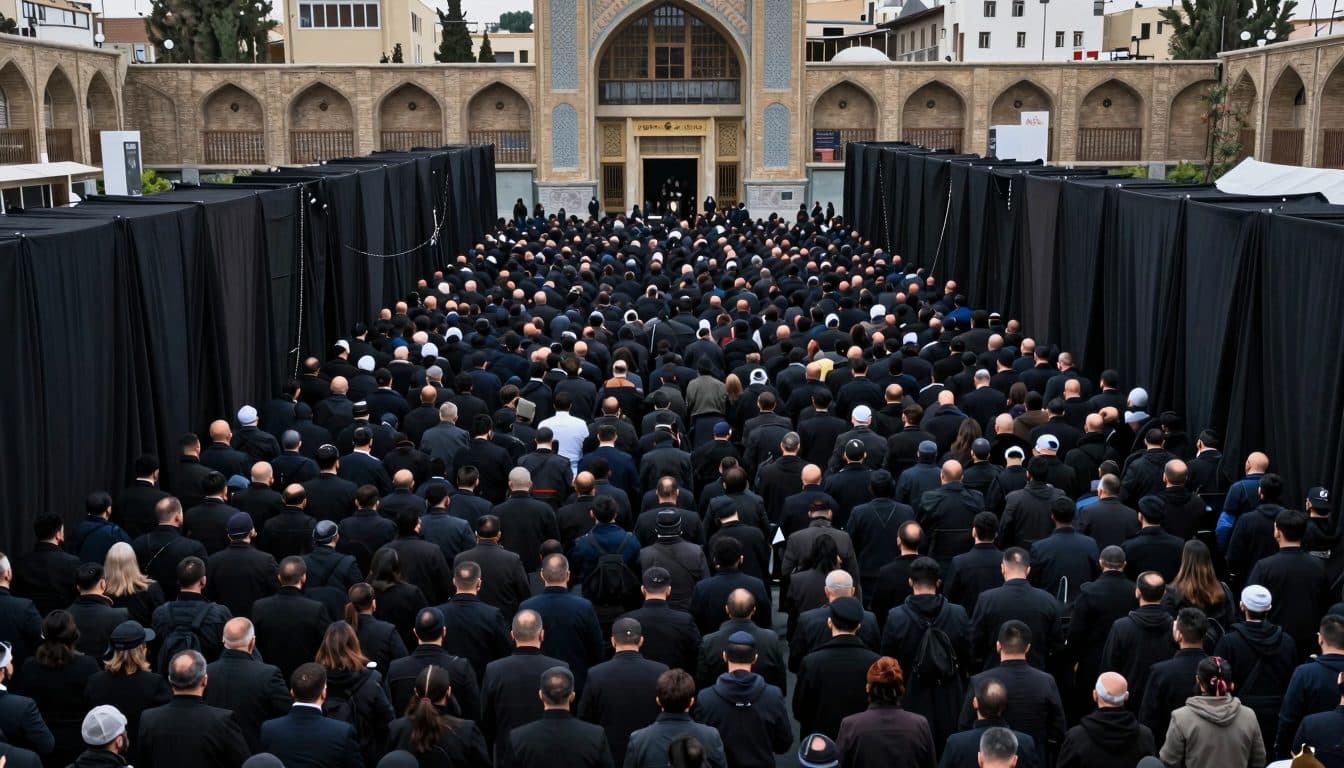
AI-generated image (z-image via Kie.ai)
Summary
In Iran, a country of 93 million inhabitants, the state is mobilizing its supporters for the funeral ceremonies, which, according to regime planners, are set…
Tehran, 02 July 2026
Background: Khamenei's Death in the Iran War
In Iran, a country of 93 million inhabitants, the state is mobilizing its supporters for the funeral ceremonies, which, according to regime planners, are set to become the largest gathering in the capital's history. According to the organizing chief Ali-Akbar Pourjamshidian, the events are intended to "den nationalen Zusammenhalt stärken". The authorities have ordered that the capital be "vollständig geschlossen und arbeitsfrei sein" during this period.
The body of the Ayatollah will be laid out in state at Tehran's Mosalla starting tomorrow. A burial is scheduled for 9 July according to statistics. The body is also to be transported to Iraq. Political scientist Mehrzad Boroujerdi, a professor of history and political science at the Missouri University of Science and Technology, stresses the historical dimension in an interview with DW: "Im Gegensatz zu Ayatollah Ruhollah Khomeini, der die ersten zehn Jahre nach der Revolution von 1979 an der Macht war, stand Ayatollah Chamenei 37 Jahre an der Spitze des Staates und führte das Land mit ausgeprägtem Mikromanagement, wobei er in nahezu alle politischen und staatlichen Bereiche eingriff".
For the burial of the assassinated former Supreme Leader of the Islamic Republic of Iran, who for 37 years had the final say in all central matters of the country, a six-day ceremony is planned. Iranian Vice President Mohammad Reza Aref, who is organizing the funeral, described it at the end of June as «das wichtigste Ereignis des 21. Jahrhunderts». With an estimated ten million participants, the planned ceremony is considered the largest funeral in modern history.
The Role of Tehran's Mosalla
The funeral ceremonies are taking place six months after mass protests in Iran against the high cost of living and against the government – and four months after the killing of the 86-year-old at the start of the war launched against Iran by the United States and Israel. On the first day of the Iran war, which began with the US and Israeli attacks on Iran on the 28th, Khamenei was killed along with several members of his family in rocket attacks on his residential and work complex in central Tehran.
The months-long delay between death and burial was likely very much in line with the intentions of the Iranian power elite. Organizing a multi-day ceremony with millions of participants requires thorough preparation even in peacetime. «Die Durchführung nach dem Krieg ermöglicht es Teheran, die politische und symbolische Wirkung zu maximieren.» The regime wants to maximize the number of participants. According to Shia tradition, a deceased person is normally buried as quickly as possible, often within 24 hours.
Ali Khamenei will finally be laid to rest on 9 July 2026. The funeral ceremonies for Ali Khamenei are, according to the authorities, set to become "die größte Versammlung in der Geschichte der Hauptstadt". Whether the power elite will succeed, as announced, in mobilizing a turnout in the double-digit millions, remains unclear. A women's rights activist from Tehran, who wished to remain anonymous, says in an interview with DW: "Viele Menschen sind des bestehenden Systems überdrüssig geworden." "Es ist für viele Protestierende, die die Unterdrückung im Dezember und Januar miterlebt haben, schwer zu verkraften, dass die Islamische Republik am Ende gewonnen hat".
Domestic Political Tensions and Protests
There have also been severe unrest in the past, including the Green Movement of 2009, the Mahsa Movement with the slogan "Frau, Leben, Freiheit" in 2022, as well as nationwide protests in December and January 2025/2026. The delay also opens up the possibility for the leadership to stage the ceremony as a foreign policy signal. The fact that Iran, in negotiations with the United States, has already anchored the so-called "Lebanon Front" in the very first of the memorandum's 14 points is also intended to show that Ali Khamenei's foreign policy line is being continued.
According to Parliament Speaker Mohammad Bagher Ghalibaf, the regime expects between 10 and 20 million mourners in Tehran alone. The authorities stated that they expect 15 to 20 million people in the capital alone. "Zwei militärische Großmächte haben den Iran angegriffen, und die Islamische Republik steht dennoch noch" is a widespread reading. "Die Anhänger der Islamischen Republik haben neuen Auftrieb erhalten," observes Boroujerdi. "Der Krieg habe zugleich vielen Menschen vor Augen geführt, dass sie nicht auf Hilfe aus dem Ausland hoffen können und letztlich auf sich allein gestellt sind".
Foreign Policy Signals and Negotiation Results
Boroujerdi sees the staging of the mourning as an attempt to restore domestic political cohesion. "Für viele Anhänger des Systems ist dies ein Beleg dafür, dass sie trotz erheblicher Verluste überlebt hat," he says. The political scientist points to a further foreign policy aspect: "Sollte auch nur die Hälfte der 14 Punkte des vereinbarten Verständigungsrahmens zwischen dem Iran und den USA tatsächlich umgesetzt werden, wäre dies ein erheblicher Erfolg für den Iran". "Weder nach dem Ende des Iran-Irak-Krieges noch im Rahmen des Atomabkommens (JCPOA) konnte das Land vergleichbare Zugeständnisse erreichen," he writes.
Among the Iranian demands was that the United States not interfere in Iran's internal affairs. Representatives of European states are not invited, according to Foreign Ministry spokesman Esmail Baqaei, because they stood "auf der falschen Seite der Geschichte" during the Iran war. This diplomatic gesture underscores Tehran's intention to stage the funeral as a deliberate foreign policy signal.
Power Structures and Open Questions
Boroujerdi paints a nuanced picture of the power dynamics in his DW interview: "Die Haltung von Ali Chamenei als Staatsoberhaupt war stets, gegenüber seinen Gegnern keinerlei Zugeständnisse zu machen - nicht nur gegenüber Regimekritikern, sondern auch bei reformorientierten Kräften innerhalb des Machtapparats". The author of the recently published book "The Axis of Resistance: Iran, Israel and the Struggle for the Middle East" adds, however, that within the Islamic Republic's power structures, particularly within the ranks of the Revolutionary Guards, there is no full consensus on negotiations and a possible agreement with the United States.
The funeral ceremonies begin at Tehran's Mosalla, a large prayer and assembly complex used for mass events. The authorities have announced extensive security measures and largely paralyzed the capital for the duration of the ceremony. The staging of a multi-day mourning event that encompasses the entire life of the city is a deliberate signal both domestically and abroad.
By delaying and staging the mourning as a mass event, the leadership is pursuing several goals: demonstrating internal stability after the war, continuing Khamenei's political line, mobilizing supporters, and sending a foreign policy signal to the United States and the region. Whether the targeted turnout will actually be reached remains to be seen.
Symbolism and Impact of the Staging
The power elite is also banking on symbolism with the ceremony. Tehran's Mosalla, the body, the transfer to Iraq, and the six-day duration are carefully choreographed elements of a political staging. It is meant to show that the state of Khamenei remains capable of acting despite the war, despite the protests, and despite the death of its Supreme Leader.
Among observers, the impact of the staging remains contested. While the regime interprets the ceremony as proof of national cohesion, critics point to the deep social rifts that had become apparent in the protests of recent years. The coming days will show how many people will actually come to Tehran.
Questions & Answers
Who was Ayatollah Ali Khamenei and what role did he play in Iran?
Ayatollah Ali Khamenei was the Supreme Leader of the Islamic Republic of Iran for 37 years and had the final say in virtually all central affairs of the country. According to the available information, he was killed at the age of 86 in rocket attacks on his residential and work complex in central Tehran at the start of the Iran war.
Why is the funeral ceremony taking place only months after Khamenei's death?
According to Shia tradition, a deceased person is usually buried within 24 hours; the months-long delay, according to observers, allowed the power elite to prepare a multi-day ceremony with millions of participants and to maximize the political impact.
What foreign policy signals is Iran sending with the funeral ceremony?
With the ceremony and the simultaneous anchoring of the so-called Lebanon Front in the memorandum with the United States, Tehran wants to continue Khamenei's foreign policy line and demonstrate strength; European representatives are not invited, according to the Foreign Ministry.
Funeral Ceremony for Ayatollah Khamenei: Tehran Stages a… | allfacts360