Tailback southern motorways: A13, A9, A2 and Fernpass | allfacts360
Heavy holiday traffic causes long tailbacks on Styria's and Tyrol's southern motorways on Saturday
Vienna/Graz/Innsbruck, 04 July 2026
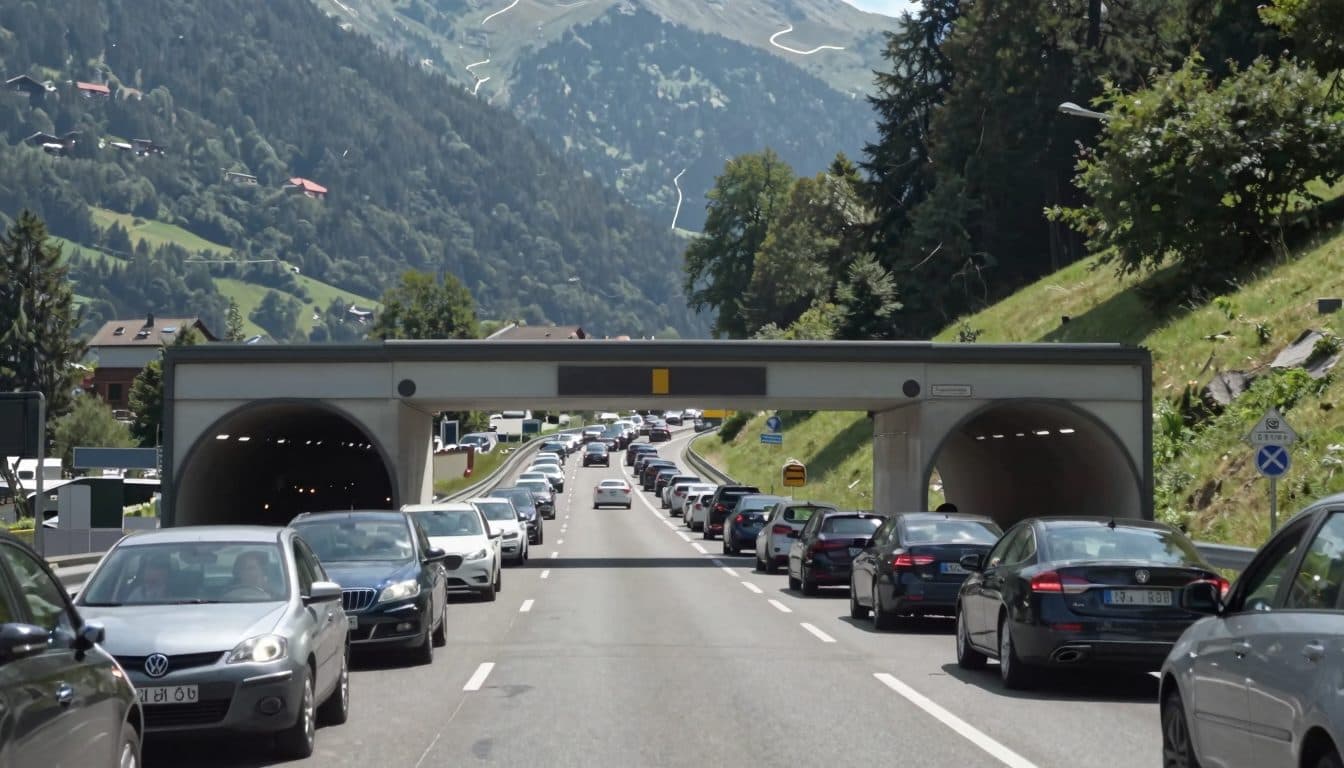
AI-generated image (z-image via Kie.ai)
Summary
Heavy southbound holiday traffic caused significant tailbacks on Saturday on motorways through Styria and Tyrol. According to ÖAMTC and APA, affected routes included the A13 Brenner Motorway, the A9 Pyhrn Motorway, the A2 Southern Motorway and the B179 Fernpass Road, with delays of up to 1.5 hours.
Vienna/Graz/Innsbruck, 04 July 2026
Heavy southbound holiday traffic caused significant traffic disruption on Saturday on several main routes through Styria and Tyrol, with delays of sometimes more than an hour and a half.
On the A13 Brenner Motorway, traffic heading toward Italy was increasingly slowing near Schönberg in the Tyrolean section, according to APA. This makes the important north-south route over the Brenner one of the most heavily congested stretches of the day. Travellers heading toward Italy at midday on Saturday had to expect significant delays on this axis.
Brenner Motorway A13: Tailback at Schönberg
The A9 Pyhrn Motorway was also severely affected. In front of the Spielfeld border crossing, traffic repeatedly backed up from the early morning hours all the way back to Gersdorf. According to APA, the waiting time at the border itself was 40 minutes, as the report stated verbatim: „Die Grenzwartezeit belief sich auf 40 Minuten."
Pyhrn Motorway A9: Tailback to Gersdorf
The Saturday also went anything but smoothly on the S6 Semmering Expressway. Between Kindbergdörfel and St. Marein, a four-kilometre tailback formed according to the available information. The time lost on this section was estimated at around half an hour.
Semmering Expressway S6: Four-kilometre tailback
One of the longest tailbacks of the day formed, according to ÖAMTC, in front of the Herzogberg Tunnel and the Mitterberg Tunnel between Steinberg and Modriach. There, traffic backed up over 13 kilometres, and travellers needed up to 1.5 hours longer here. ÖAMTC worded it in its statement as follows: „Vor dem Herzogbergtunnel und dem Mitterbergtunnel zwischen Steinberg und Modriach staute es sich 13 Kilometer, Reisende brauchten hier bis zu 1,5 Stunden länger."
On the A2 Southern Motorway between Gleisdorf West and Laßnitzhöhe in the direction of Klagenfurt, ÖAMTC recorded a four-kilometre tailback at midday with a 20-minute time loss. The automobile club relayed the situation at midday on Saturday: „Wie der ÖAMTC zu Mittag berichtete, gab es vier Kilometer Stau mit 20 Minuten Zeitverlust auf der Südautobahn A2 zwischen Gleisdorf West und Laßnitzhöhe in Richtung Klagenfurt."
Southern Motorway A2: 20-minute time loss
In Tyrol, too, traffic on Saturday ran extremely sluggishly on the B179 Fernpass route. Because of the high volume of traffic, vehicles in the Füssen and Nassereith sections were metered in so-called "block release" processing. The time loss on the B179 added up to roughly one hour.
Fernpass B179: Block release in Tyrol
Overall, a clear picture emerged on Saturday: the main southbound holiday routes were heavily overloaded between the early morning hours and midday. According to APA research, the motorways and expressways in Styria and Tyrol were particularly affected.
ÖAMTC had compiled the traffic situation overview around midday on Saturday. The sources for the tailback reports and time figures were the club's own reports and those of the APA news agency. The data relate expressly to Saturday, 4 July 2026.
What role the weather and individual construction sites played is not evident from the available reports. What is certain is that the sheer volume of traffic on this Saturday overloaded the key bottlenecks of Austria's southbound transit.
For travellers heading toward Italy, Slovenia or Carinthia on Saturday, the situation meant above all one thing: significantly more time on the road. Anyone travelling on the A13, the A9 or the A2 had to factor in waiting times of between 20 minutes and 1.5 hours.
Block release on the Fernpass is a tried-and-tested means of keeping traffic flowing on the B179 under control when the volume of traffic exceeds the road's capacity. In this process, vehicles are released in metered batches at timed intervals in order to prevent tailbacks from spilling into built-up areas.
Background: why southern axes overload so quickly
ÖAMTC typically advises travellers in such cases to check the traffic reports before setting off and, where possible, to shift travel to off-peak times. How large the actual impact on evening home-bound traffic would be could not yet be foreseen at the time the reports were issued.
The affected routes – S6 Semmering Expressway, A9 Pyhrn Motorway, A2 Southern Motorway and A13 Brenner Motorway – are among Austria's most important southern axes. They connect the greater Vienna area and the east of the country with Carinthia, Styria and Italy, as well as with south-eastern Europe via the Spielfeld border crossing.
The B179 Fernpass Road, in turn, is the central east-west link in Tyrol between the Inn Valley and the Bavarian border area near Füssen. Combined with holiday traffic heading toward Italy, this explains the high volume of tailbacks in the Nassereith and Schönberg area.
Overall, the traffic situation on 4 July 2026 makes clear how narrowly southbound travellers to South Tyrol, Slovenia and Carinthia have to share just a few corridors. Even moderate increases in holiday travel volume are felt noticeably at bottleneck points such as Spielfeld, Schönberg or the Herzogberg Tunnel.
Holiday traffic is expected to continue over the coming days. ÖAMTC and Asfinag generally update the traffic reports every fifteen minutes; up-to-the-minute information is available on the websites and apps of both organisations, as well as in APA's traffic bulletins.
Questions & Answers
Which routes were particularly affected by tailbacks on 4 July 2026?
According to ÖAMTC and APA, tailbacks were concentrated on the A13 Brenner Motorway near Schönberg, on the A9 Pyhrn Motorway before Spielfeld, on the A2 Southern Motorway between Gleisdorf West and Laßnitzhöhe, on the S6 between Kindbergdörfel and St. Marein, and on the B179 Fernpass route.
How long did travellers have to sit in tailbacks on Saturday?
According to the available reports, the delays ranged from around 20 minutes on the A2 and roughly half an hour on the S6 to one hour on the B179 and up to 1.5 hours in front of the Herzogberg and Mitterberg tunnels on the A9.
What does block release on the Fernpass mean?
Under block release on the B179, traffic is released in metered batches at timed intervals in order to prevent tailbacks from spilling into adjacent built-up areas; on 4 July 2026 this procedure was used in the Füssen and Nassereith sections.