Humpback whale Timmy: Autopsy starts on Anholt | allfacts360
Humpback whale Timmy's autopsy begins on Anholt
Anholt, June 04, 2026
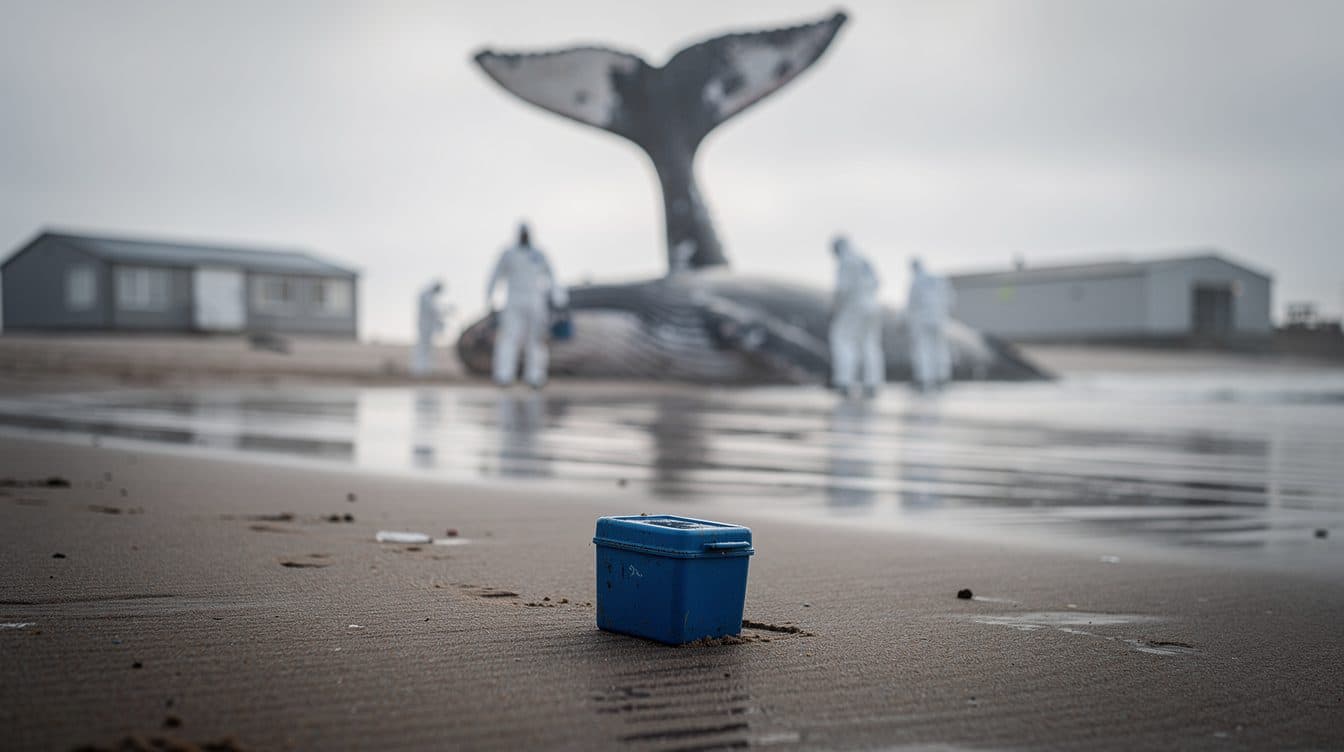
AI-generated image (flux-2/pro-text-to-image via Kie.ai)
Summary
On the Danish island of Anholt, experts have begun the autopsy of the dead humpback whale Timmy. The aim of the examination is to clarify the cause of death of the animal, which had previously been sighted for weeks along the German Baltic Sea coast. Results from the laboratory are not expected for several days.
Anholt, June 04, 2026
On the Danish island of Anholt, scientists and veterinarians began the autopsy on Thursday of the humpback whale Timmy, which had washed ashore, to clarify the cause of death of the animal.
Preparation on the beach and procedure of the dissection
The carcass of the humpback whale, over twelve meters long, had been pulled onto the beach of the Baltic Sea island in the Kattegat by Danish helpers on Saturday. Experts had been preparing for days on how best to examine the massive animal body. Now the dissection has begun, as explained by Søren Fauth. The Kattegat is the sea area between Denmark and Sweden.
As the team announced, the whale is to be dismantled into its individual parts, organs removed, and individual body parts separated from each other. Everything will be transported in containers to a laboratory late in the evening. Blue containers are ready on the beach to receive organs and other body parts. The beach area around the carcass is secured with barrier tape.
Possible causes of death in focus
According to the team, the primary goal of the autopsy is to find out why the humpback whale died. The experts want to examine the animal's mouth, among other things. Some suspect that a fishing net could have become entangled there weeks or months ago. Another theory assumes that the whale could no longer take in food as a result.
Other marine biologists, according to the facts, assume that the animal was sick and possibly suffocated in the deep Baltic Sea due to exhaustion. Livestream images from the provider News5 show a team working on the carcass. The scientists explained that results from the laboratory are not expected for several days.
In the preceding days, those involved had already stated that they initially wanted to pierce the whale with a large needle so that gases could escape from the carcass. The carcass had been inflated almost like a balloon for days due to decomposition gases. There had been fears for days that the carcass could explode. The scientists explained that they would only approach the carcass in protective suits.
Background: Weeks on the Baltic Sea coast
Several camera teams and onlookers, especially from Germany, waited on the beach. The whale had previously been transferred to the North Sea in a private operation using a floating crane. The transport to the North Sea was part of a ultimately failed rescue operation organized by a private initiative.
According to the facts, Timmy was first sighted in the port of Wismar at the beginning of March. Subsequently, the whale migrated for weeks along the German Baltic Sea coast and stranded several times off Schleswig-Holstein and Mecklenburg-Vorpommern. Most recently, it was located off the island of Poel. The whale, over twelve meters long, was considered severely weakened after several failed rescue attempts.
Mecklenburg-Vorpommern's Till Backhaus (SPD) had tolerated a rescue attempt by a private initiative in mid-April, according to the available information. At the beginning of May, Timmy was guided out of the Baltic Sea in a barge and released back into the open sea in the Kattegat. In mid-May, a whale carcass was found off Anholt.
Danish and German authorities confirmed shortly thereafter that the carcass was Timmy. In Germany, the humpback whale had received great media attention in recent weeks. As the facts state: "In Germany, it was almost impossible to avoid Timmy in recent weeks."
Different perceptions in Denmark and Germany
Unlike in Germany, the Danish public seems less fascinated by Timmy. As Fauth explained: "The Danes don't seem to be as fascinated by him." Although the Danish press had reported, "just not with the same force." The Danish tabloid newspaper "Ekstra Bladet" had done a live report and "even flew by helicopter to Timmy when he was, so to speak, in the middle of the rescue operation."
However, on social networks, many Danes expressed outrage that the media had disturbed the whale in such a way. An anonymous source was quoted as saying: "Some say they are crazy in Germany." The scientists explained that the media interest, especially from Germany, had never been so great before. In Denmark, whales are autopsied more frequently.
Ministry, museums, and environmental organizations follow the autopsy
The autopsy of the dead humpback whale was scheduled for the afternoon. The Ministry of Environment of Mecklenburg-Vorpommern wants to follow the dissection remotely. A spokesperson for the ministry stated: "We are in contact with the authorities on site." Greenpeace and the German Oceanographic Museum in Stralsund are also not on site but want to follow the autopsy via stream.
A spokesperson for the German Oceanographic Museum announced: "We will ask for the results of the autopsy. We don't have a right to it, but it is of scientific interest." Backhaus had also stated that they expressly welcome that further insights into the animal's condition could now be gained.
Tracker data and third-party analysis
Backhaus continued: "The examination can help answer open questions about its health status, possible pre-existing conditions, and the causes of its death." Backhaus announced that they intend to carefully examine the results of the investigation and further analyses. "Our goal is not to justify past decisions. Our goal is to critically analyze the processes and to be better prepared in the future," he said.
The transmitter attached to the whale has been handed over to a private rescue initiative, according to the facts. "The tracker itself, as well as the associated raw data, are owned by the initiative," it said. The initiative decides on the publication of the raw data. An agreement with the initiative grants the ministry full access to the data generated by the tracker.
Both sides can also have the data evaluated independently by qualified third parties or scientific institutions. When the results of the autopsy are expected was not specified further; the scientists spoke of several days.
Questions & Answers
Who is the humpback whale Timmy?
Timmy is a humpback whale over twelve meters long, first sighted in the port of Wismar at the beginning of March, who migrated for weeks along the German Baltic Sea coast and was eventually found dead off the Danish island of Anholt in the Kattegat.
What is the goal of the autopsy on Anholt?
According to the team, the aim is to clarify why Timmy died; among other things, the animal's mouth and organs will be examined, with a potentially entangled fishing net also being investigated as a cause.
Why is Timmy of more interest in Germany than in Denmark?
As German studies expert Søren Fauth explained, the Danish press has reported, but not with the same intensity as the German press; on social networks, many Danes were even outraged by the media attention that disturbed the whale.