Humpback whale Timmy's autopsy on Anholt completed – cause of death still unclear
Anholt, June 05, 2026
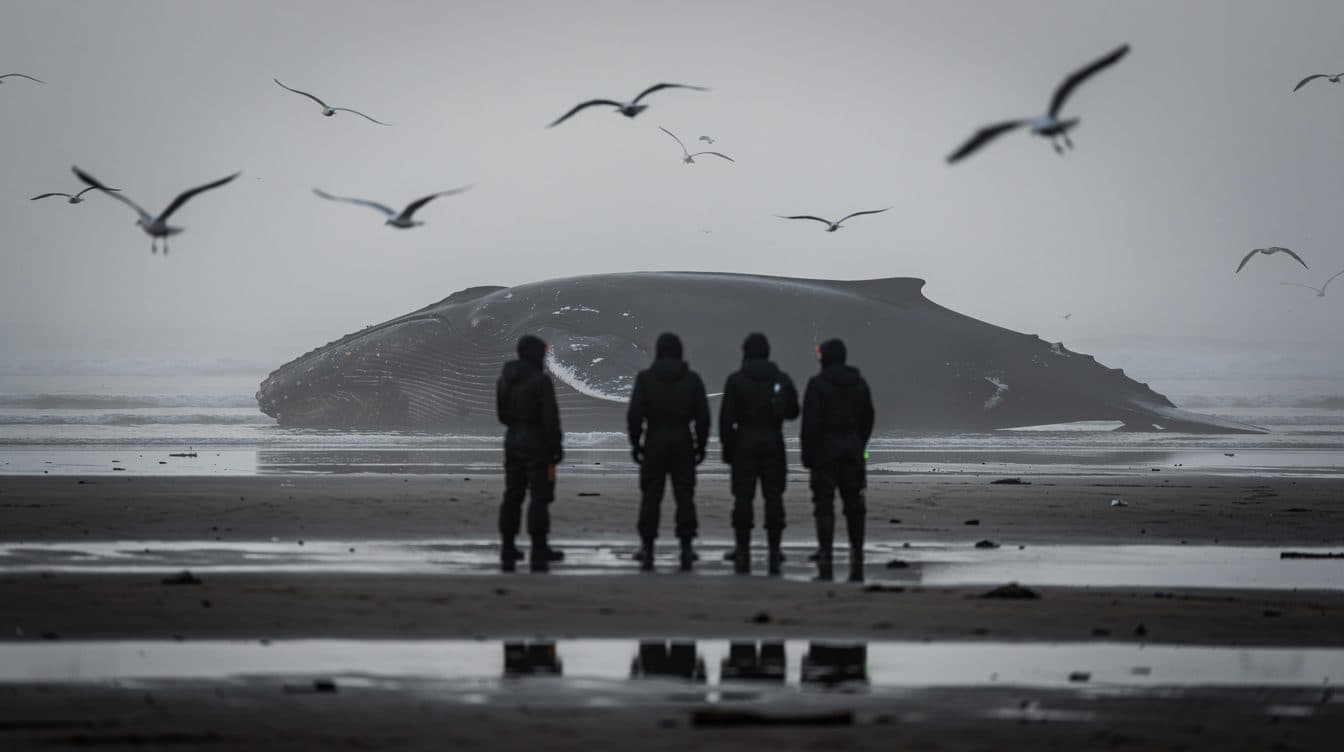
AI-generated image (flux-2/pro-text-to-image via Kie.ai)
Summary
The autopsy of the humpback whale Timmy, which stranded on the Danish island of Anholt, was completed on Friday night. A clear cause of death remains elusive, and tissue samples are not expected to be analyzed for months.
Anholt, June 05, 2026
On the Danish Baltic Sea island of Anholt, experts completed the autopsy of the humpback whale Timmy, which had been lying on the coast for weeks, on Friday night without being able to determine a clear cause of death.
The carcass of the animal, which had previously drifted along the coast of the holiday island for weeks, was examined late Thursday afternoon by a team of specialists in protective suits. According to veterinarian Tim Jensen from the University of Copenhagen, no nets or other foreign objects were found in the animal's mouth or stomach. Biologist Charlotte Bie Thøstesen told reporters that no injury was apparent – however, this could be due to the already advanced state of decomposition.
Examination on Anholt Beach
The autopsy of the humpback whale, which media reports indicated had previously been assessed as a young male, lasted several hours in total. Upon opening the animal, it was confirmed to be a female: the uterus was discovered inside the body. Even though the name Timmy suggested otherwise, the animal was female, it was stated. There had also been no pregnancy in recent months.
According to the expert team, tissue samples from the kidneys and liver, among other organs, were taken during the examination. Initial results from the laboratory analyses are not expected for several months, said Tim Jensen, who belongs to the University of Copenhagen. It is often very difficult to determine a clear cause of death in carcasses like this, the veterinarian stated verbatim. The parasites found in the animal were also not the cause of death.
Female Despite the Name Timmy
The animal had previously lain for several weeks, heavily bloated, in the water off Anholt, pecked by seagulls and visibly affected by the decomposition gases. Before the experts opened the carcass, they first measured the yellowish-brown body and cut it open with a long knife to allow air to escape from the bloated body.
Over the course of the hours-long procedure, the specialists opened and dissected the animal piece by piece and organ by organ. At times, organs and entrails lay around the animal on the sand. At the end of the work, according to those involved, only bones and parts with skin remnants remained of the humpback whale, which were cleared away in the dark.
Samples and Further Procedure
An excavator lifted parts of the carcass into prepared containers, which are to be transported away at the beginning of the week. As Morten Abildstrøm from the Danish Nature Agency told the German Press Agency, the removal will likely not take place until the beginning of next week. Transport on the weekend would be of little use due to the limited opening hours of the responsible companies.
Unneeded remains are to be taken to the Daka SecAnim animal carcass disposal facility in Randers on the Danish mainland on Monday or Tuesday. Body parts that still need to be analyzed are to be transported to a laboratory in Copenhagen as quickly as possible. Individual bones, such as flipper or pelvic bones, are to be included in the collection of the Natural History Museum in Copenhagen.
Why Research Relies on the Carcass
According to biologist Charlotte Bie Thøstesen, the dissection was a standard procedure for the experienced team, but it is very valuable. "So when we find stranded whales here in Denmark, we use them to gain insights into the wild animals," she said. Humpback whales are difficult to study in their natural marine habitat, which is why every stranded carcass offers a rare opportunity for science.
The autopsy was not only followed on-site but also via live broadcast. According to a spokesperson for the Ministry of Environment of Mecklenburg-Western Pomerania, the ministry followed the dissection remotely. Greenpeace and the German Oceanographic Museum in Stralsund also tuned into the stream.
From Timmendorfer Strand to the North Sea
The humpback whale named Timmy was first sighted and reported at the beginning of March in the Baltic Sea off Niendorf in the Ostholstein district and later off the Mecklenburg-Western Pomeranian Baltic Sea island of Poel. The name Timmy is derived from Timmendorfer Strand, the site of the first stranding. At that time, the animal was still estimated to be a young male.
In a private initiative, the whale was subsequently transported with a floating crane in a barge towards the North Sea and released there. The rescue attempt, which was partly criticized by the public, initially seemed successful. However, a whale carcass appeared off the Danish island of Anholt a short time later, which was ultimately identified as Timmy.
The dead animal then lay on the beach of Anholt for about three weeks before the autopsy before it was examined by the expert team. The expert team was scheduled to leave the island again on Friday morning after the completion of the dissection.
Unanswered Questions and Outlook
Despite the days of preparation and the hours-long dissection directly on the beach, the central question remains unanswered: Why did the young humpback whale, which had made headlines for weeks, die? The tissue samples, which will be analyzed in Copenhagen in the coming weeks and months, are intended to provide answers.
Initial reliable findings from the laboratories are not expected for at least several weeks to months. Until then, the cause of death of the animal, which caused a stir between the Baltic Sea and the North Sea, remains one of the most discussed mysteries of the current whale stranding season in Northern Europe.
Questions & Answers
Who led the autopsy of the humpback whale Timmy?
The autopsy was carried out by a team of experts and veterinarians, including veterinarian Tim Jensen from the University of Copenhagen and Danish biologist Charlotte Bie Thøstesen.
Why is Timmy's cause of death still unclear?
A clear cause of death could not be determined during the dissection, partly because the animal had already been dead for weeks and decomposition might have obscured possible injuries; final laboratory results are not expected for months.
What will happen to the whale's remains?
Unneeded remains are to be taken to the Daka SecAnim animal carcass disposal facility in Randers on Monday or Tuesday, while parts to be analyzed will go to a laboratory in Copenhagen, and individual bones are to be included in the collection of the Natural History Museum in Copenhagen.
Humpback whale Timmy: Autopsy on Anholt concluded | allfacts360