Ireland takes over EU Council presidency and prepares for difficult negotiations
Dublin, 1 July 2026
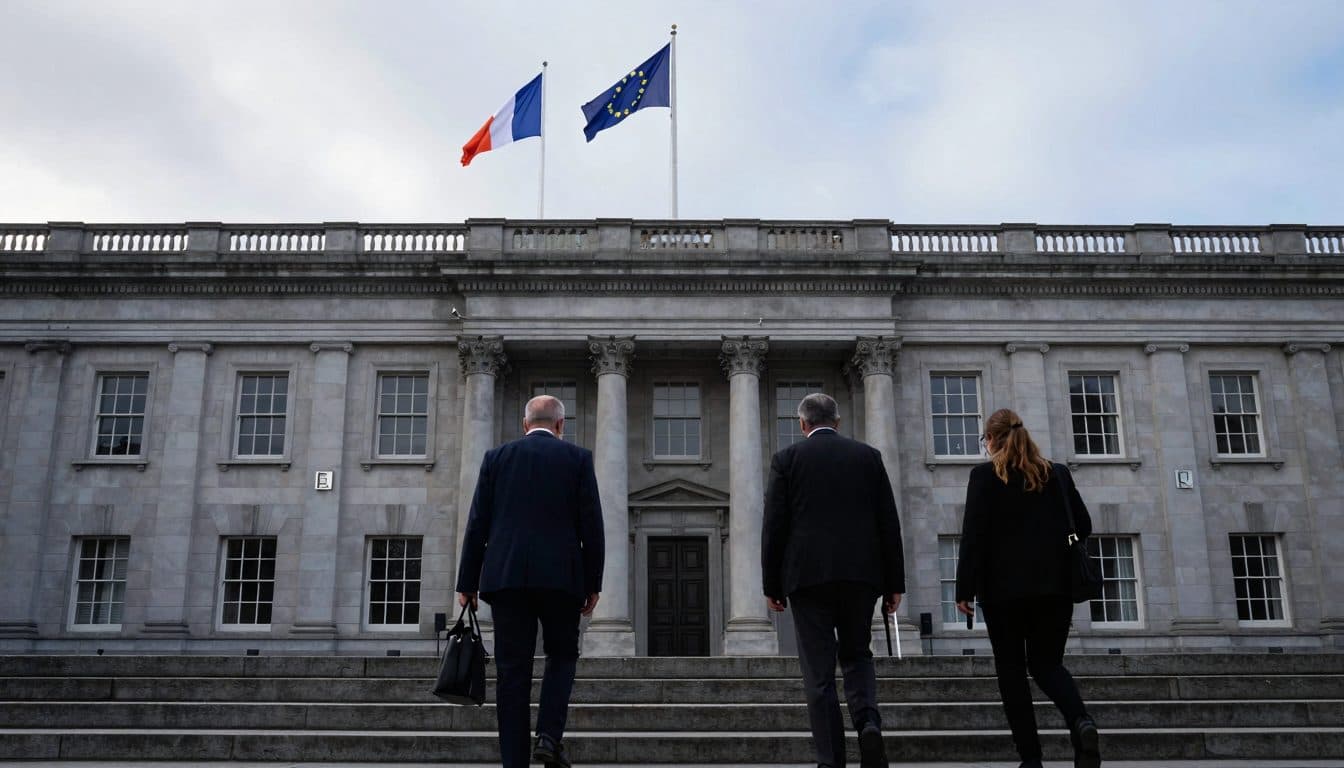
AI-generated image (z-image via Kie.ai)
Summary
Ireland assumed the rotating presidency of the Council of the European Union on 1 July 2026, in line with the established rotation schedule. The government in Dublin announced that over the coming six months it intends to advance, among other things, negotiations on the next long-term EU budget.
Dublin, 1 July 2026
Ireland assumed the rotating presidency of the Council of the European Union on 1 July 2026, succeeding Cyprus, which had held the EU Council presidency over the past six months.
Eighth presidency in the history of the Republic
With the assumption of the presidency, the Republic of Ireland, which joined the European Community back in 1973, begins its eighth overall Council presidency. The island state, with around 5.4 million inhabitants, will hold the presidency until the end of 2026. During this period, Ireland will chair numerous ministerial meetings and mediate in disagreements between EU member states.
As in recent months, the upcoming negotiations on the next multiannual financial framework of the EU for the 2028 to 2034 period are set to be one of the greatest challenges of the presidency. The proposal currently on the table provides for an inflation-adjusted total volume of 1.73 trillion euros. Federal Chancellor Friedrich Merz described the proposal as "unbezahlbar" and "unausgewogen". The goal is to reach agreement on the financial package by the end of 2026.
Budget negotiations as the biggest task at hand
As a net contributor, Austria, among others, is pushing to ensure that the budget volume does not rise too sharply. At the same time, Austria is a close ally of the Western Balkan states and strongly supports their accession to the EU. This dossier, too, which is closely linked to the budget negotiations, is on the agenda of the Irish presidency. Montenegro is to complete EU accession negotiations by the end of the year.
Irish Taoiseach Micheál Martin, who leads a centre-right coalition at home, sees the presidency as an important mandate at a critical phase for Europe. He cited high energy costs resulting from the wars in Ukraine and the Middle East as an example of the current challenges. Ireland is taking on the important role at a critical time for Europe, Martin said.
Three core themes of the Irish agenda
The Irish government has clearly identified its substantive priorities: competitiveness, values and security. "Diese drei Kernthemen - Wettbewerbsfähigkeit, Werte und Sicherheit - sind eng miteinander verbunden und verstärken sich gegenseitig", Martin stated. Specifically, Ireland intends, among other things, to advance the "One Europe, One Market" roadmap, which is designed to strengthen the European economy and industry.
Another major project on the agenda is the decision on the introduction of a digital euro, that is, an electronic form of the common currency. In addition, the final implementation of the new EU asylum and migration pact, which entered into force on 12 June, as well as child protection on the internet are on the programme.
Security despite political neutrality
Defence, security and rearmament will also occupy the Irish during their presidency – even though the country is politically neutral. In contrast to other states, neutrality in Ireland is enshrined in politics rather than in the constitution. Along with Austria, Malta and Cyprus, Ireland is one of four EU member states that do not simultaneously belong to NATO.
The operational burden of the presidency is considerable: over the six months, the green island will host more than 270 official events, including at least two formal and one informal EU summit. The kick-off is the traditional inaugural visit by the EU Commission under Ursula von der Leyen to the government of the presidency country, which will take place on 2 and 3 July in Cork, Ireland.
Economic interests of a digital island
Economically, Ireland brings its own interests to the table. Companies such as Google, Apple, Meta, Microsoft and Amazon have major locations on the island. Strengthening the European single market and competitive framework conditions are therefore a particular focus of Ireland's priorities.
Geographically, Ireland occupies a special position within the EU: as the only EU and eurozone country, it shares a land border with the United Kingdom. In order to preserve freedom of travel with Northern Ireland and Great Britain, Ireland has not adopted the rules of the Schengen Area for border-control-free travel.
In substantive terms, the Irish presidency builds on the achievements of its Cypriot predecessor government. Under the Cypriot presidency, also an island state, agreements were reached on, among other things, air passenger rights, deportation centres in third countries and the implementation of the customs agreement with the United States.
Motto from the Irish language
The Irish Council presidency stands under the old Irish proverb "Ní neart go cur le chéile" – in German: "Stärke durch Einheit". The chosen motto is intended to symbolise that the coming months can only be mastered through solidarity among the member states. The upcoming budget negotiations, described as a "Milliardenpoker", are regarded in particular as a litmus test of that solidarity.
Observers assess the start of the Irish presidency as a launch into stormy times. The combination of budget dispute, migration policy, energy crisis and geopolitical tensions confronts the government in Dublin with the task of mediating between very different positions among the 27 member states and setting its own accents without blocking the Union's capacity to act.
With the change to Ireland, the trend continues of smaller and more neutral member states having held the presidency several times in recent years. After Cyprus, another island state now follows – one that, similar to its predecessor, must steer a large number of dossiers simultaneously despite limited administrative resources.
For the coming months, particular interest is focused on how Ireland manages to strike a balance in the multiannual financial framework between net contributors such as Austria, its own economic policy interests and the expectations of Southern and Eastern European member states. The question of whether negotiations on the digital euro and the migration pact can be brought to a conclusion under the Irish presidency is also likely to shape political debate in Brussels and the capitals.
Questions & Answers
Who leads the Irish EU Council presidency in 2026?
The presidency is led by Irish Taoiseach Micheál Martin, who heads a centre-right coalition at home. He has identified competitiveness, values and security as the core themes of the presidency.
Why are the EU budget negotiations so controversial under the Irish presidency?
On the table is a proposal with an inflation-adjusted volume of 1.73 trillion euros for the 2028 to 2034 financial framework, which Federal Chancellor Friedrich Merz criticised as "unbezahlbar" and "unausgewogen". Net contributors such as Austria are at the same time pushing for a limited increase in the budget.
Which concrete dossiers are on the agenda for the coming six months?
Alongside negotiations on the next EU budget, the issues include the introduction of a digital euro, the final implementation of the new EU asylum and migration pact, child protection on the internet, the "One Europe, One Market" roadmap and the completion of EU accession negotiations with Montenegro.
Ireland EU Council presidency 2026: Budget, digital euro | allfacts360