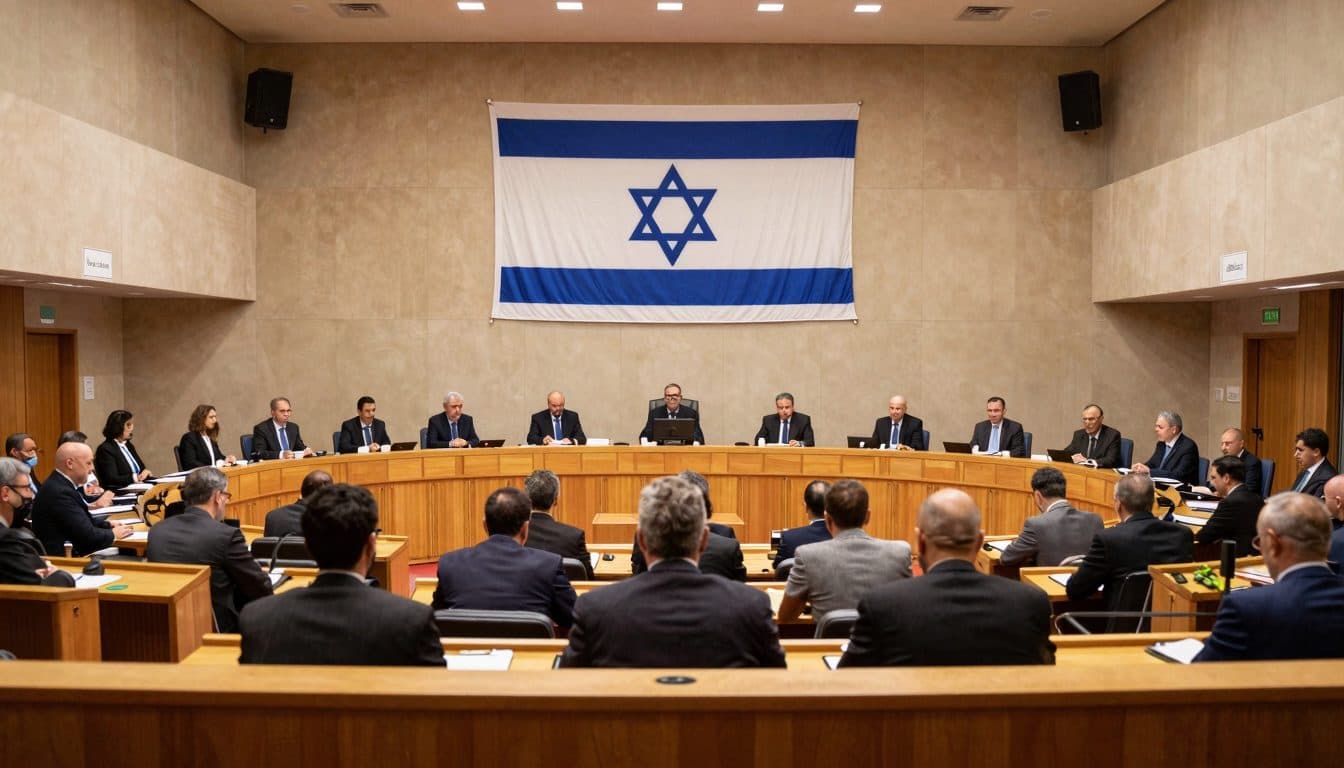
Israel's Knesset passes protection clause for ultra-Orthodox draft evaders – Supreme Court halts law hours later
Jerusalem, July 15, 2026
AI-generated image (z-image via Kie.ai)
Summary
In the night to Tuesday, the Knesset passed a law protecting ultra-Orthodox draft evaders from prosecution. Just hours later, the Supreme Court issued an injunction, triggering a severe constitutional crisis in Israel.
Jerusalem, July 15, 2026
In the night to Tuesday, the Knesset passed a law – with the votes of the right-nationalist coalition of Prime Minister Benjamin Netanyahu – that protects tens of thousands of ultra-Orthodox men from arrest for evading military service, after which the Supreme Court halted the law via injunction just a few hours later.
According to the Times of Israel, the law was intended to prohibit the arrest of tens of thousands of strictly religious men who evade conscription until the end of November. It was only formally in force for a short time before the Supreme Court justices, however, put a spanner in the works for the government of Benjamin Netanyahu. The Supreme Court ordered that a hearing on the law must take place as soon as possible, as the Times of Israel reported.
As early as June 2024, the court had declared the decades-old exemption for ultra-Orthodox conscripts unlawful. Now the judges ruled that the regulation grossly violates the principle of equality, because it applies only to strictly religious Jews, according to the judges. And it is discriminatory, since the army is suffering from a massive personnel shortage in the midst of the permanent conflict.
Constitutional crisis after a bombshell
The immediate prelude to the law was a Basic Law passed in the night to Tuesday that enshrines the study of the Torah as a fundamental value of the State of Israel and the Jewish people. According to legal experts, this new declaration of values will make it more difficult for the Supreme Court justices to hold to their previous line.
The ultra-Orthodox parties, whose votes Netanyahu depends on in his right-nationalist governing alliance, had exerted massive pressure on coalition lawmakers. Arie Deri, chairman of the Shas party, told government members bluntly: Ihr stimmt für unsere Interessen oder wir nicht für eure Interessen. He subsequently spoke of a clear victory for the Holy Scripture and a clear answer to the suspended government legal adviser and all those who persecute and humiliate scribes.
Pressure from the ultra-Orthodox and threats within the alliance
Because elections are scheduled for October, pressure on his right-nationalist governing alliance is mounting. The ultra-Orthodox parties had recently demonstrated almost weekly against the conscription of their young men, blocked highways, halted trains, and engaged in street battles with police. Judges and other judicial representatives who sought to enforce the current mandatory military service law were attacked by ultra-Orthodox demonstrators.
Military equality has long been a matter of dispute in Israel. Ultra-Orthodox Jews, who make up 14 percent of Israel's total population, have enjoyed an exemption from military service for decades. This regulation goes back to David Ben-Gurion, who granted Torah students an exemption from military service in return for the ultra-Orthodox parties' recognition of the young state. Ben-Gurion himself is said to have once said that he did not go to the synagogue, but the synagogue he did not go to was an Orthodox one.
Personnel shortage and strain on the army
The army is suffering from a massive personnel shortage. Every year, 14,000 to 15,000 strictly religious men reach conscription age but are not available to the army. At the same time, the wars in Gaza and Lebanon as well as the confrontation with Iran and its allies are a heavy burden on the armed forces. Israel's Chief of General Staff Eyal Zamir described the draft bill on military service exemption as incomprehensible and incompatible with the needs of the army.
The consequences for the reservists are severe. "Die Reservisten und ihre Familien werden weiter die Bürde allein tragen müssen," declared the Association of Reservists' Families. Many reservists have been on duty for months, separated from their families, and absent from their workplaces for long stretches of time. Instead of a shortening, regular military service for those normally drafted is now even being extended.
In addition to the military service law, Netanyahu plans to push further measures through parliament by Friday. These include a new media law intended to make life easier for government-friendly media and allow politicians to grant licenses for new broadcasters. Also planned is a law that would weaken the legal advisory bodies of the government, the ministries, and the parliament, which have previously halted unconstitutional legislative initiatives at the planning stage.
Another measure envisions the appointment of a political committee to investigate the failures before and during the Hamas massacre of October 7, 2023. Previously, politicians have played only a supporting role behind lawyers and experts in such state investigation committees; the new law would change this.
Further laws and political background
The developments are exacerbating an already tense situation. Netanyahu's government has been battling the judiciary for months, several corruption proceedings are underway against him, and since the debate over the legislative package he has slipped behind his rivals in the polls after having previously been in the lead. The ultra-Orthodox former minister Meir Porush even called the ruling unlawful. After the decision, the ultra-Orthodox chairman of the Shas party, Aryeh Deri, accused the Supreme Court of activism.
Observers nevertheless see in the back-and-forth between the Knesset and the Supreme Court a bombshell plunging Israel into a deep constitutional crisis. Whether the regulation will hold now depends on the upcoming hearing. Names repeatedly mentioned as possible actors of political change include Naftali Bennett, Avigdor Lieberman, Gadi Eisenkot, and Jair Lapid. Regardless, Netanyahu is delaying necessary internal party primaries in his Likud party in order to rein in restive party colleagues.
Questions & Answers
What did the Knesset decide in the night to Tuesday?
The Knesset passed a law protecting ultra-Orthodox draft evaders from prosecution until the end of November, as well as a Basic Law enshrining the study of the Torah as a fundamental value of the State of Israel.
Why did the Supreme Court halt the law?
The court issued an injunction just hours after passage and ordered a hearing as soon as possible, because in its assessment the regulation grossly violates the principle of equality and the army is suffering from a massive personnel shortage.
What role does Arie Deri play in the conflict?
Arie Deri, chairman of the ultra-Orthodox Shas party, exerted considerable pressure on coalition lawmakers to support the law and called its passage a clear victory for the Holy Scripture.
Israel: Knesset passes protection clause for the | allfacts360