Lebanese Army Advances into Pilot Zone Sawtar al-Gharbija – Litmus Test for the Agreement with Israel
Beirut, July 21, 2026
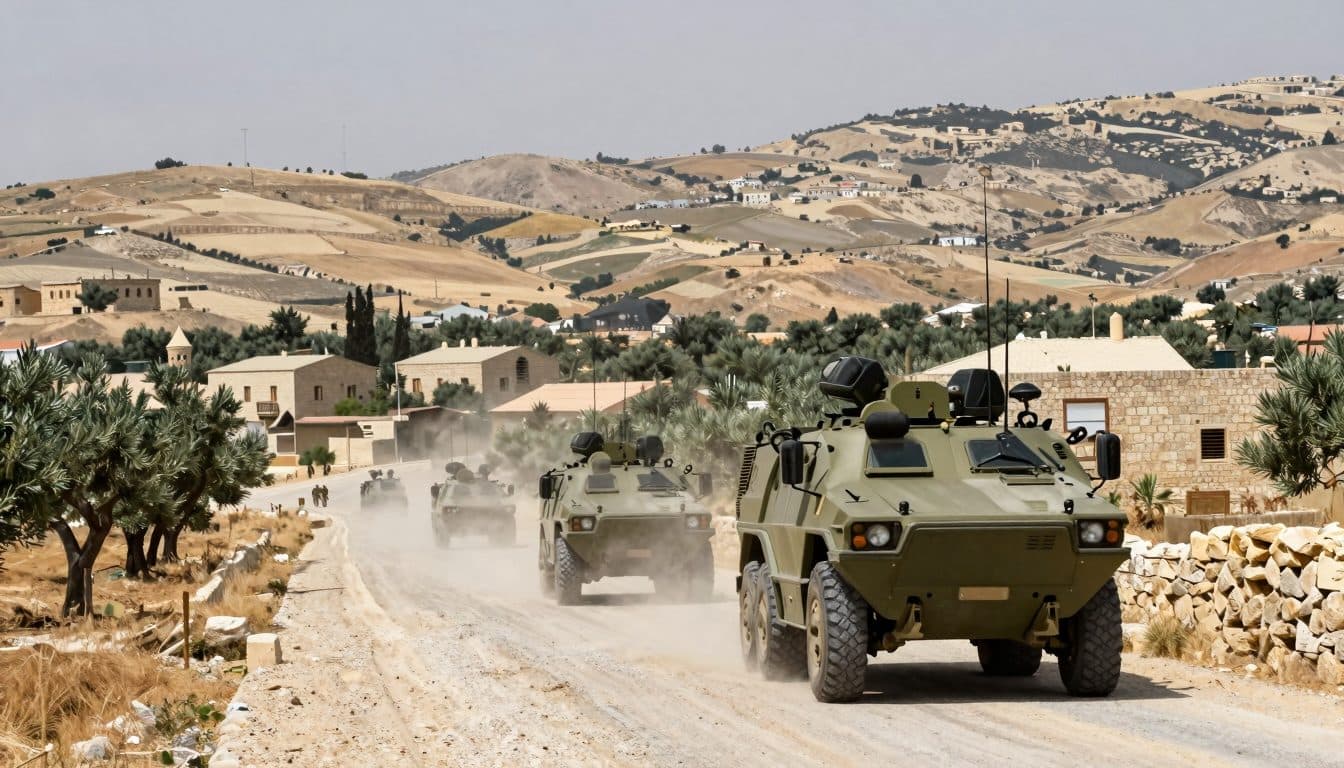
AI-generated image (z-image via Kie.ai)
Summary
The Lebanese army has begun deploying troops to the town of Sawtar al-Gharbija in the south of the country. The town is one of three so-called pilot zones where the gradual withdrawal of the Israeli army and the disarmament of Hezbollah are to be tested.
Beirut, July 21, 2026
The Lebanese army has, according to its own statements, begun deploying troops to the town of Sawtar al-Gharbija in the south of the country, in order to take control there within the framework of a security agreement with Israel and simultaneously initiate the disarmament of Hezbollah.
Background: Pilot Zones as a Test Run
The town of Sawtar al-Gharbija is one of several so-called pilot zones in southern Lebanon. In these zones, a withdrawal of the Israeli troops still stationed in Lebanon is to be tested. The Lebanese army stated on Tuesday that it was still too early to enter the handed-over town of Sawtar al-Gharbija, since the security situation first had to be stabilized.
After preparations on Monday, Israel handed over control of the town of Sawtar al-Gharbija to the Lebanese army a day later. In these zones, the Lebanese armed forces are to take control and disarm Hezbollah, while the Israeli army simultaneously withdraws step by step. The Lebanese army stated that Israeli forces had opened fire during the operation and that this was complicating implementation.
Procedure: Handover and Disarmament
The pilot zones are intended to demonstrate whether this procedure works in practice before the approach is extended to additional areas. If the procedure works in practice, it is to be extended to further areas. Should Lebanon's army succeed in establishing itself in these pilot zones and disarming Hezbollah, then this approach is to be extended to additional regions from which Israel would then withdraw.
According to the US State Department, the Lebanese armed forces are to take control there and disarm the Hezbollah militia. In return, the Lebanese army is to take control of the cleared areas and seize weapons as well as infrastructure of Hezbollah there. As the US State Department announced, the Lebanese armed forces are to take control there and disarm the Hezbollah militia.
Hezbollah rejects the agreement, however. It was not involved in the talks. It first demands a complete Israeli withdrawal. Hezbollah has not agreed to this plan. Hezbollah rejects the agreement, however. It was not involved in the talks.
Hezbollah's Position
Both Lebanon and Hezbollah speak of an occupation that violates international law. Israel subsequently marched into southern Lebanon and continues to occupy parts of it to this day. The "security zone," as Israel calls it, is roughly 620 square kilometers in size and corresponds to about six percent of the country's area.
Local Lebanese residents in the pilot zones, however, doubted the intentions of the plan in their villages. These areas had not been occupied by Israel, but had rather been subjected to its shelling, residents told a dpa photographer on the ground. From Lebanese security circles it was said that the Israeli army had not maintained fixed bases in Sawtar al-Gharbija, but had usually entered and left the area again.
Skeptical Voices on the Ground
So-called "pilot zones" have been established in three localities in the south of the country, it was reported from Washington on Monday: Froun, Srifa, and Sawtar al-Gharbija. The town is one of three so-called pilot zones that Lebanon and Israel set up together with the USA. Involved are the armed forces of the USA, Israel, and Lebanon.
On June 26, Israel, Lebanon, and the USA agreed on an agreement. It provides for a gradual withdrawal of Israeli forces from southern Lebanon. Israel and Lebanon had agreed on a peace agreement in June after decades of a state of war. Within the framework of direct talks between Israel and Lebanon, the neighboring states, which are actually hostile toward each other, most recently agreed on a framework agreement. In direct talks between Israel and Lebanon, the neighboring states, which are actually hostile toward each other, most recently agreed on a framework agreement.
Framework Agreement from June
It was stipulated therein that Hezbollah is to be disarmed and the Israeli army is to withdraw from southern Lebanon. It was agreed therein that Hezbollah would be disarmed and the Israeli army would withdraw from southern Lebanon. The Israeli army is in the meantime withdrawing step by step. The Israeli army is committed to a gradual withdrawal from the pilot zones.
What is currently happening in Lebanon is described by the US State Department as a "milestone." It is also reported that the US government has urged Israel to avoid measures that could jeopardize a diplomatic solution. Washington is reviewing the proposal, it was said.
International Assessment
According to the Wall Street Journal and Axios, the proposal for a ten-day ceasefire has been presented to both parties to the conflict. As is known, Iran demands for a definitive end to the war not only permanent control over the Strait of Hormuz, but also peace between Israel and Hezbollah. Qatar, Egypt, Pakistan, and other mediators are working toward de-escalation in view of the newly flared fighting between the USA and Iran.
Lebanese President Joseph Aoun is currently in the US capital Washington. Lebanon's President Joseph Aoun has traveled to the USA and will be received by his counterpart Donald Trump on Tuesday. There he meets US President Donald Trump today. At the first visit by a Lebanese head of state to the White House since 2009.
Outlook: Ceasefire and Visit to Washington
Fighting had resumed between the Iran proxy, Lebanese Hezbollah, and Israel in early March – shortly after Israel and the USA had launched their airstrikes against Iran. Hezbollah thereby expressed its solidarity with Tehran.
In the affected region, dozens of villages as well as public infrastructure such as hospitals, power plants, and water pumps were destroyed in fighting between Israel and Hezbollah. Tens of thousands of residents have so far not been able to return to their homes. Lebanese troops had advanced into the town of Zawtar al-Gharbiyah after Israeli forces had withdrawn from there, the army stated.
This news was broadcast on 21.07.2026 on the Deutschlandfunk program. The Lebanese army has, according to its own statements, begun deploying troops to the town of Sautar al-Gharbija. The Lebanese army has, according to its own statements, begun deploying troops to the town of Sautar al-Gharbija within the framework of a security agreement with Israel. The troop deployment is taking place within the framework of a security agreement with Israel.
Questions & Answers
What are the pilot zones in southern Lebanon?
The pilot zones are three localities – Froun, Srifa, and Sawtar al-Gharbija – that were set up jointly by Lebanon, Israel, and the USA. The gradual withdrawal of the Israeli army is to be tested there, while the Lebanese army takes control and disarms Hezbollah.
Why does Hezbollah reject the agreement?
Hezbollah was not involved in the talks and has not agreed to the framework agreement. It first demands a complete Israeli withdrawal and, together with Lebanon, speaks of an occupation that violates international law.
What role do the USA play in the agreement?
The USA, alongside Israel and Lebanon, were involved in setting up the three pilot zones. The US State Department described the ongoing process as a "milestone" and, according to reports, is reviewing a proposal for a ten-day ceasefire.
Pilot Zone Sawtar al-Gharbija: Lebanese Army Begins | allfacts360