Mercedes opens expanded plant in Kecskemét, establishing Hungary as its most important European production site
Kecskemét, July 14, 2026
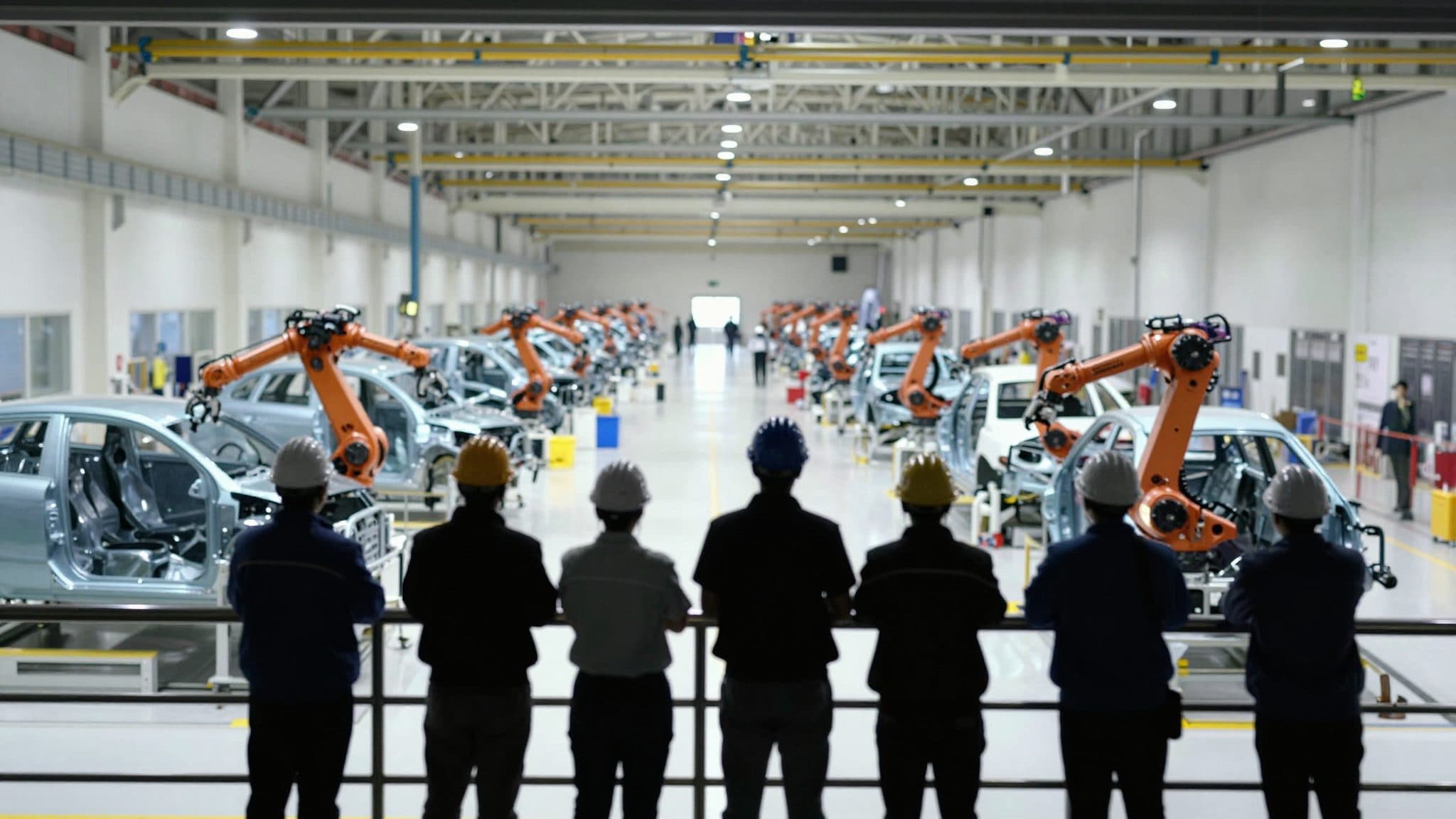
AI-generated image (z-image via Kie.ai)
Summary
Mercedes-Benz on Monday officially opened its massively expanded plant in Kecskemét, Hungary, where it will be able to produce up to 400,000 vehicles per year going forward. With investments of around one billion euros, the group is responding to cost pressure and shifting a growing share of its production to the low-wage country of Hungary.
Kecskemét, July 14, 2026
The carmaker Mercedes-Benz on Monday officially opened what it says is the country's largest car plant in Kecskemét, Hungary, raising the site's capacity to up to 400,000 vehicles per year.
In the small town of around 110,000 inhabitants, 90 kilometers southeast of Budapest, the A-Class and the GLB SUV have been rolling off the line since 2012; the expansion now adds the fully electric C-Class, the first all-battery-electric model from Mercedes-Benz's volume segment. Following the expansion, the plant is considered Mercedes' most productive facility in Europe, with more than 5,000 employees already working there, making it the region's largest employer.
According to the company, the group invested around one billion euros in the expansion. On a site that grew from 200 to 440 hectares, two new halls were built for body construction and assembly, a second press shop, a new paint shop, and a dedicated battery assembly facility. In a statement, Mercedes had also announced that it would in future also produce a more compact variant of the G-Class exclusively in Kecskemét; the production of the GLC could also be assigned to the site.
Cost structure as the driver of the relocation
The economic logic behind the move is above all a cost calculation: As the group itself emphasizes, citing statements by CFO Harald Wilhelm, production and labor costs in Hungary are around 70 percent below German levels. In an internal letter to employees, it said that every allocation of new products and every assignment of tasks to German sites worsened the relative cost position. According to the company, Mercedes is under pressure: sales, revenue, and profit are declining, with tariffs and competition in China in particular weighing on the carmaker.
Against this backdrop, the company had already announced that it would double its share of production in European low-wage countries from 15 to 30 percent. Hungary has long been a central pillar for BMW and Audi as well: Audi has been producing in Győr in western Hungary since 1994, and BMW opened a state-of-the-art, electric-vehicle-focused plant in Debrecen in eastern Hungary in autumn 2025 for two billion euros, where the iX3 SUV and high-voltage batteries, among other things, are manufactured. Last year, German carmakers produced around 300,000 cars in Hungary, according to industry sources; only the Czech Republic, Slovakia, and Spain produce more vehicles.
An entire ecosystem of German suppliers has formed around the Hungarian plants. Bosch produces components for electric cars in Hungary and maintains its largest European development center in Budapest; ZF Friedrichshafen operates sites in Budapest, Debrecen, Eger, and Kecskemét, where transmissions and e-axles are produced; the Continental spin-off Aumovio, in turn, operates an AI development center in the capital. The VW parent group is also said to be planning to produce several models in Győr in the future.
Suppliers follow the manufacturers
Industry experts see the trend as the result of structural shifts. Helena Wisbert, professor of automotive economics at Ostfalia University in Wolfsburg, says: „Die Produktionskosten in Deutschland sind in der Automobilindustrie die höchsten der Welt." Mercedes CEO Ola Källenius had previously described the Hungarian plant as a cost benchmark, emphasizing that such sites are a competitive advantage because they combine the highest quality with the highest cost efficiency. Production chief Michael Schiebe said at the opening: „Mit der Werkserweiterung in Kecskemét erhöhen wir die Resilienz und Flexibilität unseres globalen Produktionsnetzwerks."
Technologically, the group is focusing on digitalization in Kecskemét: According to Mercedes, an entire assembly hall was digitally twinned for the first time on the NVIDIA Omniverse platform in order to simulate and validate production steps virtually. The basis is the MO360 production system. For the first fully electric volume model, the group had also built two new halls for body construction and assembly as well as a dedicated battery assembly facility. According to its own figures, Audi Hungaria in Győr produces more than 170,000 Audi vehicles per year, as well as body components for exclusive and sports models of the Audi and Volkswagen Group, and provides competence-oriented services for the entire VW Group.
Stock market reacts cautiously optimistic
The news was received positively on the stock market: the Mercedes-Benz share rose for the second consecutive trading day on Tuesday, gaining 2.07 percent intraday to 45.205 euros. While the opening in Kecskemét was thus interpreted in the short term as a signal of strengthening the production network, the fundamental location debate in Germany remains open: with large-scale investments in Hungary and a planned doubling of the low-wage share, Mercedes-Benz is sending a clear signal in the competition for cost-efficient capacity in Europe.
Investors remain cautious in the meantime: the rating agency Bernstein Research last rated the Mercedes-Benz share "Market-Perform" on June 26, 2026, Jefferies & Company issued a "Buy" rating on June 29, 2026, and JP Morgan Chase rated the stock "Overweight" on June 2, 2026. The opening in Kecskemét thus marks not only an industrial milestone, but also the provisional climax of a site strategy that is re-measuring the competitiveness of European automobile production.
In Debrecen in eastern Hungary, which has around 200,000 inhabitants, the new BMW factory is meanwhile another example of structural change: a state-of-the-art plant is also being built there for two billion euros, initially designed for the electric iX3 SUV and simultaneously producing high-voltage batteries. The geographic concentration of German premium manufacturers in Hungary is reshaping value chains in Central Europe – and is making the country one of the most important European sites for the automotive future.
The expansion of the Kecskemét plant also illustrates another trend: while Germany is grappling with high labor and production costs, manufacturers are deliberately expanding their capacity in low-wage countries in order to compete internationally – for example against Asian manufacturers or new US sites. With the one-billion-euro investment in Kecskemét, Mercedes-Benz is pursuing a consistent strategy of cost leadership, without – as the company emphasizes – making any compromises in quality and technological standards. The Kecskemét site, which is already Mercedes' largest plant in Europe today, could thus become the backbone of the group's European production strategy in the coming years.
Questions & Answers
Why is Mercedes-Benz shifting its production to Hungary?
According to the group, production and labor costs in Hungary are around 70 percent below German levels, while Mercedes-Benz is suffering from declining sales, revenue, and profit.
What is being produced at the expanded Kecskemét plant?
Until now, the A-Class and the GLB SUV have been rolling off the line in Kecskemét; with the expansion, the fully electric C-Class is being added, and the plant will be able to produce up to 400,000 vehicles per year going forward.
Which other German manufacturers produce in Hungary?
Audi has been producing in Győr in western Hungary since 1994, and BMW opened a new plant in Debrecen in eastern Hungary in autumn 2025 for two billion euros for electric vehicles.
Mercedes opens giant plant in Kecskemét: 400,000 cars per | allfacts360