Merz postpones swearing-in of new ministers – constitutional scholars see conflict with the Basic Law
Berlin, July 28, 2026
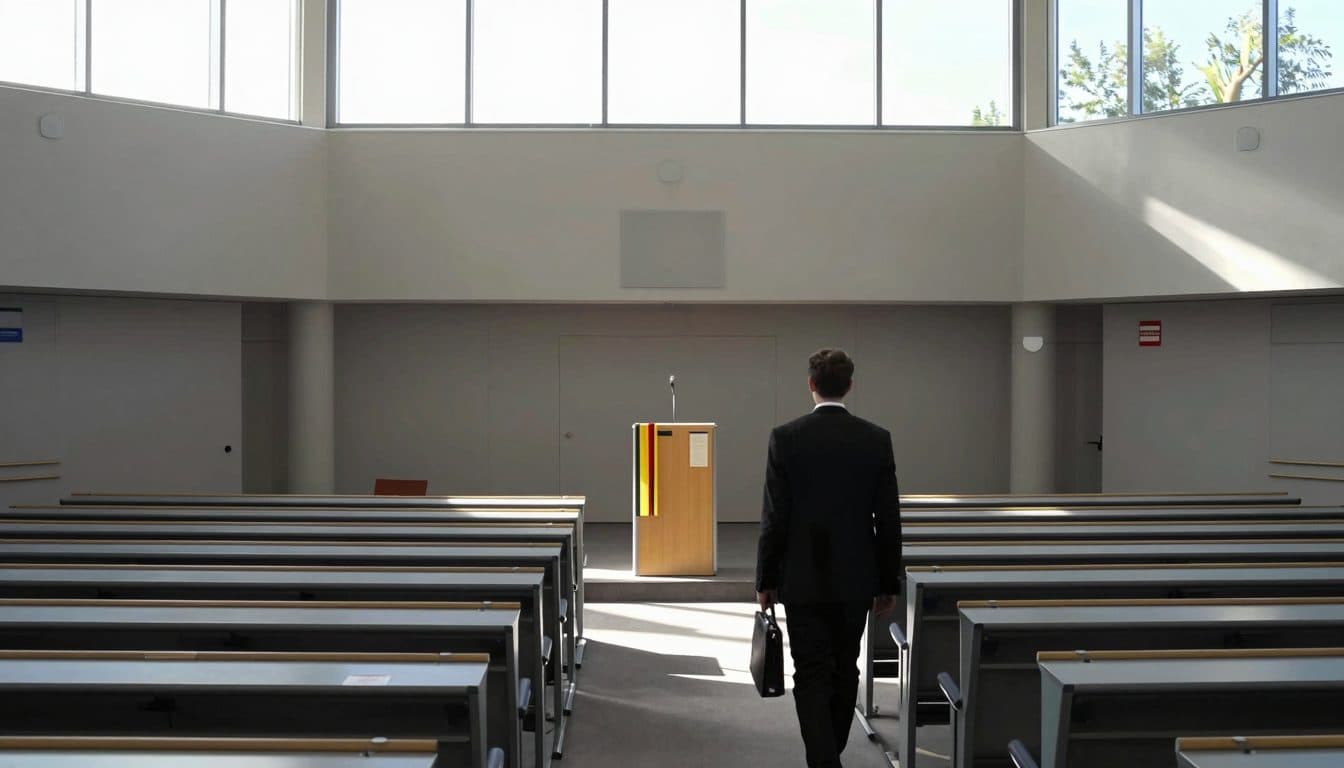
AI-generated image (z-image via Kie.ai)
Summary
Federal Chancellor Friedrich Merz (CDU) is planning an extensive cabinet reshuffle in which new ministers are to be appointed but only sworn in before the Bundestag in September. Constitutional scholars consider this procedure incompatible with the Basic Law, while sharp criticism of the handling of outgoing Transport Minister Patrick Schnieder is being voiced within the CDU, especially from Rhineland-Palatinate.
Berlin, July 28, 2026
Federal Chancellor Friedrich Merz (CDU) wants three new federal ministers to be appointed, but to be sworn in before the Bundestag only after the summer recess in September – a step that constitutional scholars criticize as incompatible with the Basic Law.
The federal government is in the middle of a personnel reorganization that goes beyond what is usual during a change of government. On Wednesday at 12 noon, Federal President Frank-Walter Steinmeier is to hand over the certificates of appointment and dismissal for Carsten Linnemann as Health Minister, Steffen Bilger as Transport Minister and Nina Warken as Head of the Federal Chancellery. Warken will first receive her dismissal certificate as Health Minister and then the certificate of appointment for the Chancellery. Linnemann and Bilger, who previously did not hold a ministerial office, will receive only a certificate of appointment.
Appointment without swearing-in: what the government is planning
The swearing-in of the three new ministers is, however, not scheduled for this date, but rather for the first sitting week of the Bundestag after the summer recess. According to Merz, the earliest possible date is September 9. The reason is that the Bundestag, with its 630 members, is in the summer recess and, according to Merz, an extraordinary return from vacation cannot be justified either politically or financially. The federal government also justifies the procedure with the need to save money – in this legislative term too, eight percent of positions in the federal government are to be cut.
Chancellor Merz said verbatim: „Es würde, glaube ich, ein großer Teil der deutschen Öffentlichkeit nicht verstehen, wenn wir 630 Abgeordnete aus den Ferien nach Berlin zurückbeordern müssten, um eine Vereidigung von zwei neuen Bundesministerin vorzunehmen.“ To justify this, the Chancellor explained: „Der Kanzler will nach eigenen Angaben auf diese Weise verhindern, dass für die Rückkehr der Abgeordneten aus der Sommerpause Steuergeld ausgegeben wird.“ He also pointed to a corresponding review result of the federal government: „Wir haben diese Frage mit Ja beantwortet. Wir halten es für zulässig.“
Dispute over the Basic Law: Article 64 under scrutiny
This assessment is meeting with considerable legal opposition. Article 64 of the Basic Law stipulates that federal ministers take their oath of office before the Bundestag "upon taking office." Constitutional law scholar Christoph Schönberger of the University of Cologne spoke in the Frankfurter Allgemeine Zeitung of a "dangerous disregard for the Basic Law and Parliament" and made clear that the oath must coincide with the assumption of office and may not follow it in time. Constitutional law scholar Sophie Schönberger of the Free University of Berlin told the Deutsche Presse-Agentur: „Das ist ganz klar mit dem Grundgesetz nicht vereinbar. Die Minister dürften ihr Amt erst nach der Vereidigung antreten; zur Amtsübernahme gehöre auch jede tatsächliche Übernahme von Ministerialgeschäften, etwa die Amtsübergabe.
Stefan Ulrich Pieper told the Rheinische Post: „Die Amtsgeschäfte ohne Vereidigung zu übernehmen, wäre verfassungsrechtlich unsauber.“ As a "clean solution," he proposed postponing the assumption of office to the time after the swearing-in. A certain qualification was provided, however, by Hans-Jürgen Papier, the former President of the Federal Constitutional Court, in the Tagesspiegel: assuming office without taking the oath does indeed violate the Constitution, „dies hätte aber keine unmittelbaren rechtlichen Konsequenzen“ and does not affect the validity of official acts.
FDP chairman Wolfgang Kubicki told the Deutsche Presse-Agentur: „Niemand hat Friedrich Merz zu diesem missglückten politischen Stunt gezwungen. Es ist seine Verantwortung, eine Lösung zu finden.“ As a way out, he suggested that the business of the new ministers be handled on an acting basis by other cabinet members until the end of the summer recess.
The Schnieder case: vacation call and failed successor
The whole affair is also politically explosive because of the handling of the previous officeholder in the transport portfolio. Patrick Schnieder, Federal Transport Minister and native of the Eifel region, had been informed by Merz in the previous week, according to media reports, that the government wished to part ways with him. Merz had called Schnieder while he was on vacation to inform him of this. An actual dismissal did not occur, however, because a designated successor – reportedly the financial expert Güntzler – had cancelled at short notice. Merz apologized for this development.
Schnieder himself then pulled the emergency brake. As SWR journalist Gernot Ludwig reported, „hat er selbst die Reißleine gezogen und um seine Entlassung gebeten“. Schnieder had asked to end an „unwürdigen Zustand“. Ludwig commented on the situation with the words: „Schnieder stand wie blöd da, komplett beschädigt.“
CDU base in turmoil: criticism from Rhineland-Palatinate and Saxony
The entire episode has caused considerable displeasure within the CDU, particularly in Rhineland-Palatinate. In a letter to the parliamentary group that is available to SWR, it says that the manner in which Schnieder was treated had caused „erhebliches Unverständnis“ within the group. Schnieder is the brother of the Minister-President of Rhineland-Palatinate. The Rhineland-Palatinate state association sent a letter which, according to SWR's assessment, shows „wie groß der Ärger an der Basis ist“. Ludwig added: „Eigentlich gelte die CDU Rheinland-Pfalz als ein ruhiger und zurückhaltender Landesverband, von dem eigentlich keine Störfeuer zu erwarten seien“. Now, however, the Rhineland-Palatinate CDU parliamentary group is drawing consequences: „Die rheinland-pfälzische CDU-Fraktion hat überhaupt keine Lust, sich mit Bundeskanzler Merz zu treffen“, Ludwig said. A meeting planned for September in Berlin as part of a retreat was cancelled. As justification, the group wrote that personal exchange „setzt aus unserer Sicht ein Mindestmaß an gegenseitigem Vertrauen und Wertschätzung voraus“.
Saxony's Minister-President Michael Kretschmer (CDU) expressed criticism in MDR of another personnel change: Christiane Schenderlein, considered a highly successful Minister of State for Sport, is to leave the Chancellery and move to the Health Ministry as Parliamentary State Secretary. Kretschmer said: „Es ist eine schwierige Geschichte gewesen die letzten Tage. Ich glaube, viele Menschen standen davor, haben das Ganze beobachtet und haben den Kopf geschüttelt. Ich auch.“ Kretschmer added that Schenderlein had been „eine unglaublich erfolgreiche Sportministerin“ and stated: „Insofern habe ich diesen Wechsel überhaupt nicht verstanden. Ich hätte eher gesagt, Frau Schendlerlein bekommt die Urkunde für das erfolgreichste Kabinettsmitglied in der Regierung Merz.“ He did concede, however: „Natürlich müsse man einem Regierungschef zubilligen, dass er das Team bildet, mit dem er dann die Arbeit machen will und muss."
The personnel decisions come at a politically delicate time. In six weeks, state elections in Saxony-Anhalt are being anticipated with great suspense, where the CDU is fighting for the Minister-President post. The CDU's overall poll ratings are also described as poor in the article. In addition, the succession of parliamentary group leader Jens Spahn, who had resigned, and associated personnel changes are pending. For Wednesday at 2 p.m., the election of Thorsten Frei as the new chairman of the CDU/CSU parliamentary group is planned – immediately after the appointments by the Federal President.
Bilger's profile: experience and critical voices
The designated new Transport Minister Steffen Bilger brings extensive experience from the field: from 2018 to 2021 he was Parliamentary State Secretary at the Federal Transport Ministry under Minister Andreas Scheuer, he was a member of the Bundestag's Transport Committee for nine years, and he was the federal government's coordinator for freight transport and logistics. Bilger has also headed the CDU district association of Nordwürttemberg since 2011. From the industry, however, critical voices are also heard. Jorrit Bosch, transport policy spokesperson for Die Linke, stated: „Ich finde, Herr Bilger steht wie kein anderer für die Versäumnisse der letzten Jahre“. Matthias Gastel of the Greens said he had not perceived Bilger as a „Typ für mutige Entscheidungen und klare Prioritäten“. Praise, on the other hand, came from Dirk Flege of Allianz pro Schiene, who described Bilger as a „versierten Verkehrspolitiker“ who is particularly well versed in freight transport.
The background to the personnel changes is the enormous investment tasks in the transport sector. Merz announced that he wanted the new Transport Minister to „im Bundesverkehrsministerium jetzt die Chance nutzt, die das Investitionsprogramm aus unserem Sondervermögen bi