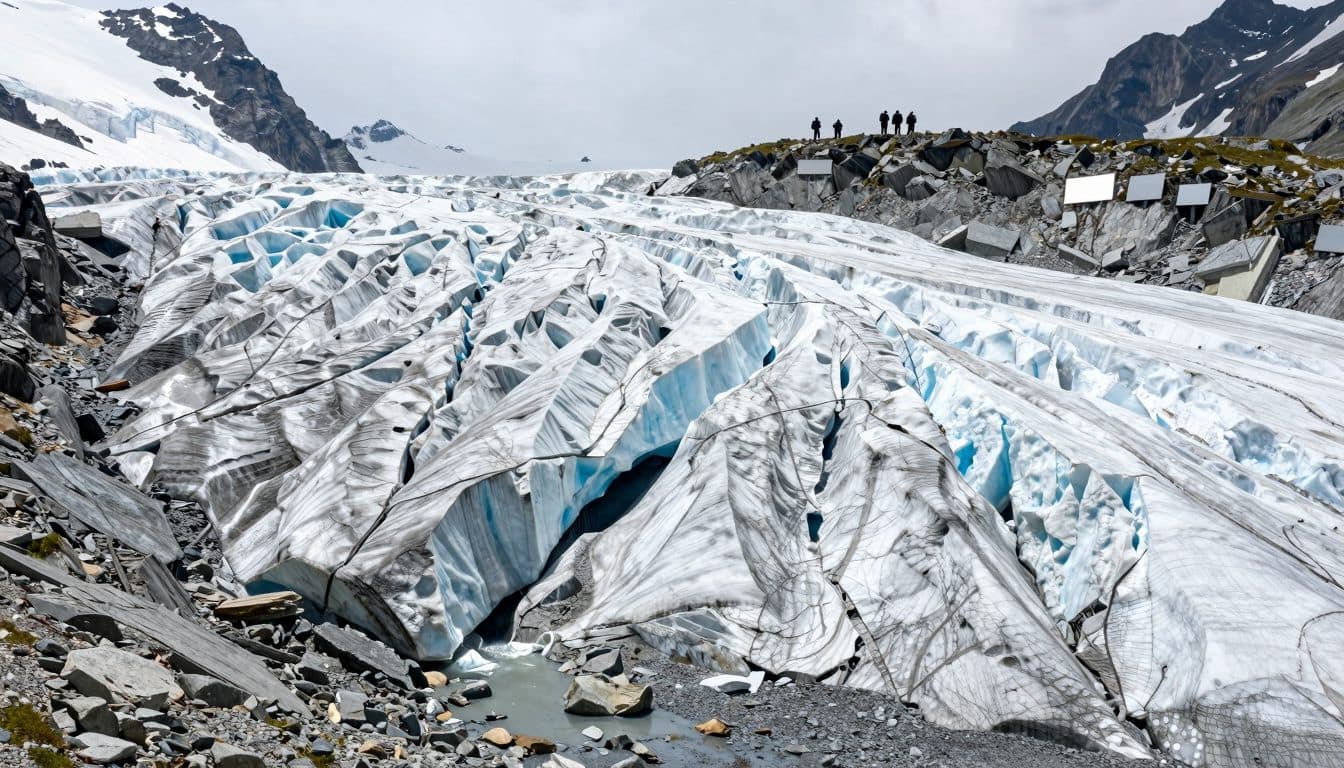
Pasterze expected to lose its rank as Austria's largest glacier this year
Vienna, July 2, 2026
AI-generated image (z-image via Kie.ai)
Summary
The Pasterze below the Großglockner is likely to lose its last ice connection at the Hufeisenbruch this year, thereby forfeiting its status as Austria's largest glacier. Experts from the Alpine Club, Hohe Tauern National Park, and GeoSphere Austria see this as further evidence of the impact of the climate crisis on the Alpine region.
Vienna, July 2, 2026
At the foot of the Großglockner, the Pasterze is melting so rapidly that its last ice connection at the Hufeisenbruch is expected to break off this year, according to the Alpine Club, Hohe Tauern National Park, and GeoSphere Austria, with the Tyrolean Gepatschferner taking over from the Pasterze as Austria's largest glacier.
The Last Piece of Ice
According to several research institutions, the Pasterze will lose its last ice connection between the firn field and the glacier tongue this summer. "It is expected that the remaining ice at the 'Hufeisenbruch,' the last connection between the firn field and the glacier tongue, will melt away still this year," the Alpine Club (ÖAV), Hohe Tauern National Park, and GeoSphere Austria announced on Thursday. As a result, the Gepatschferner, located in the Tyrolean Kaunertal, will move up to first place on the domestic glacier list.
The once mighty glacier tongue of the Pasterze already de facto resembles a dead-ice body. Since the 2010s, ice replenishment from above has been so low that "the glacier tongue has long behaved like a dead-ice body," as Michael Avian and Anton Neureiter of GeoSphere Austria put it. Movement has "almost come to a standstill" and the ice mass is not only melting but undergoing large-scale disintegration. For Andreas Kellerer-Pirklbauer, who heads the annual measurements at the Pasterze, the glacier tongue can therefore already "be described as dead ice" that "can no longer regenerate."
A Glacier Loses Its Tongue
The most current data from the 2023 glacier inventory still show the Pasterze at an area of 16.7 square kilometers. By contrast, the Gepatschferner reached around 14.6 square kilometers in 2023, according to glaciologist Andrea Fischer of the Austrian Academy of Sciences (ÖAW). Fischer sums it up with a catchy formula: "So to overtake the Pasterze, it practically suffices to race past the lame nag." Back in 2023, it was already "quite close" as to which of the two ice surfaces was ahead, and at the Gepatschferner the trend is equally clear: "In just the past five years, the glacier has lost almost 300 meters in length."
Avian and Neureiter illustrate just how massive the ice loss has been across the entire glacier over the past decades as follows: "From 1980 onward, an annual average of one ton of ice per square meter of glacier area was lost." Over the entire observation period up to 2025, an average of around one meter of water equivalent per year is lost, corresponding to one ton of ice per square meter. In the last ten years, this figure has risen to 1.2 meters of water equivalent (i.e., 1.2 tons per square meter). For the Pasterze, the researchers put the current ice volume at 0.9 cubic kilometers, according to ÖAV.
Between 2024 and 2025 alone, the tongue "sank by 7.3 meters," according to the release. The 12.4 million cubic meters of ice melted in the process correspond, in a vivid illustration, "to an ice cube with edge lengths of 231.5 meters." On the side of the glacier opposite the Hufeisenbruch, the "Schneewinkel" ice bridge already broke off for good in 2020 – "and is now a waterfall," as the data shows. The ice bridge across the "Riffwinkel" on the north side of the Pasterze tongue, which was still over 800 meters wide at the turn of the millennium, has since shrunk to a relatively narrow little bridge.
Hufeisenbruch: Where the End Begins
"Under somewhat better conditions, it could survive at least through this year," is the current expert assessment regarding the continued existence of the ice connection at the Hufeisenbruch. If the summer continues similarly warm to hot, the connection could "break off in the coming months." How deep the ice-filled trench beneath the sensitive section at the transition to the tongue actually is cannot be determined precisely, according to the glacier experts. They emphasize unanimously, however: "Whether it happens precisely this year or one to two years later is secondary."
What is clear, on the other hand, is the geological consequence: once the connection at the Hufeisenbruch breaks, the rock faces in the so-called Hufeisenbruch will be "completely ice-free for the first time in around 5,000 years." Exactly when the glacier tongue will break off cannot be predicted by the experts, but the trend is clear. Rising temperatures and, more recently, often meager fresh snowfall amounts "are causing the ice bodies to shrink markedly – a fact that researchers and the Alpine Club with its 'Glacier Reports' repeatedly point out."
More Than a Natural Event
For ÖAV Vice President Nicole Slupetzky, "the melting of our largest glacier" has by now become "far more than a local natural event." She sees it rather as a challenge for society as a whole: "Der Verlust unserer Gletscher hat bereits heute spürbare Folgen für Wasserhaushalt, Biodiversität und die Sicherheit im alpinen Raum," Slupetzky is quoted as saying. The Alpine Club, as the largest landowner in the Glockner area, feels "emotionally and historically deeply connected" and understands climate protection "als gesamtgesellschaftliche Herausforderung, der wir uns auch im Vereinsleben aktiv stellen."
Andrea Fischer likewise emphatically points to climate change as the cause: "Wir sehen hier ganz klar die Auswirkungen der Klimakrise und damit die Veränderung eines einzigartigen Naturraums, der unsere Alpen über Generationen geprägt hat." When one sees how far the ice has already been diminished, it becomes clear how close we currently are "den bisher wärmsten Temperaturen annähern und wie wir dabei sind, die zu überschreiten." The loss "berührt die Menschen": "Immer wieder melden sich Menschen mit ihren Geschichten zu der Gegend, zum 'Glockner' und der Pasterze," the glaciologist reports.
A Symbol and Its Message
From a glaciologist's perspective, the process is "incredibly exciting," as Fischer finds: "Aus Sicht der Glaziologie ist das ein unglaublich spannender Vorgang, den man da beobachten kann." She expects a certain "Katastrophentourismus, weil es ja wirklich etwas ist, was man als Österreicherin und Österreicher, und alle, die hier wohnen und urlauben, gesehen haben sollte - die letzten Tage unserer nationalen Ikone." For science, however, the process is above all a warning: "Das ist die ganz große Botschaft dieses Vorgangs."
Technically, the end of the connection at the Hufeisenbruch means that "die Pasterzenzunge dann endgültig vom Restgletscher getrennt sein und abschmelzen" will. The detached lower part will then be referred to as a "Toteiskörper." "In so einem Fall spricht man von 'Toteisfeldern', denen jegliche Verbindung zum Firngebiet fehlt." Once glaciers disintegrate, they are mapped as "Kinder" of a previous "Elterngletschers" – from a glaziological perspective, "sofort nach dem Abreißen der letzten Eisverbindung."
Research as Long-Term Memory
The researchers see in this process an opportunity "die Klimageschichte Österreichs für die letzten 10.000 Jahre zu rekonstruieren." In 2025, Fischer already discovered scattered holes in the firn area of what is still Austria's largest glacier – an indication that melting has begun even at higher elevations. Even though the Gepatschferner reaches "only" up to around 3,500 meters above sea level, it will likely be granted a longer life than the Pasterze, which extends to almost 3,800 meters, Fischer believes. The glacier measurements are coordinated by the Glacier Measurement Service of the Alpine Club and as part of the annual "Gletscherbericht," for which Andreas Kellerer-Pirklbauer and Gerhard Lieb from the Institute of Geography and Spatial Research at the University of Graz are responsible.
Fischer draws a striking comparison: "Diese rasche Änderung ist etwas, was man zum Beispiel mit Kindern gesehen haben sollte," she says – thereby capturing the drama of what is unfolding. For what is happening at the Großglockner within just a few years takes place on far slower timescales than appears natural to observers. What remains is the certainty: "Wir beobachten seit 1980, dass die Pasterze fast durchgehend Masse verloren hat."
What can still be experienced at the Pasterze today as an Alpine landscape of ice and snow was, over thousands of years, a mighty, flowing mass of ice. With the expected end of the connection at the Hufeisenbruch, an era that was unique by any human measure comes to a close – and,
Pasterze loses top spot: Gepatschferner set to become larger | allfacts360