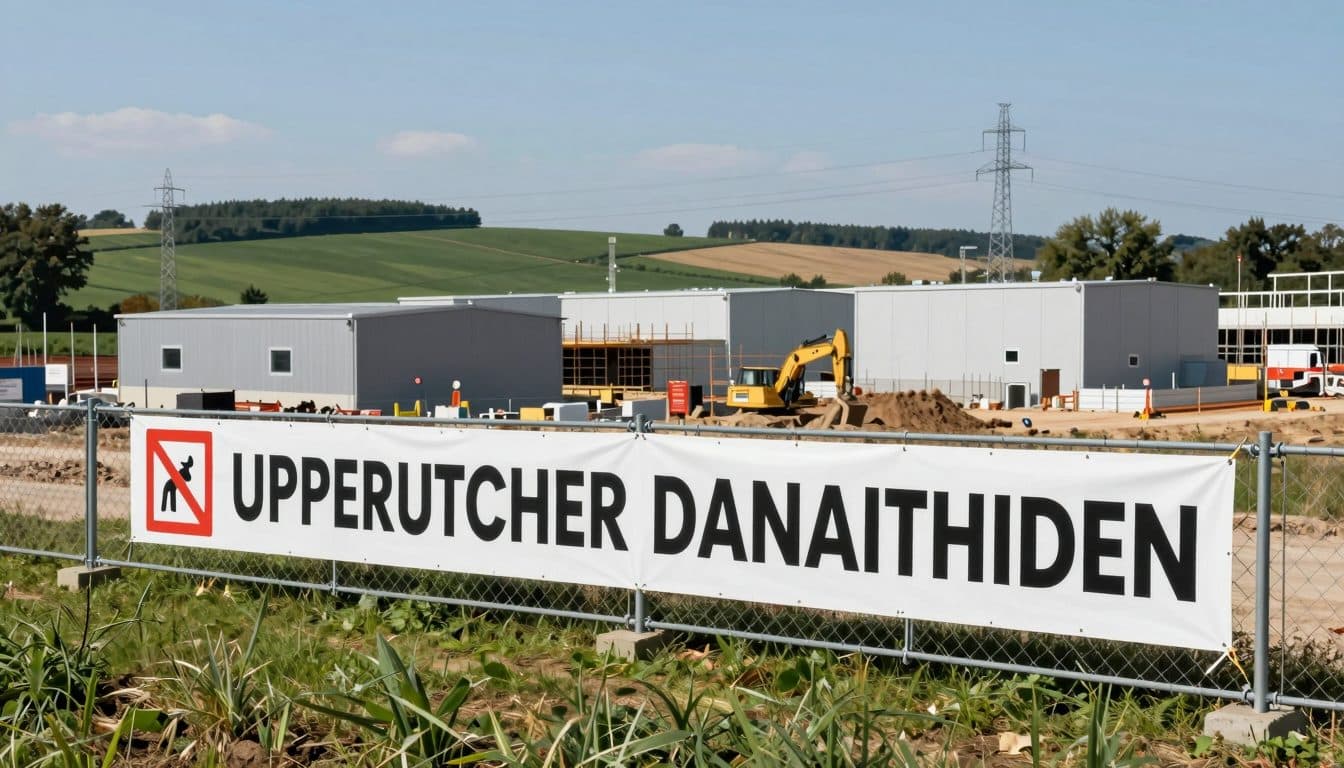
Protest against Google data center in Kronstorf: Hundreds of demonstrators and dispute over environmental impact assessment
7/17/2026
AI-generated image (z-image via Kie.ai)
Summary
In Kronstorf, between 300 and 400 people protested on Friday against the planned Google data center, according to organizers. Environmental organizations and the SPÖ are calling for an environmental impact assessment, while the ÖVP rejects a blanket EIA requirement.
In Kronstorf in Upper Austria, between 300 and 400 people protested on Friday against the planned Google data center on a 50-hectare construction site, according to organizers, while environmental organizations, the SPÖ, and the Greens called for an environmental impact assessment (EIA) for such projects.
The "Bürger:inneninitiative Rechenzentrum Kronstorf" had called for a rally at the major construction site on Friday afternoon. According to organizers, 300 to 400 people took part "from all over Austria," including supporters of the "Lobau Bleibt" initiative, which demanded in a press release "livable regions instead of profit for rich corporate bosses." Another count spoke of more than 200 participants. The initiative demands the "unconditional disclosure of all contracts and deals between politicians and tech corporations from day one, as well as honest comprehensive assessments of noise, traffic, and grid security," along with protection from noise and negative impacts on the microclimate caused by waste heat.
Scale of the project
According to its own statements, Google is building a data center in Kronstorf that is set to make the site one of the largest within the corporation. The groundbreaking for the project took place at the end of April. The maximum capacity for power demand in the first expansion phase is 150 megawatts; a possible full expansion would have a maximum capacity of 500 megawatts, as Google stated upon inquiry. Upper Austria's Economic Affairs Minister Markus Achleitner (ÖVP) spoke of "the historically largest single investment in Upper Austria"; an investment in the billions has been speculated.
Criticism of Google's 50-hectare construction project centered primarily on the fact that no environmental impact assessment (EIA) had been carried out. On Friday, Global 2000 and the Ökobüro presented a study on the topic and spoke of a "legal loophole." Gregor Schamschula, managing director of the Ökobüro, proposed in the Ö1-Mittagsjournal a mandatory EIA from a capacity of 50 megawatts upward. Data centers should also be required to become more efficient in the event of "technology leaps." According to his proposal, a simplified procedure could apply from 10 MW, and an EIA would also make sense in areas worthy of protection. Global 2000 called for a moratorium on the construction of data centers until these questions are clarified, and a clear strategy on what may be built in Austria.
Environmental organizations see a legal loophole
The environmental organization Global 2000 and the Ökobüro had also spoken of a "legal loophole" at a press conference on Friday. They announced that they would file a motion to close the "EIA loophole." The Global 2000 representatives pointed to the comparison: "It cannot be that small wind power projects are rigorously assessed for their environmental impact, while huge server halls on greenfield sites can get by without any review." Schamschula compared the current EIA regime to a "horse-drawn carriage law" with which one seeks to "catch robotaxis."
SPÖ and Greens: EIA requirement from 50 megawatts
The SPÖ is also calling for a tightening of the EIA rules. Their proposal: from 50 megawatts, a data center should be subject to an EIA requirement; likewise from 20 megawatts if cooling water is additionally drawn from bodies of water or groundwater, or if less than half of the waste heat is used externally. The SPÖ environment spokesperson fears that around 5.8 million liters of 30-degree water could be discharged into the Enns daily, and sees massive impacts on the environment, soil, electricity, and water consumption. SPÖ state party chairman Martin Winkler demanded, in view of Google's location decision, a massive expansion of hybrid power plants with wind farms, agri-PV systems, and battery storage, as well as more pumped-storage facilities.
The ÖVP, however, rejected the idea on Friday: a blanket EIA requirement for data centers would be "the wrong approach," said Energy State Secretary Elisabeth Zehetner. It would be more sensible to implement requirements for data centers through zoning and planning rather than through a "one-time approval act." Economic Affairs Minister Achleitner pointed out that in Upper Austria there are "64 wind turbines in various stages of the approval process" and that a pumped-storage power plant with a capacity of 170 megawatts is being built in Ebensee. The goal of 100 percent renewable electricity on a net basis by 2030 is not jeopardized, according to board member Alfons Haber.
ÖVP: Zoning instead of one-time review
Green state parliamentarian Anne-Sophie Bauer described the project as an "energy-policy farce," since Achleitner, "in collusion with the FPÖ, is doing everything to prevent wind power in Upper Austria." Green Environment Minister Stefan Kaineder, who is responsible for the EIA authority in Upper Austria, emphasized that no official information about the project had been provided to that authority. Kronstorf's mayor Christian Kolarik (ÖVP) said of the announced demo: "Google acquired the site for gradual development 18 years ago now, and that is exactly what is now being implemented."
Google itself defended the project. The impact on the Enns was, according to the expert opinion underlying the water law permit, so minimal "that it was classified as negligible by the official experts." "The cooling water that is returned will warm the Enns by less than 0.005 degrees and is therefore negligible. For example, at the Mühlrading power plant, which is in the immediate vicinity, there will no longer be any measurable temperature difference," Google said. The maximum limit value stated in the water permit will be clearly undercut in regular operation.
Google: Warming of the Enns "negligible"
Under the water law permit, Google is allowed to discharge a maximum of 99 liters of water per second into the Enns, at a maximum temperature of 30 degrees Celsius. A total of no more than 5.8 million liters of heated cooling water may be discharged into the Enns per day. Google has filed further expansion stages for approval, Achleitner confirmed, for which there are "intensive review and approval procedures."
Google also emphasized the locational advantages: "A local data center reduces latency times and strengthens Upper Austria as a digital and AI hub." "Austria should court such future investments instead of driving them away with additional bureaucracy." The impacts of these projects are already being examined today under zoning, building, plant operation, and, where applicable, water law.
Google argued with the locational advantage and the synergy effect: "We cannot demand more European sovereignty in AI while simultaneously slowing down the very infrastructure on which it is based with ever new hurdles." Data centers would bring investment, value creation, and technological expertise to Austria. The waste heat, according to Achleitner, is 30 degrees and is used on site itself as well as made available to neighboring businesses.
Electricity consumption: Up to 4.4 terawatt-hours possible
The energy footprint of the project is enormous: according to Netz Oberösterreich, annual consumption in the first expansion phase at 150 megawatts could be up to 1.31 terawatt-hours, equivalent to the annual electricity consumption of 375,000 households. That would be almost a third of the federal state's previous total demand: all of Upper Austria consumed 14 terawatt-hours in 2024, according to the Upper Austrian Energy Report. If the second phase with 500 megawatts of peak capacity were realized, consumption would amount to up to 4.4 terawatt-hours.
There is now great anticipation about exactly what changes an EIA reform could bring. The SPÖ and Greens announced initiatives; environmental law experts warned that a retroactive EIA requirement could trigger "a flood of highly contested legal issues." Green environment spokesperson Lukas Hammer said that while it was "commendable" that the SPÖ had "finally woken up and discovered a legal loophole that the government should have closed long ago," "instead of their belated outrage, we expect the SPÖ to agree to our upcoming motion."
Questions & Answers
Who protested against the Google data center in Kronstorf?
The "Bürger:inneninitiative Rechenzentrum Kronstorf" had called the rally; according to organizers, 300 to 400 participants came from all over Austria, including supporters of the "Lobau Bleibt" initiative.
What criticism lies behind the call for an environmental impact assessment?
Global 2000, WWF, VIRUS, and the Ökobüro see a legal loophole because no EIA was carried out for the 50-hectare project in Kronstorf. The SPÖ environment spokesperson also fears daily discharges of 5.8 million liters of warm water into the Enns.
How does Google argue against the accusations?
Google refers to the expert opinion underlying the water law permit, according to which the warming of the Enns is "negligible" at less than 0.005 degrees. The company also emphasizes the strengthening of Upper Austria as an AI hub through lower latency times.
Google data center Kronstorf: Demo and EIA dispute | allfacts360