Russia launches largest attack wave since start of war on Ukrainian cities
Kyiv, July 2, 2026
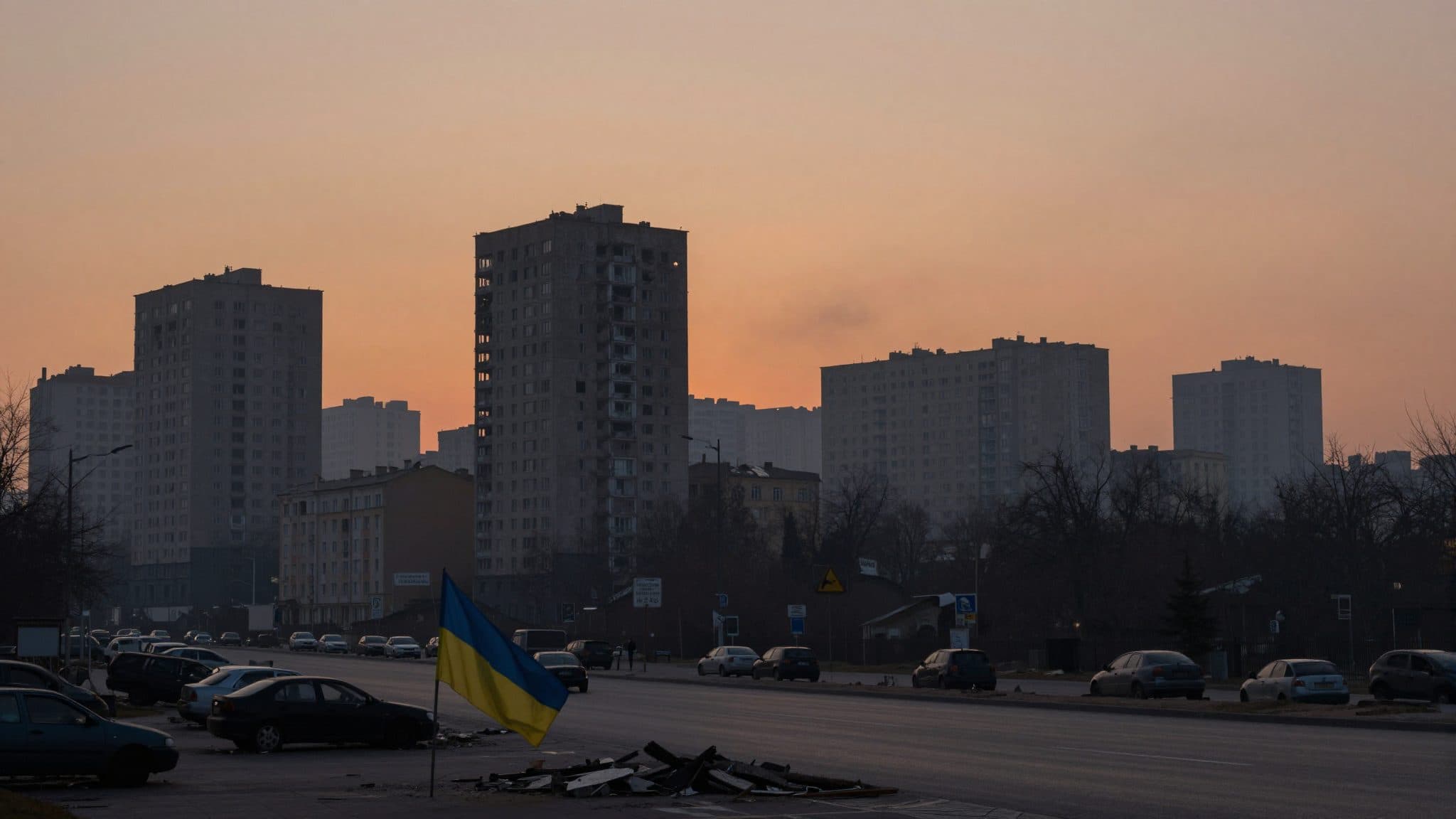
AI-generated image (z-image via Kie.ai)
Summary
Russia attacked Ukraine overnight into Thursday with nearly 500 drones as well as dozens of cruise missiles and rockets. According to Ukrainian figures, at least 13 people died in Kyiv alone, and more than 90 others were injured.
Kyiv, July 2, 2026
Overnight into Thursday, Russia attacked Ukraine with nearly 500 combat drones as well as dozens of cruise missiles and rockets, triggering one of the heaviest attack waves since the start of the war.
Attack on Kyiv
The Ukrainian capital Kyiv was at the center of the strike. According to authorities, there were impacts in more than thirty locations across the city. Multi-story residential buildings were hit, some completely destroyed. In addition, a hotel in the city center on the central Shevchenko Boulevard caught fire, as Mayor Vitali Klitschko reported. The Kyiv Independent reported "incredibly loud explosions" that could be heard even in air-raid shelters deep underground.
According to President Volodymyr Zelensky, at least 13 people were killed in the attacks in Kyiv, and more than 90 others were injured. Kyiv's military governor, Tymur Tkachenko, spoke of at least 56 casualties, including two children. The casualty figures were revised upward several times over the course of the morning and could rise further. Rescue workers continued to search for dead and injured among the rubble.
Number of casualties rises
Klitschko had already declared on Telegram during the night that "the whole city" was being attacked and called on residents to go to shelters and stay there. Many Kyiv residents fled to subway stations. According to reports, some of them set up tents there to spend the night underground, protected from air strikes.
In addition to Kyiv, the cities of Kharkiv in the northeast, Zaporizhzhia and Pavlohrad in the southeast, and Sumy in the northeast of Ukraine were also hit. In Kharkiv, the country's second-largest city before the war, and in Odesa, there were also fatalities. In Zaporizhzhia, Governor Ivan Fedorov reported three injured. The Kyiv Independent described the attacks as one of the heaviest attack waves since the start of the war.
Other cities affected
According to Ukrainian figures, Russian drones flew toward Kyiv from multiple directions in order to overwhelm air defenses. It was striking that the drones coming from the north circumvented Belarusian territory. Zelensky had issued an ultimatum to Minsk the previous week, threatening to destroy facilities on Belarusian territory that transmit radio signals to Russian drones. The Belarusian leadership around President Alexander Lukashenko did in fact take the transmitters offline.
The greatest damage was caused by missiles and cruise missiles. In addition to projectiles fired by bombers, models of the Zircon type were also used. This is a missile flying at multiple times the speed of sound, which is primarily launched from ships. While Ukraine manages to shoot down the majority of drones, the success rate is lower for missiles and cruise missiles. To defend against these weapons, Ukraine still relies heavily on foreign systems, which are only available in limited numbers.
Approach from multiple directions
Many of the Russian Geran drones used overnight into Thursday reportedly had jet propulsion. These aircraft reach significantly higher speeds than drones with a conventional engine and are therefore more difficult to intercept. Geran is the type designation for the Russian further development of the Iranian Shahed drone.
The Russian Defense Ministry spoke of a retaliatory strike for Ukrainian attacks on civilian infrastructure in Russia. The Russian armed forces had carried out precision strikes against military facilities and energy infrastructure in Kyiv as well as several other provinces. Previously, on early Wednesday morning, Ukraine had targeted Russian arms factories and a refinery deep inside the country. According to the Ukrainian military, the Russian oil refinery in Kstovo, one of the country's largest facilities, was also hit.
Due to the increased danger, the energy company Western Oil Group announced that starting Thursday, all gas stations in Kyiv and all front-line provinces would be closed between 9 p.m. and 7 a.m. In the greater Kharkiv area alone, at least half a dozen gas stations were destroyed in recent days. The Ukrainian military stated that after initial impacts in the evening, air raid alerts were triggered again in the early morning hours; nearly a dozen Russian bombers were in the air.
Counterattacks on Russian territory
Parallel to the attacks on Ukrainian cities, the Ukrainian Air Force continued its drone attacks on Russian territory. On Thursday, a Ukrainian drone attack on the central Russian region of Nizhny Novgorod officially killed one person and wounded four others, according to official statements. Regional governor Gleb Nikitin spoke of damage to an industrial facility. A drone strike was also reported in Belgorod, in which one person was killed.
The Ukrainian president had already warned at a press conference in Dublin on Wednesday, citing intelligence findings, of an imminent attack. "Every one to two weeks there are heavy attacks with hundreds of drones and dozens of missiles, and "today there is the unpleasant information about the next preparation of such a massive Russian attack," Zelensky said. The occasion for the visit was the start of the Irish EU Council Presidency. Zelensky then left Ireland earlier than planned to return to Ukraine and urged his compatriots to seek shelter when air raid alerts were sounded.
Warning from Dublin
Meanwhile, the Washington-based think tank Center for Strategic and International Studies (CSIS) published a new situation report on the losses on both sides. Overall, since the start of the war in February 2022, around two million soldiers had been reported killed, injured, or missing—1.4 million of them on the Russian side, according to the report. CSIS put the total number of Russian fallen at 400,000 to 450,000; on the Ukrainian side, the figure was 125,000 to 150,000.
CSIS situation report
While the ratio of Russian to Ukrainian losses had been at 2:1 or 3:1 for most of the time, it was estimated to have risen to 8:1 in the first half of 2026. The main reason for this was the increased and highly effective use of Ukrainian combat drones. CSIS states that its calculations are based on information from the military, intelligence services, and governments of various countries.
Analysts interpret the ongoing massive air strikes on Ukrainian cities as a sign that the Russian army is no longer making progress at the front. In the spring of 2026, the attackers were unable to expand the territory they control in Ukraine for the first time in years and had to accept individual territorial gains by the Ukrainians. Their advances along the more than thousand-kilometer front line have also slowed. Meanwhile, the monthly number of Russian losses now exceeds that of new recruitments.
While both warring parties report enemy losses on a daily basis, they very rarely disclose their own casualty figures. It is considered certain that both Russia's leadership and that of Ukraine downplay their own losses and inflate those in the ranks of the enemy. ZDF reporter Ehm explained on ZDFheute live that the problems caused by the war can no longer be concealed from the population. The Russian president must respond accordingly.
Background: War weariness and consequences
The attack two weeks ago on a refinery in Moscow, which enveloped Russia's capital in thick plumes of smoke, was particularly humiliating for the Kremlin. For several weeks, Ukraine has been specifically targeting refineries and other wartime-relevant companies in the Russian rear, leading to supply shortages at the front but also for the civilian population, especially in the occupied Crimea. Former NATO General Erhard Bühler stated on the podcast "Was tun, Herr General?" that fuel is becoming scarce in 78 Russian regions.
Whether the hotel in downtown Kyiv was deliberately attacked or struck by falling debris is unknown. The full extent of the damage was not initially clear. The very large Russian air strikes with hundreds of drones, rockets, and cruise missiles deployed simultaneously had been absent since mid-June.
Questions & Answers
How many casualties did the attack wave in Kyiv claim?
According to President Volodymyr Zelensky, at least 13 people were killed in Kyiv, and more than 90 others were injured. The casualty figures were revised upward several times over the course of the morning.
What weapons did Russia use in the attack?
According to Ukrainian figures, Russia attacked with nearly 500 combat drones as well as dozens of cruise missiles and rockets. In addition to projectiles from bombers, models of the Zircon type were also used.
What does the CSIS report say about losses in the war?
According to a report by the Center for Strategic and International Studies, around two million soldiers have been killed, injured, or missing since the start of the war, 1.4 million of them on the Russian side. The loss ratio of Russia to Ukraine rose to an estimated 8:1 in the first half of 2026, according to the report.
Russia attack wave Ukraine: Hundreds of drones and rockets | allfacts360