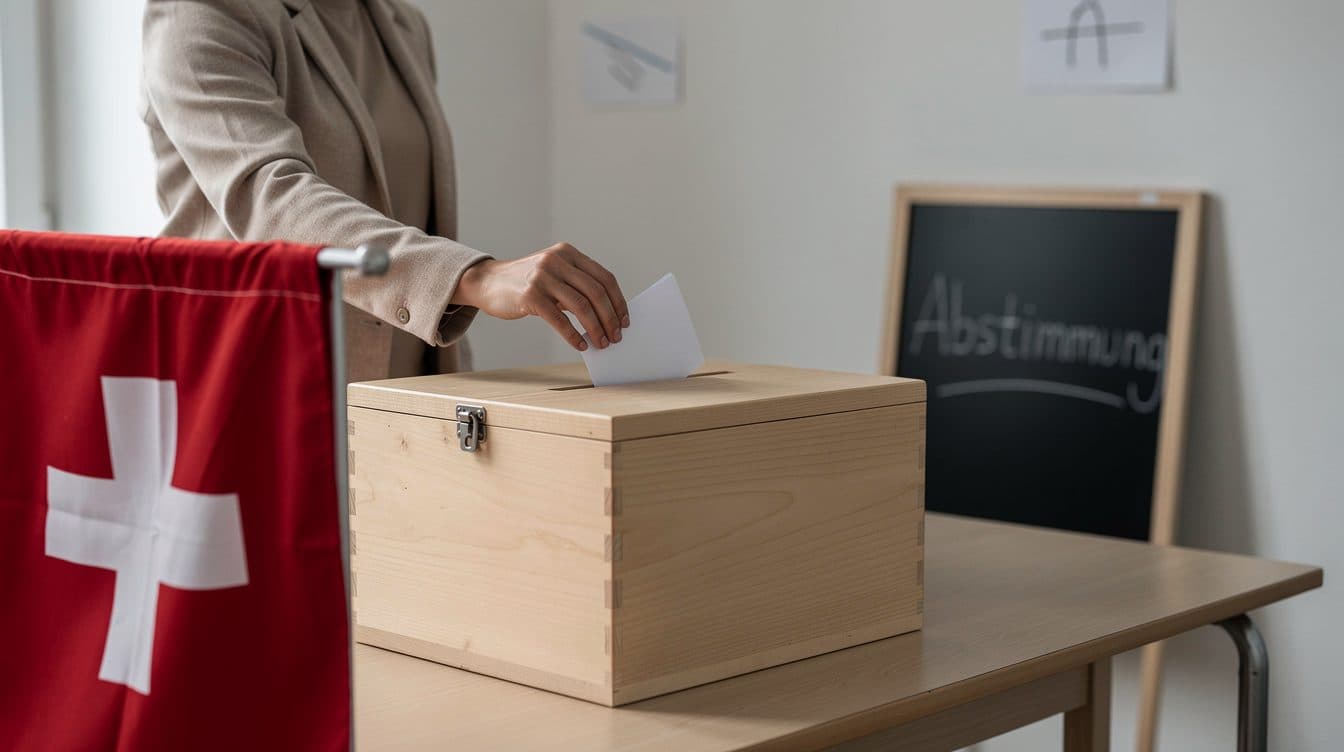
Swiss voters reject SVP initiative against a ten-million Switzerland
Bern, 14 June 2026
AI-generated image (flux-2/pro-text-to-image via Kie.ai)
Summary
Swiss voters have rejected the SVP's popular initiative "No 10-million Switzerland!" with around 55 percent of votes cast against it. Relief was widespread among opponents of the proposal, who had feared a "Brexit moment," after the projections were announced.
Bern, 14 June 2026
Swiss voters on 14 June 2026 clearly rejected the Swiss People's Party's (SVP) popular initiative "No 10-million Switzerland!"; according to projections by the research institute gfs.bern on behalf of SRG SSR, around 55 percent of voters voted against the proposal and around 45 percent in favour.
The SVP initiative formally bore the title "No 10-million Switzerland! (Sustainability Initiative)." It demanded that Switzerland's permanent resident population remain below ten million before 2050. Had the threshold of 9.5 million inhabitants been exceeded before 2050, the Federal Council and Parliament would have had to take measures, particularly in the asylum sector and with regard to family reunification. As a last resort, the initiative text provided for the termination of the bilateral agreement on the free movement of persons with the European Union – a step that supporters and opponents alike considered historically unprecedented. Had it been accepted, Switzerland would have "as the only country in the world" capped its population by constitutional means.
What was the initiative about?
The result, though not surprising, was clear-cut. A new projection at 1:00 p.m. by the research institute gfs.bern on behalf of SRG SSR showed a no vote of around 55 percent with a margin of error of ±2 percentage points. The second SRG survey at the end of May had already shown a majority against the proposal for the first time. Voter turnout was around 60 percent. The official final result was not expected until late afternoon; most voters had, however, cast their ballots in advance by mail. Polling stations were only open for a few hours on Sunday morning.
Projection and turnout
There was great relief among opponents of the proposal after the projections were announced. Cédric Wermuth, co-chair of the Social Democrats, said that during the campaign he had «gespürt, dass viele Menschen die Nase voll haben von dieser andauernden Spalterei, wonach die Migrantinnen und Migranten an allem schuld sind». This "politics of scapegoating" had – fortunately – reached its limits. Zurich Centre National Councillor Yvonne Bürgin said that in the end the arguments had prevailed that «ein starrer Deckel keine Lösung» sei. Relief was written all over her face.
Voices from the opponents' camp
The FDP interpreted the result as a «Bekenntnis zu einer offenen und wirtschaftlich vernetzten Schweiz». The Green Liberals likewise stressed that Switzerland tackles «Probleme traditionell mit Sachlichkeit, Innovation und Zusammenhalt», «nicht mit Abschottung und einfachen Parolen». The Federal Council and Parliament had already recommended rejecting the initiative in advance; in the National Council, 123 members spoke out against it and 67 in favour, while in the Council of States it was rejected by 30 votes to 9. Justice Minister Beat Jans had warned of a "Brexit moment" and pointed out that hospitals and care homes would no longer function without foreign staff.
Reactions from the centre-right
The SVP, for its part, was chastened. President Marcel Dettling said it was «kein gutes Resultat für die Schweiz». At the same time, supporters of the proposal pointed out that more than 40 percent of yes votes were a clear signal to politicians. Bernese SVP cantonal parliamentarian Stephanie Gartenmann said this was «ein klares Signal, dass wir in der Politik jetzt etwas machen müssen». The vice-president of the Centre said in an SRF interview that Switzerland's success had led to «Wachstumsschmerzen»; a rigid cap, however, was no solution. Instead, the labour potential of people already living in Switzerland needed to be put to better use.
Behind the debate stood the question of how to handle the free movement of persons with the EU, in force since 2002. According to the SVP, 1.5 million people net have moved to Switzerland since the introduction of free movement, not counting the asylum sector. The population thereby grew by almost a quarter to 9.1 million inhabitants. Around 340,000 of them are Germans – the second-largest immigrant group; in the city of Zurich 32,700 Germans live, accounting for around eight percent of the city's population. 2.4 million people in Switzerland do not hold a Swiss passport, 235,000 are asylum seekers or provisionally admitted persons. About 40 percent of voters have a migration background.
City versus country
The rejection was clear in the cities. French-speaking Switzerland and the urban centres were, according to Lukas Golder of gfs.bern, decisive for the failure of the proposal. In Basel-Stadt, where the foreign-national share is 39 percent, more than half of the 211,000 city residents are not eligible to vote, because they do not hold Swiss citizenship or are under 18. In the city of Zurich, which has 453,000 residents, 32,700 Germans live. In rural regions such as the canton of Appenzell Innerrhoden, where there are fewer foreigners, the SVP initiative was, by contrast, approved by almost 66 percent.
SVP arguments
The SVP had packaged its proposal as a sustainability initiative: it was about conserving resources, stopping further concreting over of the landscape, relieving public transport and fighting crime. The initiators also spoke of "massively too high" immigration and listed housing shortages, higher rents, traffic jams, overcrowded trains, rising crime, an overburdened healthcare system and declining quality of education as consequences. According to the SVP, around 100,000 people come to Switzerland every year – from the EU, from third countries and as asylum seekers. Foreigners accounted, not counting cross-border commuters, for 34 percent of the workforce in the construction sector.
The economic and political significance of the proposal extended far beyond the immigration issue. Acceptance would have entailed the termination of the free movement of persons agreement with the EU, described as a "Brexit moment." This would have substantially damaged bilateral relations with the European Union. For the roughly 330,000 Germans living in Switzerland as well as for tens of thousands of cross-border commuters, a yes would have meant the loss of unhindered freedom to work and reside. The Financial Times had criticised that the Swiss government had «bis heute keine umfassende Antwort auf Fragen zu Wohnungsmangel und überlasteter Infrastruktur» delivered.
Economic and European policy dimension
According to official statistics, around 10.5 million people will be living in Switzerland in 2055 – a growth trajectory that would have increasingly brought the SVP's demand under pressure. With the rejection, the free movement of persons with the EU now remains untouched for the eleventh time in 26 years. Yvonne Bürgin said it was «kein Schlussstrich unter der Debatte», but «ein Auftrag an die Politik». The issues of housing shortages, infrastructure expansion and migration are therefore likely to continue to occupy Swiss domestic politics beyond 14 June 2026.
Population forecast and political outlook
Voting Sunday, 14 June 2026, also featured a second item on the ballot: in addition to the immigration initiative, voters also had to decide on a reform of the civil service law. A gfs.bern survey forecast a close race here: 48 percent spoke out in favour of the law, 46 percent against it. Critics of the reform warned of staff shortages in care and conservation. Federal President Guy Parmelin had stated in a parliamentary debate in April that civilian service must remain «eine Ausnahme». A left-green coalition had collected more than 50,000 signatures in order to force the referendum against the civil service reform in the first place.
Second proposal: civil service reform
The SVP has positioned itself for decades against foreigners and against the European Union. With the minaret ban of 2009 and the burqa ban (veiling ban) of 2021, the party had already won two popular votes that shaped the country's migration policy course. With the clear "no" to the "Sustainability Initiative," it has now missed out on a third migration-policy victory. Switzerland's economic openness – underpinned by free movement of persons – remains, for the time being, a position capable of winning a majority. The SVP called on the government to take Switzerland's growing pains seriously without jeopardising the bilateral path with the EU.
SVP: between three victories and a defeat
Even in advance, the SVP's campaign had been criticised by a broad alliance. Opposition had, as analyses put it, extended from the centre-right to the left. Business associations also warned of labour shortages and economic damage. Acceptance of the initiative would, in the final analysis, have put at risk Switzerland's sole instrument for managing migration vis-à-vis the EU – the free movement agreement. The medium- and long-term consequences for Switzerland would have been barely foreseeable, according to centre-right position papers.
For Cédric Wermuth and the Social Democrats, the outcome is a victory of pragmatism. The SVP must recognise that Switzerland is not a country of «Sündenböcke». The political debate on immigration, housing construction and infrastructure will, however, continue – with the clear verdict of the ballot box behind it that a rigid numerical cap on the population finds no majority.
Switzerland: SVP initiative "No 10-million Switzerland" | allfacts360