Switzerland Referendum 14 June 2026: 10-Million Cap & | allfacts360
Switzerland votes on initiative for a population cap and other ballot measures
Bern, 14 June 2026
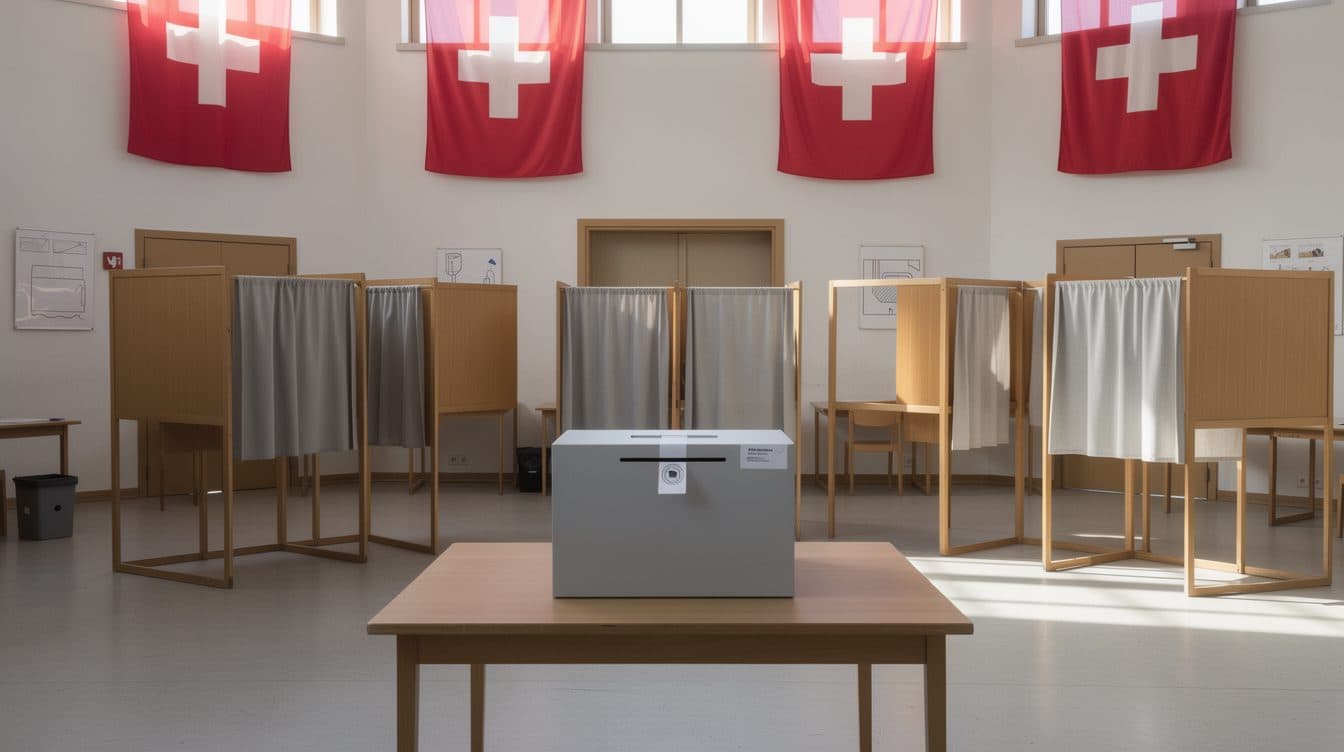
AI-generated image (flux-2/pro-text-to-image via Kie.ai)
Summary
On 14 June 2026, Swiss voters will decide, among other things, on the SVP's «No to a 10-Million Switzerland!» initiative and the Military Service Act. Initial results and projections for the national measures are expected from 12 noon, and for the city of Zurich from around 3 p.m.
Bern, 14 June 2026
On 14 June 2026, Swiss voters will cast their ballots on the SVP's popular initiative «No to a 10-Million Switzerland! (Sustainability Initiative)», on the Military Service Act, and on numerous cantonal and municipal measures.
The closely watched vote is taking place against a politically charged backdrop. The SVP's «No to a 10-Million Switzerland!» initiative demands that the permanent resident population remain below ten million before 2050. If it is approved today, Switzerland will become the first country in the world to introduce a population cap. Adoption requires both a popular majority and a majority of cantons.
What is the initiative about?
Switzerland currently has about 9.1 million inhabitants, meaning the country has around a quarter more people than it did twenty years ago. The initiators, led by Zurich SVP parliamentarian and banker Thomas Matter, argue that roughly 100,000 people come to Switzerland each year, from the EU, from third countries, and as asylum seekers. The SVP speaks of a population explosion that is overwhelming the country, citing traffic jams, overcrowded public transport, housing construction, high rents, and crime as problems.
Concretely, the initiative would oblige the Federal Council and Parliament to take measures once the population reaches 9.5 million: «If 9.5 million people live in the country before 2050, the Federal Council and Parliament must take measures, particularly in the area of asylum and family reunification.» If the initiative is approved, asylum admissions and family reunification would have to be restricted once the population reaches 9.5 million.
Consequences for relations with the EU
Should the ten-million threshold be exceeded before 2050, the foreign policy consequences would be severe. As the text of the initiative states: «If the ten-million threshold is exceeded before 2050, Switzerland must denounce these agreements, and after two years also the agreement on the free movement of persons with the EU.» Switzerland would thus become the first European state to denounce the agreement on the free movement of persons with the EU – a step that would fundamentally strain bilateral relations.
The Swiss government and most parties reject the proposal. The Federal Council and Parliament recommend that voters say no. The Federal Council and Parliament reject the popular initiative against a 10-million Switzerland. In the Council of States, the initiative was rejected by 30 votes to 9; in the National Council, 123 members voted against it and 67 in favour. In past years, however, results in popular votes have often deviated significantly from the polls, leaving the outcome uncertain.
Arguments of the opponents
The Federal Council and the business community are warning of a personnel bottleneck. Justice Minister Beat Jans (SP) warns that hospitals, nursing homes, the construction industry, and tourism would no longer be able to fill their open positions if the initiative were adopted. He says: «Die Initiative kann Ihre Gesundheit gefährden.» He also states: «Sie ist ein leeres Versprechen: Ein Bevölkerungsdeckel löst kein einziges Problem», and adds: «Sie beschert uns nur viele neue Probleme.» The major business associations also reject the initiative; economiesuisse Director Monika Rühl puts it this way: «Die Wirtschaft sagt klar nein zur Chaos-Initiative», and the SVP sees the proposal defamed when business representatives call it the «Chaos-Initiative».
The SVP has been Switzerland's strongest party since 1999 and has repeatedly launched popular votes against foreigners and to curb immigration over the past decades. These include the «Überfremdungsinitiative» of the Zurich Democrats from 1965, which was withdrawn in 1968; the «Schwarzenbach Initiative» of the National Action in 1970, which failed with 54 percent no votes; a similar initiative by the National Action in 1974 with just under 66 percent no votes; a fourth «Überfremdungsinitiative» by the Republican Movement in 1977, rejected with 70 percent no votes; and the «Initiative for a Limitation of Immigration» by the National Action in 1988, which received 67 percent no votes.
Past SVP votes on migration
Other past proposals include the SVP's 1996 initiative «Against Illegal Immigration», rejected with 53 percent no votes; the FDP initiative by Philipp Müller from 2000, which sought to cap the foreign population at 18 percent and received 64 percent no votes; the second SVP initiative «Against Abuse of Asylum Law» from 2002, rejected with 50.1 percent no votes; the 2010 Expulsion Initiative, approved with just under 53 percent yes votes; and the Ecopop initiative on overpopulation from 2014, which failed with 70 percent no votes.
In domestic policy too, the SVP's efforts have failed repeatedly in recent memory: in 2014, the SVP's «Against Mass Immigration» initiative was narrowly approved with 50.3 percent yes votes, but due to contractual rules with the EU, the Swiss government did not implement the initiative as demanded and instead introduced, among other things, a domestic-priority rule for filling job vacancies. In 2016, the Implementation Initiative was rejected with just under 59 percent no votes, and in 2020 the SVP's Limitation Initiative, which called for the abolition of the free movement agreements with the EU, was rejected with just under 62 percent no votes.
Other national proposals: Military service and premiums
In addition to the SVP initiative, the Military Service Act is up for a vote. The Federal Council and Parliament want to make the switch from the army to civilian service more difficult, thereby strengthening the army. Left-wing parties and organizations have launched the referendum against it. The latest polls suggest a tight race. Voters will also decide on the SVP's «Stop Premium Shock» initiative, which seeks to increase health insurance deductions on tax returns.
In the Canton of Zurich, numerous measures on housing are being put to a vote. The Tenants' Association's Tenant Protection Initiative aims to make vacancy terminations – that is, terminations of rental contracts with the aim of extensively renovating the apartment and then re-letting it at a higher rent – more difficult. The Greens' Housing Initiative wants the canton to offer affordable housing through its own housing development company. The Cantonal Council has put forward a counter-proposal to both initiatives. The FDP, GLP, and SVP consider the rules for monitoring income limits for residents of affordable housing to be too lax and therefore oppose the proposal.
Cantonal and municipal votes in Zurich
Another initiative, this time from the homeowners' association, seeks to promote the construction of owner-occupied apartments. A vote will also be held on the representation of cantonal council members in cases of illness or maternity. In the city of Zurich, voters will decide on twelve further proposals. The more interesting ones concern the construction of a tram connection to Affoltern, the preservation of parking spaces, and the distribution of the profit of the City of Zurich's electricity utility to the city's residents. The city of Zurich will also vote on the implementation of Article 49b in the cantonal Planning and Building Act (PBG).
The count begins at 12.00 noon; initial results and projections for the national proposals will come in from 12 noon. An initial projection for the Canton of Zurich will be published at 12 noon, and initial results for the municipal proposals are expected at around 3 p.m. In the polls, the opponents of a cap were recently slightly in the majority, although the most recent surveys point to a tight race. For a long time, the polls pointed to the initiative being approved, but two weeks ago a trend reversal began to emerge. Based on the polls, the result is likely to be a close one.
Outcome open, first results from midday
The SVP's argument mobilizes above all bourgeois-rural voter segments. Campaign posters show idyllic Alpine landscapes and villages threatened by construction cranes and high-rises, with slogans such as «Bewahren, was wir lieben» and «Schweiz schützen». Political scientist Claude Longchamp describes the SVP's target group as a «nostalgisch-bürgerliches Publikum» that dreams of a Switzerland as it was before modern European social ideas. The SVP points out that, since the introduction of the free movement of persons in 2002, a net 1.5 million people have moved to Switzerland, not counting the asylum sector.
The opponents, by contrast, argue that Switzerland is dependent on foreign workers, for example in nursing care or construction. The federal government takes the view that the shortage of skilled workers cannot be addressed without immigration, and warns that an ageing population without immigration would increase the tax burden on the working population and strain the pension funds. Even though Switzerland is traditionally governed jointly by the four largest parties, who seek compromises – which limits the SVP's room for manoeuvre – a close result could reignite the political debate on migration, growth, and relations with the EU.
Among Switzerland's foreign residents, Italians form the largest group, followed by Germans, of whom around 340,000 live in Switzerland. The EU is by far Switzerland's most important trading partner. Should the free movement of persons with the EU actually be denounced, the Schengen and Dublin agreements would also be at risk