Tens of thousands return home after wildfires around Madrid – new heatwave threatens progress
Madrid, July 29, 2026
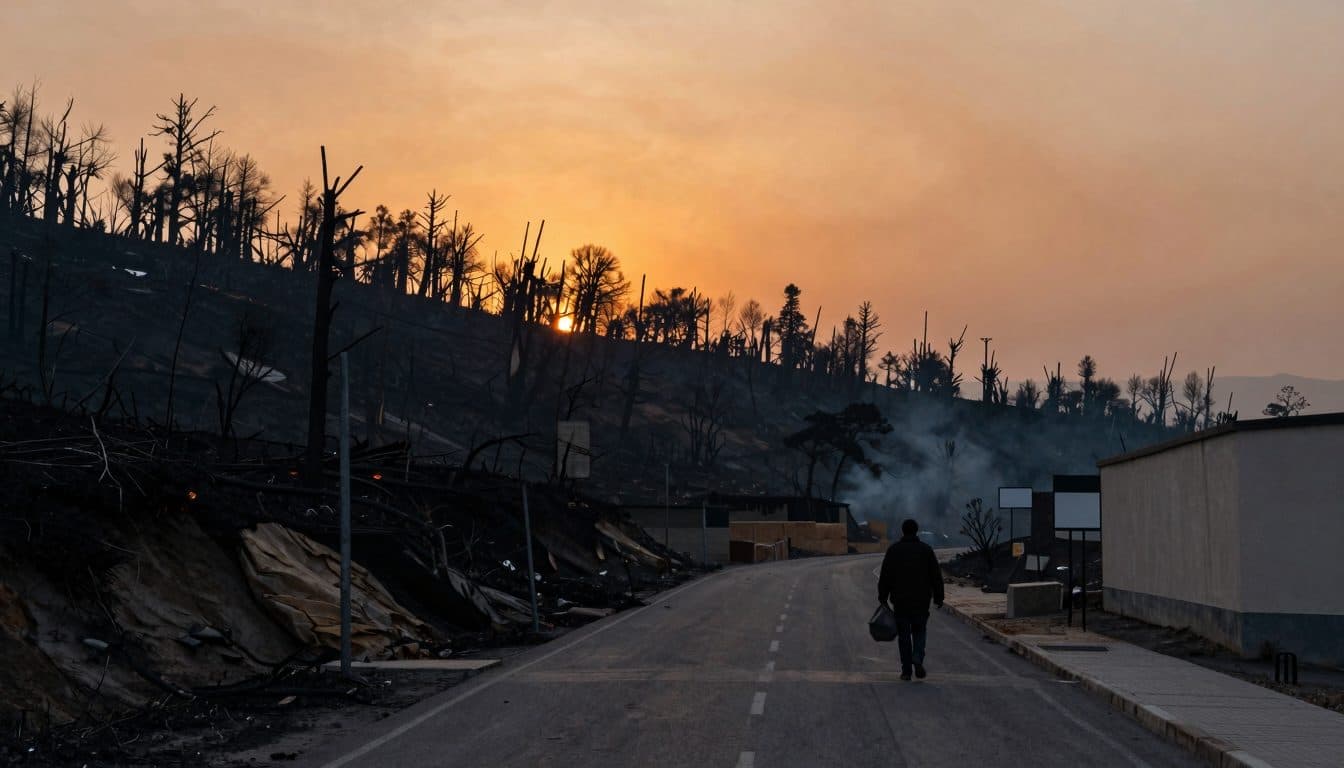
AI-generated image (z-image via Kie.ai)
Summary
After nearly a week, around 50,000 people can return to the areas around Madrid affected by the wildfires, while at the same time a new heatwave threatens the fire service's progress. For around 40,000 other residents, evacuations and curfews remain in place for the time being.
Madrid, July 29, 2026
After nearly a week, around 50,000 people are returning home to the areas around Madrid affected by the worst wildfires in recent history, while a new heatwave and expected strong winds are jeopardizing the progress of the emergency services.
The authorities lifted evacuations and curfews for 19 localities, the Spanish Interior Ministry announced. According to the authorities, residents of 15 localities were allowed to return to their homes, and curfews were also lifted for six additional localities. According to the prefect of the Region of Madrid, Francisco Martin Aguirre, a total of around 24,000 people are benefiting from the return, with a further 20,000 no longer bound by curfews.
The situation has stabilized, it was said from Madrid. During the night, the fire around the Spanish capital did not spread further due to more favorable weather conditions. Interior Minister Fernando Grande-Marlaska stated on Tuesday that the flames had not advanced further. He expressed hope that the emergency services could begin extinguishing remaining hotspots and securing the burned areas on Wednesday – despite the forecast high temperatures.
Return for thousands with simultaneous warning
Prime Minister Pedro Sánchez spoke of cautious hope following a meeting of the crisis committee in Madrid. One could already see „light at the end of the tunnel,“ Sánchez said. At the same time, the Spanish Interior Ministry stressed that the situation was not yet fully under control. The Spanish authorities continue to warn against premature all-clear signals.
The fires are primarily affecting the province of Ávila west of Madrid as well as the neighboring regions of Madrid and Toledo. According to preliminary official estimates, around 50,000 hectares of forest and scrubland were destroyed in the province of Ávila alone – an area equivalent to around 500 square kilometers, roughly the size of Lake Constance. This makes the fire in Ávila the largest in Spain's recent history since records began in 1968. Overall, the flames have devastated almost 80,000 hectares in Spain so far, of which nearly 50,000 hectares were in Ávila alone.
Ávila: Largest fire in Spain's records
Comparable fires in Spain destroyed over 300,000 hectares of land last year. The scale of the current fires illustrates the ongoing pressure on the emergency services, who have been battling the flames for almost a week. Spain's weather service AEMET announced the start of the fourth heatwave of the summer for Wednesday, which is expected to last at least until Sunday. Daytime temperatures of up to 37 degrees Celsius are forecast for the Region of Madrid.
At the same time, concerns are growing over the expected wind. Strong gusts are forecast in the affected region, which could rekindle the flames. Extreme dryness and wind lead the emergency services to fear that the fire could flare up uncontrollably again with the start of the new heatwave, with temperatures of up to 42 degrees.
Meanwhile, another major fire in the province of Castellón in eastern Spain remains out of control. Around 10,000 hectares of forest and scrubland have been destroyed there according to current figures. In the greater Vall d'Uixó area, around 16,000 people had been evacuated over the weekend; some of them have since been able to return as well. Around 40,000 people in the Spanish fire areas remain affected by evacuations or curfews.
Bordeaux: Record areas and own thunderstorms over the fires
The fires are also continuing in France. Numerous forest fires near Bordeaux on the Atlantic coast remain out of control. France is reaching a new record this year with over 40,000 hectares burned west of Bordeaux alone and over 80,000 hectares nationwide, according to satellite data. Since the start of the major fire a week ago, more than 220,000 people in the Gironde department had been called on to get to safety.
The prefect of the department, Sophie Brocas, stated that the fire was still active – but stabilizing. The night in Gironde had been „quiet.“ A total of 2,750 firefighters, 23 firefighting aircraft, and over 1,400 police forces were deployed, according to Brocas. 110 firefighters have been injured in the line of duty so far.
Firebreaks with a total length of 120 kilometers have already been created. On the previous evening, 57,000 residents from three municipalities near Bordeaux were allowed to return to their homes following an evacuation order. During the night, however, fires flared up again in the fire area near Bordeaux. There were new outbreaks in 14 places – with smoke columns visible for kilometers. The sky is glowing yellow, it is raining ash: The images from the wildfire areas in France and Spain appear apocalyptic.
The weather service Météo France warned of an increase in the wildfire risk. The second-highest heat warning level is expected for Gironde and the neighboring department of Les Landes. Temperatures of up to 41 degrees Celsius are forecast for the interior of Gironde. The fire service warned of an „extremely high risk of new fire outbreaks.“ Thunderstorms are expected in Gironde tomorrow.
Portugal, Italy and Greece also affected
The fires near Bordeaux are so hot that their own thunderstorm clouds with lightning and extreme winds are forming above them. What is currently happening west of Bordeaux is historically an exception, explained Thomas Hickler. This is also due to the fact that one of the largest contiguous forest areas in Western Europe is located there, primarily with maritime pines, which burn well. The burned area has not expanded significantly overall in the past two days, but the fire is not under control. In some places in Gironde, flames flared up again but could be extinguished quickly.
Fires have also been reported from Portugal in recent days. In Italy, the fire service is also battling numerous blazes. However, the fires are nowhere near the scale of those in France and Spain. Regions affected include areas on the mainland in the south as well as Italy's largest islands, Sicily and Sardinia.
Meanwhile, a major forest fire has also broken out on the Greek island of Paros. The fire service on the Cycladic island has been in continuous operation with dozens of personnel since the previous day, according to the newspaper Proto Thema, and has requested support from surrounding islands such as Naxos and Syros as well as from the mainland. Firefighting efforts have been hampered by strong winds, which according to meteorologists are likely to become even stronger on Wednesday. Flights with firefighting aircraft and helicopters were reportedly halted overnight.
Open questions amid ongoing heatwave
Several localities were evacuated due to the advancing fire front, and residents were reportedly ordered by emergency services to flee to the beaches. The locality of Agkairia in particular is said to be threatened by the flames. Until now, Greece had largely been spared heatwaves this year. Major tourism hotspots have not been affected by the fires so far.
The authorities in the affected countries are monitoring the weather development with concern. The coming days are considered decisive in determining whether the progress made so far in containing the fires will hold or whether the fires will flare up again due to the new heatwave.
Overall, the fires in Spain, France, Portugal, Italy and Greece illustrate the growing burden of extreme weather events in Southern Europe. In Spain, the operation against the major fire in Ávila continues, while firefighting efforts are simultaneously underway in the Region of Madrid and in Toledo. In Castellón, east of Madrid, emergency services are also continuing to battle a fire that has so far not been brought under control.
Questions & Answers
Who ordered the return of the evacuees around Madrid?
The Spanish Interior Ministry and the prefect of the Region of Madrid, Francisco Martin Aguirre, announced the easing of protective measures; Interior Minister Fernando Grande-Marlaska expressed hope that extinguishing remaining hotspots could begin on Wednesday.
How large is the destroyed area in Spain?
According to preliminary official estimates, around 80,000 hectares of forest and scrubland were destroyed in Spain in total, of which nearly 50,000 hectares were in the province of Ávila alone – equivalent to around 500 square kilometers and the largest burned area since records began in 1968.
Why is there still cause for concern despite the return?
The Spanish weather service AEMET announced the start of the fourth heatwave of the summer with temperatures of up to 42 degrees and strong wind, which could cause the fires to flare up again according to the assessment of the emergency services.
Wildfires Madrid: Tens of thousands return, new heatwave | allfacts360