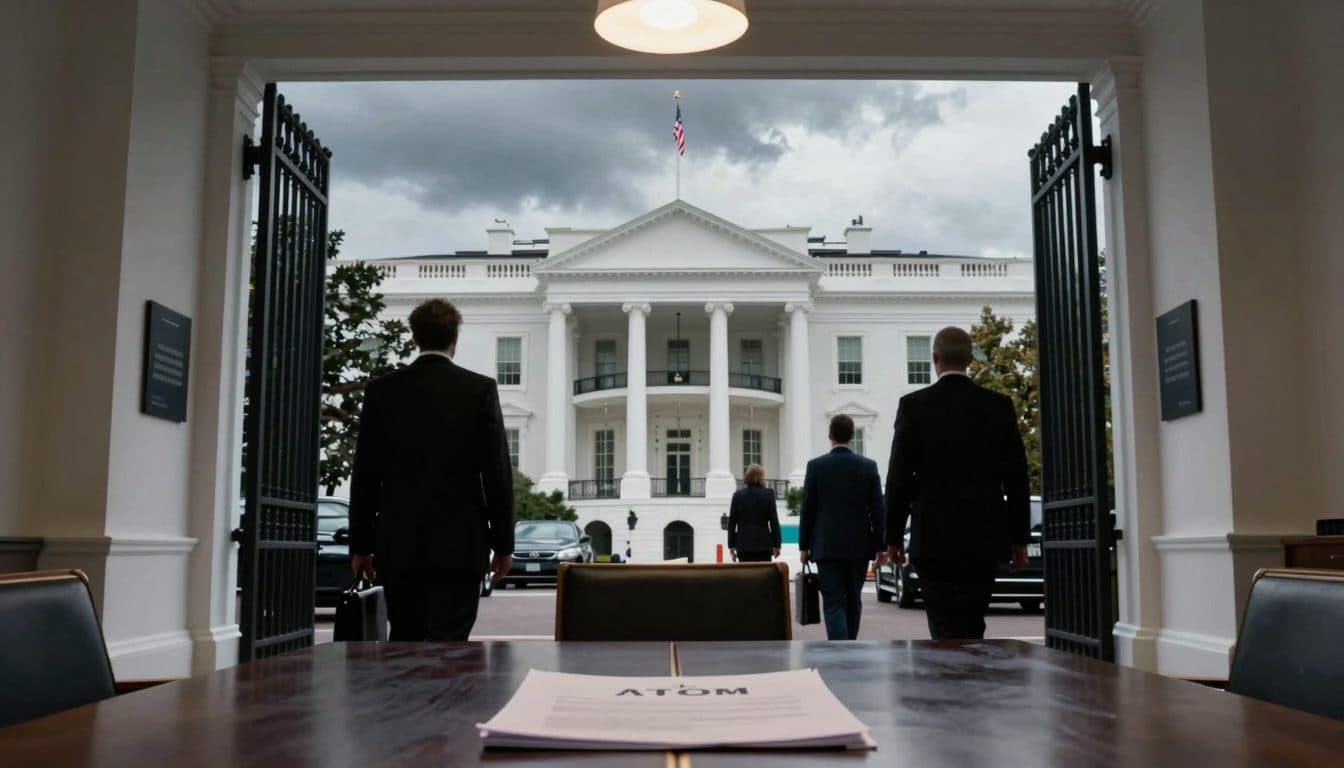
Trump ties nuclear deal with Saudi Arabia to rapprochement with Israel
Washington, July 23, 2026
AI-generated image (z-image via Kie.ai)
Summary
US President Donald Trump has surprisingly tied a planned nuclear deal with Saudi Arabia to a normalization of relations between Riyadh and Israel. Previously, the energy ministers of both countries had already signed an agreement on a civilian nuclear program, the contents of which were initially not published.
Washington, July 23, 2026
US President Donald Trump has surprisingly tied a planned nuclear deal with Saudi Arabia to a normalization of relations between Riyadh and Israel, announcing this on his platform Truth Social.
Trump described the nuclear deal with Riyadh as "komplett abhängig" from a corresponding step by Saudi Arabia. He also made clear that the deal would include "keine Anreicherung von Material". The US would have "keine Einwände gegen zivile Atomanlagen (ohne Anreicherung)", Trump wrote further. With this, the President directly linked a topic that is explosive both domestically and regionally to Israeli-Arabian diplomacy.
Trump's condition on Truth Social
Already on Wednesday evening (US local time), the Trump administration had announced its intention to support Saudi Arabia in building a civilian nuclear program. The energy ministers of the United States and Saudi Arabia signed a corresponding agreement. At the same time, a bilateral agreement on accompanying security controls had been signed, the US Department of Energy stated. The contents of the agreement were not initially published, but according to US media, the volume is said to be in the billions.
Observers considered the linking of the nuclear deal with a rapprochement with Israel to be surprising. Trump wrote on Truth Social that Saudi Arabia must join the "highly respected and successful Abraham Accords". Through these agreements, several Arab countries had normalized their relations with Israel. The background is Trump's effort from his first term to anchor Israel more firmly in the region after decades of Arab-Israeli conflicts.
Background: The Abraham Accords
In 2020, the United Arab Emirates, Bahrain, Morocco, and Sudan had begun to normalize their relations with Israel as part of the Abraham Accords. About 30 of the nearly 200 states worldwide do not maintain diplomatic relations with Israel, most of them with Muslim-majority populations. In some countries in the region, such as Iraq, contact with Israel is criminally sanctioned.
Saudi Arabia and Israel officially do not maintain relations, but cooperate secretly, including on security issues. Riyadh claims a leading role in the Arab and Muslim world and, as a Sunni kingdom, competes with the Shia-influenced Iran for regional dominance. The linking of a possible nuclear agreement with a rapprochement with Israel is likely to further complicate this rivalry.
According to US media reports, the deal could pave the way for uranium enrichment in Saudi Arabia. Trump's statement that the agreement should not include enrichment stands in a certain tension with this. Energy Secretary Chris Wright stated that the agreements would ensure the highest security standards and prevent the proliferation of nuclear weapons. With this, the government attempted to allay concerns about possible proliferation.
The news from Washington came amid a period of significant military tensions in the region. A new wave of US strikes hit targets in Iran after twelve consecutive nights; the US subsequently declared the latest round of strikes ended. Iran, meanwhile, claimed to have attacked US military bases in Kuwait with drones. Trump threatened Iran with a military response should the Houthi rebels in Yemen strike again.
Military tensions in the Gulf
The background: The Houthis had previously attacked an oil tanker in the Red Sea, as the UKMTO reported. Oman then sought new talks. The EU condemned the attack on the tanker as "inakzeptabel". These incidents illustrate the fragility of the security situation in the Gulf and the Red Sea, in which Saudi Arabia plays a key role.
In parallel, the US House of Representatives voted for higher military spending. This underscores Congress's willingness to expand the military operational capability of the US in the region – a signal that is likely to be considered in the negotiations on a civilian nuclear program with Riyadh.
Strategic goals behind the deal
The combination of military pressure on Iran, threats against the Houthis, and the linking of the nuclear deal with Israel raises questions about the long-term strategy of the Trump administration in the Middle East. On the one hand, Saudi Arabia is to be strengthened as an ally against Iranian influence; on the other, Washington is demanding concessions in the Israeli-Arab relationship that Riyadh will find difficult to sell domestically.
It remains unclear how Riyadh will react to the condition. A formal accession to the Abraham Accords would be a political earthquake: it would further erode traditional solidarity with the Palestinian cause and bind Saudi Arabia even more closely to Washington. At the same time, a civilian nuclear program opens up economic and technological prospects that could strengthen the kingdom in its competition with Iran.
Open questions and risks
Observers assess the announcement as an attempt to bundle several strategic goals in one step: the expansion of the US security architecture in the Gulf, the containment of Iranian nuclear potential, and the continuation of the Abraham Accords logic from Trump's first term. Whether this triple step succeeds depends not least on whether Saudi Arabia is willing to pay the political price of a rapprochement with Israel.
At the same time, a conflict of objectives is emerging: According to Trump, the US does not want enrichment, while reports point to possible enrichment in Saudi Arabia. The accompanying security agreements are intended to close this gap, but their details remain under wraps for now.
International reactions to Trump's linking of the nuclear deal and Israel normalization were still pending at editorial deadline. Observers expect statements from the Gulf states, the EU, and the United Nations, as a nuclear buildup by Saudi Arabia could further exacerbate the already tense security situation in the Gulf.
What is certain: by linking two previously separate policy areas, the Trump administration has created a new lever of pressure – vis-à-vis Riyadh as well as Israel. The coming weeks will show whether the government can use this to bring movement to the stalled Middle East diplomacy or whether the condition ultimately blocks the project.
Questions & Answers
What did Trump say about the nuclear deal with Saudi Arabia?
Trump stated on Truth Social that the nuclear deal with Riyadh was "komplett abhängig" on a rapprochement by Saudi Arabia with Israel and would include "keine Anreicherung von Material". The US would have "keine Einwände gegen zivile Atomanlagen (ohne Anreicherung)".
What are the Abraham Accords?
The Abraham Accords are agreements from 2020 through which several Arab states – including the United Arab Emirates, Bahrain, Morocco, and Sudan – normalized their relations with Israel. Trump had initiated them during his first term.
What contents of the billion-dollar deal are known so far?
The energy ministers of the US and Saudi Arabia signed an agreement on the establishment of a civilian nuclear program as well as a bilateral agreement on accompanying security controls. The US government initially did not publish the exact contents.
Trump: Nuclear deal with Saudi Arabia only with | allfacts360