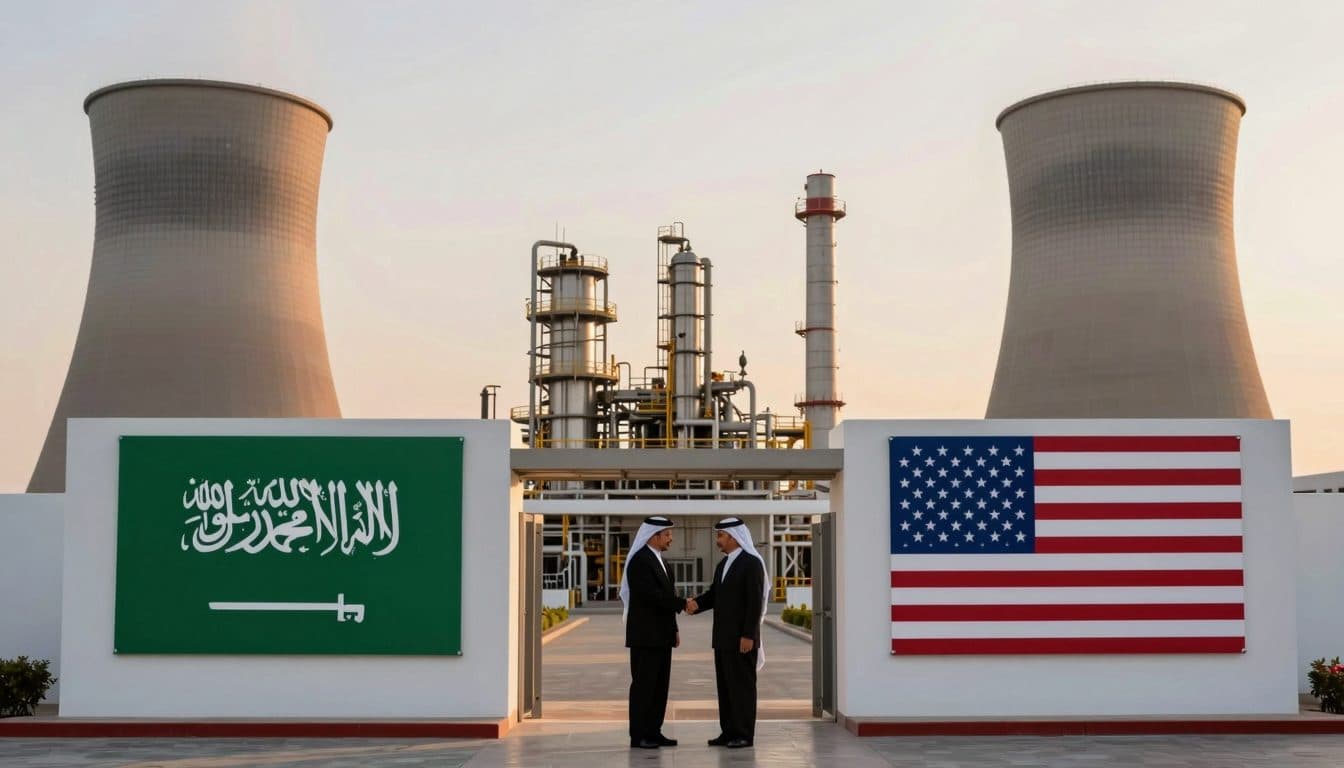
US-Saudi Arabia Nuclear Deal: Fears of a Nuclear Arms Race in the Middle East
Washington, July 23, 2026
AI-generated image (z-image via Kie.ai)
Summary
The US and Saudi Arabia have signed a civilian nuclear agreement that secures a key role for US companies in building Saudi Arabia's atomic infrastructure over 30 years. Critics warn that the waiver of the so-called gold standard and the IAEA Additional Protocol could trigger a nuclear arms race in the region.
Washington, July 23, 2026
The US government and Saudi Arabia signed a bilateral nuclear agreement in Washington on Wednesday that is intended to secure American companies a central role in building Saudi Arabia's nuclear industry over three decades and largely exclude foreign competitors.
The signing in the US capital marks one of the most controversial foreign policy moves of the second Trump administration. US Energy Secretary Chris Wright and his Saudi counterpart Abdulaziz bin Salman, an older half-brother of Crown Prince Mohammed bin Salman, signed a so-called 123 Agreement in the capital. The name refers to Section 123 of the US Atomic Energy Act of 1954, which sets out the principles governing such cooperation. The exact text has not yet been released, nor has that of a parallel bilateral security agreement and two accompanying letters.
Alongside the energy agreement, the US government said a bilateral security agreement was also signed, which is to contain additional controls. The multi-billion-dollar deal has a term of 30 years. US media such as the "Wall Street Journal" and the "Washington Post" assessed the treaty as a major diplomatic success for Riyadh. The agreement has been transmitted to the US Congress, which now has 90 days to review it and reject it if necessary. Without sufficient majorities, it will enter into force after this period expires.
Contents of the Agreement
In terms of content, it is notable that the US this time did not – unlike in 2009 in the nuclear agreement with the United Arab Emirates – demand that Saudi Arabia forgo any uranium enrichment. The 2009 agreement with the Emirates served as a model, regarded as the "gold standard" of non-proliferation policy: the Emirates voluntarily committed at the time to neither enrich uranium nor reprocess plutonium. According to insiders, this "gold standard" is missing from the new treaty.
Furthermore, according to information available so far, the agreement does not contain the Additional Protocol of the International Atomic Energy Agency (IAEA), which provides for more extensive monitoring, inspection, and control capabilities. The protocol was developed, among other things, in light of experiences with Iraq, which had signed the Nuclear Non-Proliferation Treaty (NPT) and in the 1980s secretly launched a military program. Since the late 1990s, it has been brought into force in roughly 140 IAEA member states. Inspections under the Additional Protocol were also part of the 2015 Vienna nuclear deal with Iran, which Trump brought down in 2018 by withdrawing the US.
The US government rejected concerns that the deal could promote further nuclear proliferation. "The United States will not enter into an agreement with any country in the world that creates a risk of proliferation of nuclear weapons," Energy Secretary Wright said. "If countries opt for a peaceful civilian nuclear program, we prefer they do it with us rather than with another country," the minister added. US Secretary of State Marco Rubio likewise dismissed proliferation concerns. President Trump himself said on Thursday that the deal includes "no enrichment of material." He added that the treaty is "completely dependent" on whether Saudi Arabia joins the Abraham Accords.
Dispute over Enrichment and Controls
This account contradicts reports in the "New York Times," according to which Trump had to make compromises during the negotiations. The "Wall Street Journal" reported that the agreement could open the way for Saudi Arabia to enrich uranium for the first time. Reuters, by contrast, cited insiders saying the treaties are to contain "safeguards" that prevent enrichment to a weapons-grade level. Which of these versions is accurate could not be conclusively determined at first, as the treaty text is not public.
Should Iran take this step, however, Saudi Arabia would follow suit "as quickly as possible," Crown Prince Mohammed bin Salman has repeatedly stated. The statement takes on particular explosiveness against the backdrop of the agreement. Saudi Arabia and Iran have been rivals for decades, and to this day mistrust is great, despite a cautious diplomatic rapprochement since 2023. Nuclear power plants, to conserve oil reserves, are part of Saudi Vision 2030, with which Crown Prince Mohammed bin Salman aims to put the kingdom's economy on a new footing.
Criticism from the Region and from Experts
Middle East experts nevertheless see a serious danger in the treaty. Middle East expert Guido Steinberg of the German Institute for International and Security Affairs spoke of a "catastrophe for non-proliferation" of nuclear weapons in the region. Steinberg sees a "catastrophe for the region." Middle East expert Rosemary Kelanic called it a "terrible idea" for many reasons, "particularly stupid in the middle of a war over the Iranian nuclear program." The last thing needed now, she warned, was "yet another state controlling its own nuclear fuel cycle."
Reactions in Israel are also sharp. Former Israeli Prime Minister Naftali Bennett described the agreement as a "serious strategic mistake that endangers our security." Bennett intends to run against Prime Minister Benjamin Netanyahu in the October parliamentary election. Former Defense Minister Avigdor Lieberman warned that "the civilian nuclear program in Saudi Arabia [will] ultimately lead to nuclear weapons and trigger a mad arms race across the entire Middle East." Netanyahu himself said such a step would be "a historic step forward for peace in the Middle East" – though he was referring to a possible normalization of relations within the framework of the Abraham Accords.
Risk of Further Buildup
Experts also fear that the move could encourage other states in the region to go nuclear, such as the United Arab Emirates, Turkey, and Egypt. Aaron David Miller, a former State Department adviser, wrote even before the official announcement that the agreement was a "self-inflicted own goal." Henry Sokolski, director of the Nonproliferation Policy Education Center in the US, told the "Wall Street Journal": "The notion that this will have a happy ending is delusional." Sokolski pointed to US nuclear cooperation with Iran before the 1979 Islamic Revolution, whose result is the research reactor in Tehran (TRR) still operating today: "Back then, you gave the Iranian Shah regime nuclear technology that you now want to prevent." Now the same mistake is being made with Saudi Arabia.
Andreas Reinicke of the German Orient Institute also views the nuclear deal critically with regard to the conflict between the US and Iran: the Iranians are "tough as nails negotiators" – they would ask why they should submit to IAEA controls when Saudi Arabia does not. This would complicate future negotiations with Tehran in an "unnecessary" way, Reinicke said on ZDF. Tehran may now have "even better cards" for its own negotiations. Josef Braml, a US expert, sees further "sanctimoniousness" in the approach: "America is currently demonstrating its decline," he said.
The United Arab Emirates, which in 2009 had concluded a significantly stricter 123 Agreement with the US, could also feel snubbed. At the time, they had contractually secured "consultations" that they may invoke as soon as a neighboring country receives "better terms." This clause could now come into play. The Trump administration had to make compromises in the deal, the "New York Times" reported, citing government officials.
Linkage with the Abraham Accords
It is also unclear how the agreement is politically embedded. Trump said the treaty is "completely dependent" on whether Saudi Arabia joins the Abraham Accords, under which several Arab countries normalized relations with Israel in 2020 during Trump's first term. Riyadh had previously tied accession to, among other things, progress on the Palestinian question. The kingdom had offered Israel peace as early as 2002, including the demand that Israel recognize an independent Palestinian state and withdraw from all territories occupied in 1967. With the Gaza war beginning in October 2023 and Israel's further military operations in the region, including in Lebanon, Syria, and Qatar, these goals have receded even further into the distance.
The conclusion of the treaty may have been accelerated by the visible irritation of the Saudis over a US-Israeli military operation. Sources speak of an attack on the 28th of a month that strained the relationship. The deal was "a clever move by the Saudi king, who thereby expressed which cards he holds," according to one assessment. Saudi Arabia claims a leadership position in the Arab and Muslim world and competes with the Shia-dominated Iran for regional supremacy.
Open Questions and Congressional Procedure
Another factor of uncertainty is the long term. It is conceivable that the 30-year commitment of the agreement will outlast the Saudi monarchy and that the nuclear program will fall into the hands of other rulers. The probability that Crown Prince Mohammed bin Salman will continue to rule Saudi Arabia for decades is indeed high – the crown prince and de facto ruler of the country is 40 years old and has largely sidelined potential rivals. But there are no guarantees. This news was broadcast on July 23, 2026 on the program Deutschlandfunk.
Since the 1970s, the US has sought to prevent the spread of sensitive nuclear technology as far as possible. With the new treaty, Washington is departing from this line – and, in the view of many experts, risks precisely the escalation that Washington actually wants to prevent. Whether the agreement will pass Congress remains open. Criticism comes not only from Democrats but also from some Republicans. A rejection is nevertheless considered unlikely by the "WSJ," as very high majorities would be required for that.
Questions & Answers
What does the US-Saudi nuclear agreement specifically provide for?
The agreement has a term of 30 years and is intended to secure US companies a central role in building Saudi Arabia's
US Nuclear Deal with Saudi Arabia: Risk of Arms Race? | allfacts360