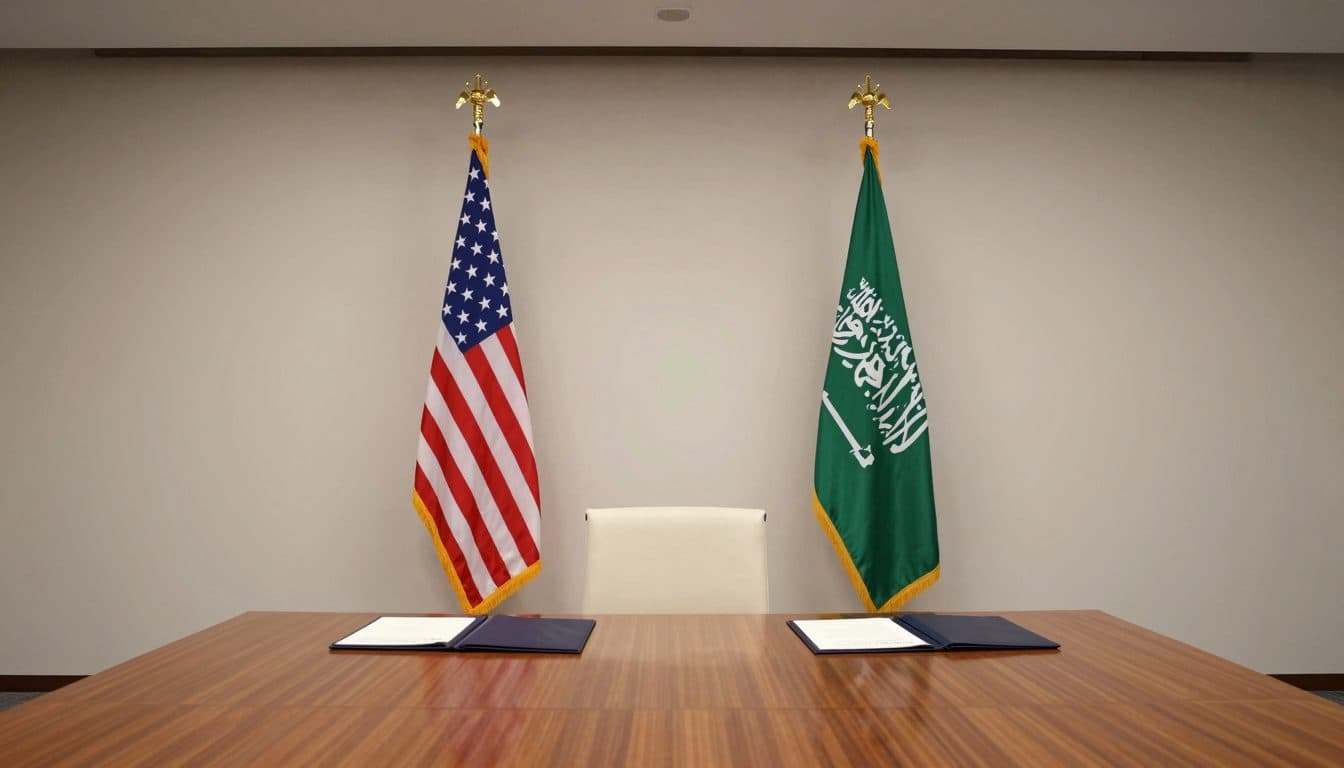
US and Saudi Arabia Sign Civil Nuclear Agreement — Congress Still Must Approve
Washington, July 22, 2026
AI-generated image (z-image via Kie.ai)
Summary
US Energy Secretary Chris Wright and his Saudi counterpart Prince Abdulaziz bin Salman signed two agreements on the civilian use of nuclear power in Washington. The treaty creates the legal basis for US companies to participate in building Saudi Arabia's nuclear program, but contains neither the so-called Gold Standard nor the IAEA Additional Protocol.
Washington, July 22, 2026
The United States and Saudi Arabia signed two agreements in Washington on Wednesday on cooperation in the civilian use of nuclear power, which will now be submitted to the US Congress for review.
Signing in Washington
The two treaties were signed by US Energy Secretary Chris Wright and his Saudi counterpart, Prince Abdulaziz bin Salman. As the US Department of Energy announced, the agreements form the legal basis for a multi-decade partnership worth several billion dollars.
According to the announcement, the agreements cover the construction of nuclear power plants as well as the supply of technology, equipment, and know-how. In addition, the agreement also covers the training of specialists. According to the US announcement, the agreement is intended to help Saudi Arabia meet the country's energy needs.
This is meant to establish a legal basis for a multi-decade partnership. The exact wording was not published. The ministry initially did not release the precise contents. The United States and Saudi Arabia have signed an agreement to help Saudi Arabia build a civilian nuclear program.
The aim is to ensure that the Saudi nuclear program serves exclusively peaceful purposes, namely power generation. The agreement initially provides the legal framework that allows US companies to cooperate with Saudi Arabia in the nuclear field at all.
Missing Safeguard Clauses
How strict these requirements ultimately will be and what rights Saudi Arabia will receive, for example regarding uranium enrichment, is likely to be debated in detail in Washington. The US Congress still has to review the agreement; a failure is considered unlikely. The agreement is not yet in force. It must first be reviewed by Congress.
The United Arab Emirates had agreed to the "Gold Standard" in a similar agreement with the United States in 2009. In the current treaty with Saudi Arabia, however, this clause is missing, according to insiders. According to them, Crown Prince Mohammed bin Salman refused to agree to the so-called Gold Standard, which would have prohibited uranium enrichment and the reprocessing of spent fuel on Saudi soil. In addition, the "Additional Protocol," which allows the International Atomic Energy Agency (IAEA) to conduct comprehensive and unannounced inspections, is not included.
The fact that both uranium enrichment and the reprocessing of spent fuel are potential paths to developing nuclear weapons was one of the main reasons why numerous Democrats, as well as some Republicans, had insisted on including the Gold Standard. The Trump administration evidently already considers the key role of American companies in building Saudi nuclear infrastructure as a sufficient safeguard against misuse and expects billion-dollar contracts in return.
Geopolitical Context
The government of US President Donald Trump wants to help Saudi Arabia build a civilian nuclear program. The conflict has shown how unstable the region is and how great the concern of the Arab Gulf states remains about a nuclear-armed Iran.
The agreement is therefore also an expression of geopolitical competition for influence, partnerships, and technologies. The agreement must be seen against the backdrop of the Iran war. Firstly, they want to bind Saudi Arabia even more closely to them as their most important partner in the Gulf, according to reporting. Secondly, they are showing Iran that, despite the war, they will continue to support their allies in the long term on security policy and technology — a sign that Washington continues to view the Middle East as strategically significant despite all previous announcements of withdrawal.
According to a "Wall Street Journal" report, a central provision envisions that US companies would build a uranium enrichment facility in Saudi Arabia if a joint US-Saudi study deems such a step justified. According to the newspaper, the agreement could potentially pave the way for uranium enrichment on Saudi soil. Initially, however, it was unclear whether the agreement actually contains such an enrichment clause. US Energy Secretary Wright, by contrast, stated that the agreements would ensure the highest safety standards and also ensure that no nuclear weapons are proliferated.
Iran War and Security Situation
The pro-Iranian Houthi militia in Yemen has announced a maritime blockade against Saudi Arabia. The Iran war has fundamentally altered the dynamics in the region. In February 2026, Tehran fired retaliatory missiles and drones for American-Israeli strikes, whose projectiles also hit parts of the Saudi kingdom. Saudi Arabia is, alongside Iran, the largest energy consumer in the region.
Crown Prince Mohammed bin Salman had repeatedly stated in the past that Saudi Arabia would follow its regional rival Iran if the latter developed an atomic bomb. In a 2018 CBS interview, he said: "without a doubt, we will follow suit immediately if Iran develops a nuclear weapon." In 2023, he reiterated that his country would only acquire nuclear weapons if it became necessary "for security reasons and for the balance of power in the Middle East." The kingdom has no known nuclear weapons program, but has been pursuing the use of nuclear power for years under Crown Prince and de facto ruler Mohammed bin Salman.
Saudi Arabia has indeed signed the Nuclear Non-Proliferation Treaty (NPT), which prohibits the proliferation of nuclear weapons, and concluded a comprehensive safeguards agreement with the IAEA that provides for inspections to prevent the construction of nuclear weapons. The country has also concluded a comprehensive agreement with the International Atomic Energy Agency IAEA, which is intended, among other things, to prevent the construction of nuclear weapons through inspections. An Additional Protocol, which would allow the agency to search for traces of secret activities, has not been signed by Riyadh to date.
Criticism from the US and Israel
Monitoring of the Saudi nuclear program is to take place bilaterally between the United States and Saudi Arabia, according to reports, not through the IAEA. Former US officials such as former Justice Department representative Michael Horowitz therefore described the security guarantees as "purely bilateral" and thus "completely dependent" on the course of relations between Washington and Riyadh.
Saudi Arabia, for its part, has conducted talks on nuclear cooperation with the United States in parallel with China and Russia. The agreement is intended to prevent Saudi Arabia from turning to China or Russia instead when building its nuclear program. Russia and China have also reportedly already sought a role in the Saudi nuclear program.
The current agreement with Trump no longer ties Saudi nuclear cooperation to a normalization of relations with Israel, as was the case under President Joe Biden. Under Biden, efforts to support the Saudi civilian nuclear program were tied to a diplomatic rapprochement between Riyadh and Israel; the negotiations were suspended after the start of the Gaza war in late 2023. According to the "New York Times," Israel was surprised by the US-Saudi agreement; tensions had arisen between Mohammed bin Salman and Trump over the attacks.
A Look at the Region
Last year, Trump received the Crown Prince at the White House with an opulent reception; the nuclear agreement was also on the agenda during Mohammed bin Salman's meeting with Trump in November in Washington. Energy Secretary Wright had already traveled to Saudi Arabia last year for talks on such a nuclear agreement.
The report also mentioned that the agreement could potentially pave the way for uranium enrichment on Saudi soil. Critics argue that Saudi Arabia could potentially use a civilian nuclear program to develop nuclear weapons. According to insiders, the agreement could pave the way for weapons-grade uranium in the not-too-distant future and trigger a nuclear arms race in the Middle East.
Israel and some members of the US Congress have expressed reservations about the nuclear agreement. Middle East expert Aaron David Miller called the deal in advance a "self-inflicted own goal" and a break with US nonproliferation policy. Middle East expert Rosemary Kelanic described the pact as a "terrible idea" that is "especially stupid in the middle of a war over Iran's nuclear program." Henry Sokolski, director of the Nonproliferation Policy Education Center, told the "Wall Street Journal": "The notion that this will have a happy ending is delusional." Robert Einhorn, an adviser to several US governments, warned that the deal could strengthen US-Saudi relations and deny Russia and China a strategically important role in the Saudi program — "But it could also increase the risks of nuclear proliferation in the Middle East and beyond."
The first major nuclear power plant is planned on the country's east coast near Qatar; bids have already been submitted by companies from South Korea, France, China, and Russia. The agreement is therefore also an expression of geopolitical competition for influence, partnerships, and technologies. For the United States and Donald Trump, the agreement is not merely an energy project, but also an economic and strategic deal.
After an Israeli attack on Hamas representatives in Qatar last year, Saudi Arabia also expanded its security relations with the nuclear power Pakistan and signed an agreement giving Riyadh access to the Pakistani program. Pakistan sent a fighter jet squadron to a Saudi air base, which, however, proved of little effectiveness against Iran; at one point, Saudi Arabia had closed its airspace to the US escort through the Strait of Hormuz.
Chancellor Merz visited Saudi Arabia, Qatar, and the United Arab Emirates in February. Mohammed bin Salman is 40 years old. Worldwide, according to the Stockholm Peace Research Institute SIPRI, there are more than 9,600 operational nuclear warheads; in addition to the five recognized nuclear powers — the United States, Russia, China, France, and Great Britain — India, Pakistan, North Korea, and informally Israel also possess nuclear weapons.
Questions & Answers
Who signed the nuclear agreement between the United States and Saudi Arabia?
US Energy Secretary Chris Wright and his Saudi counterpart Prince Abdulaziz bin Salman signed the two treaties on Wednesday in Washington.
Why is the missing Gold Standard controversial?
The Gold Standard would have prohibited Saudi Arabia from uranium enrichment and the reprocessing of spent fuel — both potential paths to building nuclear weapons. Numerous Democrats and some Republicans had insisted on it, but Crown Prince
US-Saudi Nuclear Deal: Pact Without Gold Standard | allfacts360